Launched in February, NASA’s Solar Dynamics Observatory — the “Hubble for the sun” — has started to send back some amazing footage.
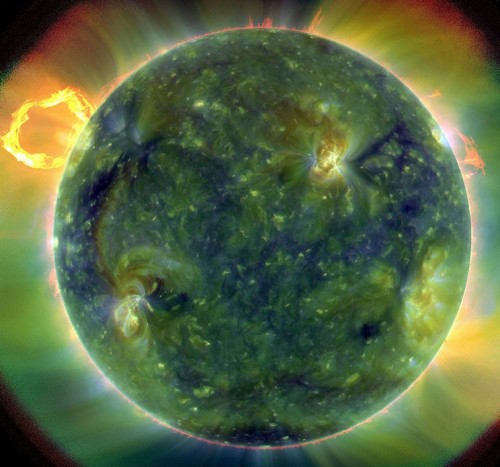
Take this image for example, which is a full-disk multi-wavelength extreme ultraviolet image of the sun:
The red spots are relatively cool, while the green and blue spots are much, much hotter.
One of the amazing things about SDO is that it is able to study the sun in its entirety, rather than small patches like previous observatories.
An objectives of SDO is to learn more about the sun’s relationship to Earth. From NASA:
Launched on Feb. 11, 2010, SDO is the most advanced spacecraft ever designed to study the sun. During its five-year mission, it will examine the sun’s magnetic field and also provide a better understanding of the role the sun plays in Earth’s atmospheric chemistry and climate.
…
SDO will determine how the sun’s magnetic field is generated, structured and converted into violent solar events such as turbulent solar wind, solar flares and coronal mass ejections. These immense clouds of material, when directed toward Earth, can cause large magnetic storms in our planet’s magnetosphere and upper atmosphere.
Another objective is to use SDO to predict when solar events are going to happen, probably in the hopes of avoiding the massive electronic damage a storm can cause here on Earth.
Artist Ron Miller, using data from various probes that have traveled the Solar System, has created beautiful images of the planets around us and their amazing features.
Some of the wonders are pretty common knowledge at this point, like Saturn’s rings and the red spot on Jupiter, but others I had no idea about, like the geysers on Triton, or the peaks of eternal light on our own Moon; the peaks are always bathed in sunlight, which could make for a possible tourist attraction or settlement as the temperature never fluctuates more than 20 degrees.
The interactive look also includes videos and an audio clip of lightening on Saturn.
I remember in 1997 when the Cassini probe to Saturn lifted off. As the first (in a while) nuclear-powered spacecraft, there were all kinds of protests. After the launch, though, you didn’t hear much about Cassini-Huygens, because it kind of takes a long while to get to Saturn.
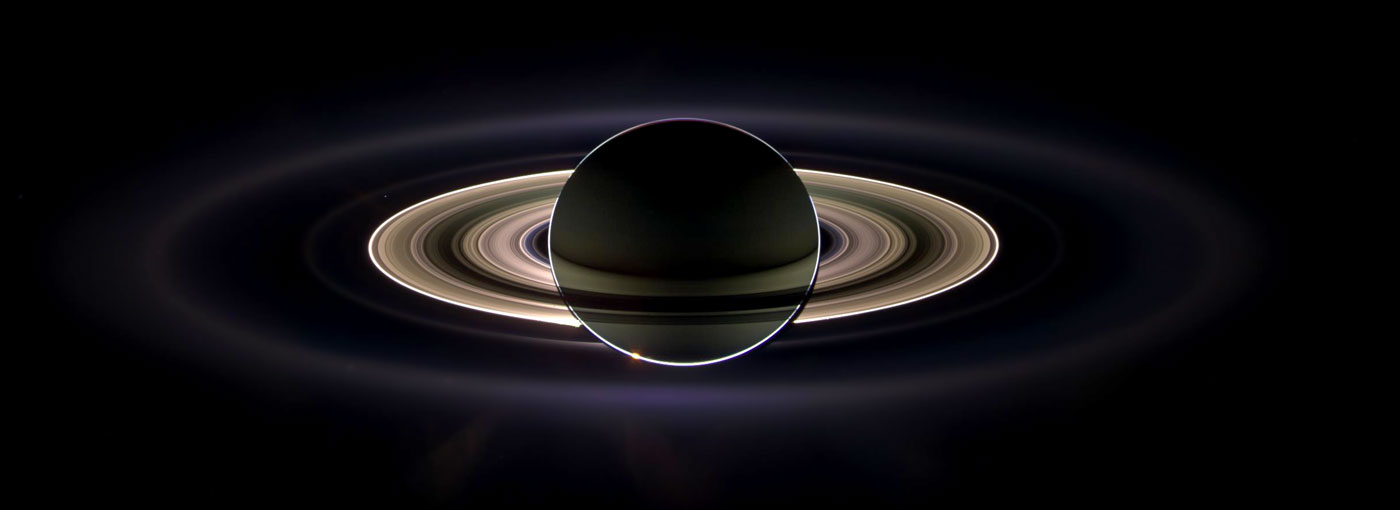
But if you really want to fall in love with Cassini, head over to the Boing Boing feature page. In honour of NASA deciding to extend the probe’s lifespan until 2017, they’ve put up a special feature, breaking down the science and what it means — while also managing to display some jaw-dropping images.
It’s the kind of feature that would do any mainstream magazine proud — and I’m happy to see it on a blog. Good work by all involved.
I’ve seen this on a couple of sites over the past day or so, but I finally got around to watching it — and it’s pretty cool. Sure, just watching a needle-thin rocket (an Atlas V) ascend to space on a jet of flame looks identical to the pulp sci-fi fantasies of my youth.
But when the rocket goes supersonic — and happens to be in the midst of a layer of ice crystals — my jaw dropped. Because of the ice crystals, you can actually see the shock wave of the sonic boom rippling out. It looks like a pebble tossed into a lake, except that this lake is thousands of feet up, in clear air.
And here’s another video of the same event, from a NASA camera:
On Jan. 28, 1986, Jack Moss was 80 miles away from the launch of the Challenger, and waiting to film it on his new home video camera (I don’t think the word “camcorder” had been popularized yet — heck, the devices were pretty rare back then).
This is what he saw:
Then, not really thinking that he had perhaps the only amateur film of the incident, Moss packed it away in his basement. His pastor uncovered it after Moss died:
“It took a while to find someone with an old Betamax video player, then I had to watch four hours of gameshows and sitcoms from the 1980s, but when I found the Challenger film my reaction was that people really have to see this.”
NASA is planning to retire the space shuttles in the next year or so, but once they’re done with them, they’re going to offer them up to interested buyers. Yes, the space shuttles are for sale.
And, they’ve dropped the price. When the initially announced the sale, in late 2008, they estimated that the price of the shuttles, including shipping from the Kennedy Space Center to an airport, would be $42 million.
Good news, millionaires! Space shuttles must go! They’ve reduced the price to a crazy-low $28 million — and they’ll throw in the engines for free (you must pay shipping and handling and, as the New York Times wryly notes, “assembly will be required.”)
I just took out the garbage, not normally a time for high contemplation.
And yet if I must pick one thing about winter that I enjoy, it’s the crisp clear nights — and even in the midst of a semi-urban environment, there’s enough darkness in my neighbourhood that the stars shine brightly above me.
So despite the chilldownright cold, I took a few extra moments between hauling full personal dumpsters through the snow and to the curb and looked up, up, up.
No, I didn’t see any shooting stars (though, it’s always a treat when you do see one, unexpectedly). I did manage to pick out a few half-constellations (the light pollution makes it kind of difficult).
But I got the important part — a sense of my own insignificance next to the immensity of the universe.
Constellations, by the way, have always intrigued me. First of all, even during the darkest of rural nights, I’ve never been able to “see” the shapes that they’re supposed to fit. It’s artistic license taken to a colossal extreme.
And secondly, it strikes me as a remnant, a holdover from the geocentric view of the universe. I can understand naming stars and planets — even just from a point of view of differentiating them. But assigning stars to groupings based on where we are in a three-dimensional universe seems anachronistically arrogant. That’s like saying the trees you see from your house look like a castle. Sure, maybe, but cross the street, and parallax has changed your point of view. Some of the stars that are in constellations together are so far apart — and so far away from Earth — that some of them have probably already burned out.
But that’s just unromantic of me. I love the spectacle of the stars. I even appreciate the mythology behind the constellations. So try this on for size:
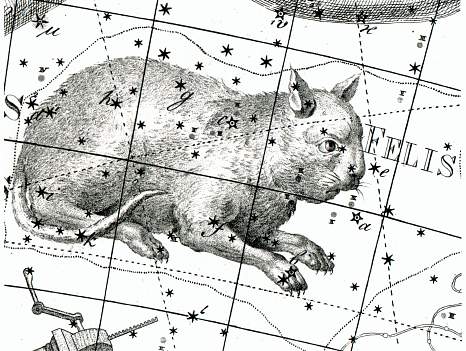
A small constellation between Hydra (the water snake) and Antlia (the pump). The constellation was created by Lalande in 1799 who said: “I am very fond of cats. I will let this figure scratch on the chart. The starry sky has worried me quite enough in my life, so that now I can have my joke with it.”
Then go out and look at the sky. Make up your own constellations, if you like. The only meanings they have are the ones we give to them. That’s probably enough.
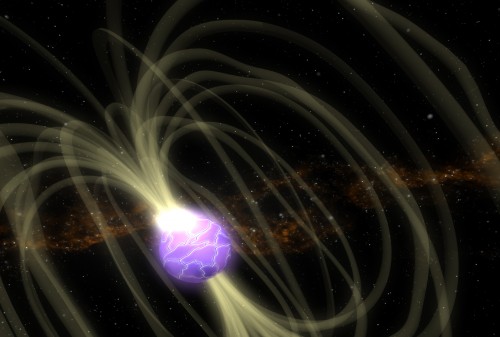
Reading about the magnetar burst that blinded satellites five years ago left me agape. Some facts, gleaned from this blog post at Discover Magazine:
If you crushed every car in the United States into the size of a sugar cube, that’s the density of this magnetar. Except the magnetar is 20 kilometres wide. That gives it a gravity that’s maybe 100 billions times as strong as Earth. And a magnetic field that may be a quadrillion times as strong.
So what happens when the surface cracks? In a ’star quake’? Well, such a quake might have a Richter value of 32 — and remember, a Richter earthquake that’s 9 (like the one that caused the Indian Ocean tsunami, also five years ago) would be 10 times as powerful as Richer 8. A Richter 10 quake would be 100 times as powerful as a Richter 8. A Richter 11 would be a thousand times as powerful as a Richter 8. And so on. And this is a Richter 32.
The quake released a blast of energy — so much that in a fifth of a second, the magnetar released as much energy as our sun does in a quarter-million years.
It was 50,000 light years away, thank goodness. Which is really freaking far. But on some satellites, the resulting wave of photons completely washed-out their detectors — even through the photons had to travel through the satellite itself.
I can’t do it justice — and even the Discover blogger seems to struggle for superlatives to describe it — but let’s just say I’ve awed by how insignificant we are.
Following Amy’s otherworldly post, this video gives an incredible representation of just how insignificant Earth is within the larger picture. I particularly like how it shows the sphere of our influence (how far our earliest radio transmissions have traveled) as well as the limited extent of our knowledge (how far we can see/have mapped).
I have to admit, I watched it with my mouth open — gob-smacked, if you will.
The image above is Titan, one of the moons of Saturn. That shiny blip at the top? That would be one of Titan’s lakes reflected in the sun, the first such photograph of its kind.
From the Nasa story:
“This one image communicates so much about Titan — a thick atmosphere, surface lakes and an otherworldliness,” says Bob Pappalardo, Cassini project scientist, based at NASA’s Jet Propulsion Laboratory. “It’s an unsettling combination of strangeness yet similarity to Earth. This picture is one of Cassini’s iconic images.”
Titan, Saturn’s largest moon, has captivated scientists because of its many similarities to Earth. Scientists have theorized for 20 years that Titan’s cold surface hosts seas or lakes of liquid hydrocarbons, making it the only other planetary body besides Earth believed to have liquid on its surface. While data from Cassini have not indicated any vast seas, they have revealed what appeared to be large lakes near Titan’s north and south poles.
Like most pictures from space, I am just in awe looking at it, and find it completely stunning.
Although there hasn’t been a lot of movement on the 2 Guys 1 List front in the past few months, I haven’t forgotten about it. Let’s just say things remain in the planning stages.
One of the more “out-there” items on Grant’s list, the “Go to space” entry, has come one step closer with the very recent announcement coming from Virigin Galactic:
After five years of secret construction, the cloak is coming off a privately funded spacecraft designed to fly well-heeled tourists into space.
The long-awaited glimpse of SpaceShipTwo, slated for rollout Monday in the Mojave Desert, could not come sooner for the scores of wannabe astronauts who have forked over part of their disposable income for the chance to float in zero gravity.
Virgin Galactic. SpaceShipTwo. The whole story abounds with awesome band names. But I digress.
Although SpaceShipTwo has been revealed, don’t start lining up to purchase your tickets yet.
Flight testing of White Knight Two has been ongoing for the past year. The first SpaceShipTwo test flights are expected to start next year, with full-fledged space launches to its maximum altitude by or in 2011.
It remains unclear when Virgin Galactic customers will receive their astronaut wings, but it will largely depend on how the test program fares. Some 300 clients have paid the $200,000 ticket or placed a deposit, according to the company.
Sigh. I can see it now. Climbing aboard SpaceShipTwo and blasting off for a couple of weeks of R&R on the International Space Station. Pure bliss.
Wait. What do you mean that’s not how it will be?
Virgin Galactic plans to operate commercial spaceflights out of a taxpayer-funded spaceport in New Mexico that is under construction. The 2 1/2 hour trips — up and down flights without circling the Earth — include about five minutes of weightlessness.
SpaceShipTwo will be carried aloft by White Knight Two and released at 50,000 feet. The craft’s rocket engine then burns a combination of nitrous oxide and a rubber-based solid fuel to climb more than 65 miles above the Earth’s surface. After reaching the top of its trajectory, it will fall back into the atmosphere and glide to a landing like a normal airplane. Its descent is controlled by “feathering” its wings to maximize aerodynamic drag.
That seems a lot less like “space tourism” and a whole lot like “catch a fleeting glimpse of space.” But, I suppose, it is a place to start.
And a well funded start, too:
Virgin Galactic expects to spend more than $400 million for a fleet of five commercial spaceships and launch vehicles.
I was absolutely enthralled when Amy showed me the latest Toshiba commercial, which features an ordinary-looking chair, hitched to a weather balloon and sent to the edge of space. Watch it below — and stay past the product ID for the heart-stopping finale:
I’ve watched it now easily a dozen times — and it never stops giving me a thrill at the sense of possibility that it embodies.
So much was I interested in it that I found and watched a “making of” video, too. Although a lot of blogs cite the facts given in the Toshiba press release (it reached 98,268 feet (about 18.6 miles), and hit -90 degrees, using eight cameras, weighing four pounds, it took 83 minutes to go up, and 24 minutes to come back down) there was some other interesting info in the making-of:
Wow — that rig fell for 24 minutes, reaching a speed of Mach 1, and they managed to get HD footage out of the wreckage? I’m guessing it was a solid-state flash drive.
I was seriously impressed.
Then I saw this — an art project by Simon Faithfull from 2004:
I’m not the first to notice the similarity. This site quotes a Toshiba marketing manager as saying that Faithfull was involved from the start as “absoutely part of the team.” But his answers get a little weaker when he’s asked how a “a company which prides itself on innovation align [can] its slogan with a project that is clearly a near copy of something done 5 years ago.” So how does he square it?
“We weren’t saying that the innovation was sending the balloon up. No one had done it in HD before and not as an advert before. We didn’t use a music sound track or any celebrity voices. That’s the innovation. The fact that we created it as an advert”.
Riiight. So taking a piece of art and re-creating it in high-def “as an advert” qualifies as innovation now?
I still love the ad. But now I’m mostly glad that they’ve introduced me to the work of Simon Faithfull. From an article in The Telegraph:
“I made my first Escape Vehicle back in 1996,” says Faithfull down the line from his home in Berlin. “It was a chair, fitted with rockets and designed to be a heroic failure. But I wasn’t prepared for how anticlimactic it was when the chair just turned upside down and exploded.” It’s like a Top Gear experiment as filmed by a desperate castaway. Even though you know the chair – looking so lonely against a wide, pink sunrise – will fail to leave our planet’s atmosphere (possibly even the ground) it’s hard to suppress that little flutter of irrational hope that perches in the soul.
Faithfull’s Escape Vehicle No 2 was, he says, “a truly pathetic object” – inspired by a Victorian plan for a flying machine. But by Escape Vehicle No 4 Faithfull’s ideas were really taking off. His boiler suit tethered to a hot-air balloon made of dustsheets “actually flew off, and disappeared!” he says. “Although it later came down on an elderly couple’s patio while they were taking tea in the garden.”
But it’s the 25-minute film of Escape Vehicle No 6 that sends the emotions on the giddiest trip. You watch, in horrified fascination, as a generic office chair rises 18 miles (over South East England) dangling from a weather balloon.
The sound of static is ritualistically punctuated by a bell-tolling noise (which is actually sending back a GPS signal) as the chair twitches vulnerably in an environment where there’s no oxygen and the temperature is minus 60 degrees. Suddenly there’s a violent spasm and a leg hurtles off into the void.
“At that point, the pressure has burst the balloon off camera,” Faithfull says, “and the chair is actually falling. Only you can’t tell because there are no reference points.” While captivating at its most basic, physical level, Faithfull’s work also speaks of the futility of human attempts to escape “the trivial, the mundane and the self”. And also of the beauty in the soul’s constant attempts to soar beyond “the forces of everyday reality”.
This one comes from regular reader Matt, who asks if I’d care to shell out $30 for an acre of land — on Mars.
Yes, the people from the Lunar Embassy have expanded. At BuyMars.com you can get a gift package (just in time for Christmas shopping) that includes:
Martian Deed: legal document listing the actual location of the purchased property by quadrant, lot number, latitude and longitude.
*Standard Package does not include custom name print on the Martian Deed. Custom name print is included in a Premium & Deluxe Package.
Martian Map: marks a dot showing the exact location of the purchased property by quadrant, lot number, latitude and longitude.
Martian Codes Covenants and Restrictions: single page outlining the important facts such as a preamble, our mission, articles 1-8 of covenants and restrictions, and epilogue.
Custom Packaging: all documents are packaged in an attractive, futuristic envelope designed to enhance the experience of gift giving.
*Standard Package does not come wrapped in a gift box. Custom Packaging display may vary.
Wikipedia has a strangely sparse article on the legalities of private ownership of space, but my guess is that, when it gets finally settled (ha!) in court, the doctrine of possession being nine-tenths of the law will come into play. Ie. If you have the deed, great — if you’re there. If you’re stuck here on Earth, and your Mars Acre happens to be where the Russia-China consortium wants to build their Mars Base (I propose the term “Marsoleum”), then you’re going to be Es Oh El.
I’m a big fan of meteor showers, even if they often happen to be a bust — either it’s too cloudy, or this doesn’t happen to be a good year, or I miss the best day or the best hour.
The Leonids are one of those reliable meteor showers that happens ever year. And I hardly ever go out to see them. Because it’s November.
This year, though, at least where I am, the weather is fine — a bit chilly, but for November, I’ll take it — and I think it would behoove me to check them out.
Luckily, NASA provides what they call a Fluximator (great name!) which allows you to calculate the best time for your location to get out there and look up.
This year’s Leonids appears to peak, where I am, just before 1:30 a.m. on Monday night. It’s a VERY BRIEF PEAK — the rate doubles between 1:10 a.m. and 1:26 a.m. and then falls off a cliff. This is bad news for dedicated meteor watchers, but it’s also pretty good news because there’s no reason to stay out there in the cold for very long.
Of course, like any nighttime cosmic event, it’s best to get far, far away from city lights.
That’s why I’m so happy to have found a “dark sky” resource online — ClearDarkSky.com. First of all, if you follow the links to your home area, it will automatically sniff out the weather forecast for you, and tell you the best day and time to go stargazing. (With a meteor shower, you don’t have too much choice, but you can at least check to see if it’ll be cloudy.)
Better, though, there’s a link to light pollution maps. The one for Brandon is reproduced below:
This square is about 240 km east-west and 370 km north-south, with the US/Canada border as that white line. Brandon’s marked with the blue crosshairs.
If you want to do some driving, I’ve checked out the darkest areas — obviously, there’s the Riding Mountain “handgun” shape up north, but there are also promising dark splotches around Rock Lake, the north shore of Whitewater Lake, and a stretch of Highway 2 between Souris and Pipestone. There’s a large dark area west of Hamiota and south of Birtle, too.