Yesterday, a woman accused in the abduction and death of a child appeared in court. Or, was scheduled to. But nothing that actually happened in court can be reported, thanks to a sweeping gag order imposed by the judge.
Media are arguing against the gag, including this excellent editorial, but I’m not going to get into the free speech vs. fair trial argument here. I just want to note how the Toronto Star, with a simple graphical element, drove home the point of censorship.
In Rosie DiManno’s column, she writes about how the whole town knows the details — people talk, after all. They gossip and compare notes, and phone each other. The coffee shops must be abuzz.
But none of that can appear in print. So, where the relevant details in a well-reported column might go, DiManno (or a designer) has put long black boxes instead.
It’s a classic visual image, one that screams censorship, and it’s a great, elegant way to make the point of the column. Good job, Star. I would love to see how you handled this in print, but I think you’ve done an excellent job online.
This is for all the journalists out there. One of the joys (?) of working at a newspaper is that people expect you to be perfect on a day-in, day-out basis.
It’s good to always keep on your toes, and I agree that accuracy is the foundation of any good journalism. But when readers find something in your paper that you haven’t gotten right, they’re quick to call or email and to irately take you to task for it.
This can be good — letting you know that you’ve goofed, however embarrassingly, is key if you’re going to correct it.
But this can also be bad. Sometimes readers want to get into very arcane grammatical discussions with you. Sorry, the serial comma just isn’t CP style.
And sometimes they think you’re not doing it right just because you’re not doing what they want or expect. For example, give me one good reason why a TV grid is relevant information in this day and age. But readers will piss and moan that your 75-cent paper is suddenly robbed of all value should you so much as shrink the crossword by a half-inch.
Anyway, I’ve found a website that is devoted to these cranky complaint calls and emails. In any newsroom, some of the crankiest cranks get passed around on the voice mail system, or forwarded along via email so that everyone can get a kick out of the crazy old bat who drunkenly berates you for canceling Marmaduke but then, after three minutes of vitriol, manages to find it on the page, and yet still signs off with an accusatory tone, because it should somehow have been easier to find it.
Yes, we’ve all got those tales, and Paper Haters is the place to send them, so that newsrooms around the world can share. Sometimes, it’s a chance for reporters to vent with people who just aren’t happy with the coverage of something, but there are some gems. Try this email:
I just wanted to let you know, that your story and pictures on WRESTLER, state champ from TEAM X High School, were perfect … Athough this was great, the other local wrestling coverage stunk.
Or this one:
Miss REPORTER, you are a Socialist Liberal Democrat scumbag and when the journalism business goes through another wave of lay-offs, I hope you’re at the top of the axing list. Journalists like you are what’s wrong with this country.
But the best are always the voice mails. I love this guy:
If you know anything about college sports, you probably know that Duke is the team that so many people love to hate. I don’t know why — does anyone? — but even I am aware of the animosity.
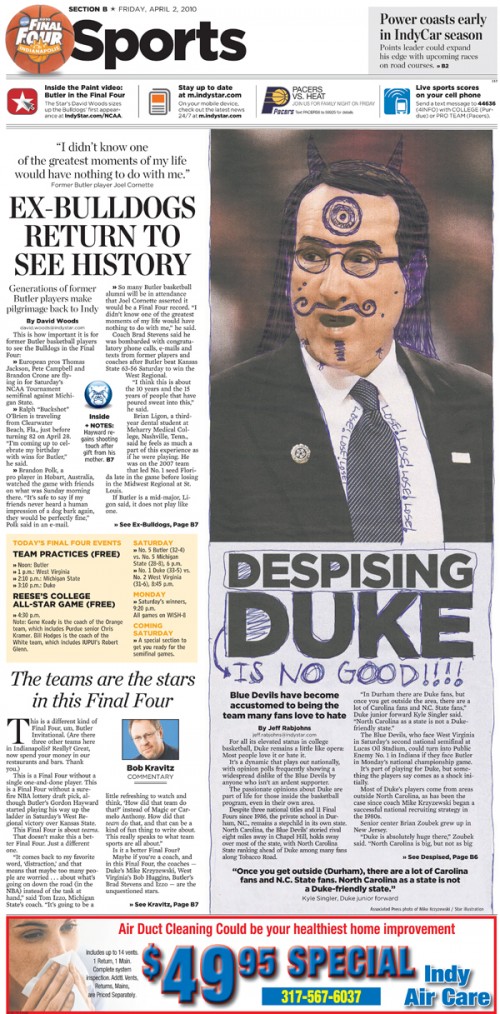
So the Indianapolis Star decided to do a story about the Duke-hate, and to illustrate the story, which ran big on the front of their sports section, they chose a picture of the Duke coach. And then, they defaced it with a ballpoint pen, printing a paper that looked like someone had drawn on it before it reached your mailbox.
Here’s what it looked like — for the first 30,000 copies, before someone got nervous and pulled the illustration in favour of a non-doctored photo.
The concept, I think, is incredibly creative, even if the execution is a little flawed. There’s a great discussion going on over on Charles Apple’s blog, which points out that, yes, it’s juvenile, but so are the feelings involved in sports rivalries.
Apple, himself an influential newspaper designer, also says that he would have toned down the image a little bit — he doesn’t think the long hair works, he thinks the bulls-eye is “ominous” and he would have added the image of a pen laying in the bottom of the story.
But overall, as he tweeted, he likes the idea.
Unfortunately, not everyone does. The coach, who one would assume might have developed some thicker skin, says he didn’t like his grandkids seeing it. And the newspaper management is falling all over themselves to backpedal — perhaps if they’d used Duke’s Blue Devil mascot, instead, they suggest, it would have been okay.
I’m not sure I buy that — the coach is a public figure, and ridiculing him is probably fair game.
Is the illustration appropriate for every newspaper, everywhere? Absolutely not. But I love that the Indianapolis Star is taking some risks, and doing something different.
Actual printed newspapers are staid and conservative by nature. But shaking up the design a little bit like this once in a while is a great idea.
I’m personally on the fence when it comes to newspaper websites allowing comments. I feel that there are a lot of great viewpoints out there in the public sphere that don’t get heard, and newspapers have a duty to seek them out. Comments on stories are an easy way to fulfil that repsonsibility.
On the other hand, comments on the Internet? Have you read any? Yikes.
For a while, I thought that the solution might be to require that commenters use only their real name. Perhaps require that they have a credit card or other ID to sign up. Not to charge, but to verify a real, actual name. Like letters to the editor.
But there’s something to be said for anonymous/pseudonymous comments, too. Sometimes people have valid reasons for not exposing their identity.
On this site, I automatically allow any and all “true” comments (ie. no spam) — so long as you’ve commented once before. Once you’re trusted (and, assuming you use the same nickname and email address) your comment is automatically approved. The volume of comments on this website is low enough that it’s easy to police for any offensive comments. And there haven’t been any yet, anyway.
But for some large newspaper websites, I imagine it’s a full-time job just to moderate comments. And so they delegate the duty to computers and to readers (asking them to “flag” offensive comments, for example). That doesn’t always work, as you will have noticed if you read comment sections on, oh say, the Washington Post.
Now, the Post is feeling some heat. No one’s threatening to sue, that I know of. But the vitriolic comments are starting to scare off potential interviews.
Any first-year reporter knows that lots of people are timid about “being in the paper.” They’re worried that they will be portrayed in a way that they don’t approve of. They’re worried that they’ll be misquoted, or that they’ll be taken out of context, or that the story will attract unwanted attention.
Most reporters know several techniques to soothe these fears. Now, though, sources need to be worried about how anonymous internet commenters will snipe at them. And it’s costing the Washington Post at least one source, according to this column:
He wasn’t happy with the comments that readers posted on washingtonpost.com about the story.
You could hardly blame him …. among the comments were these hard-to-stomach posts:
“What scum….Scam-acne-face-Sutherland and all his little minions, scum….special place in Hell for them,” wrote someone who went by the screen name griffmills.
“They should be hung up by their private parts and shot,” wrote billdinva2.
Sutherland said such comments were “why I was so hesitant in doing an interview” in the first place. “Lesson learned,” he wrote, “I will never allow for another interview.”
The Dallas Morning News is a broadsheet daily — the lone major newspaper of the metro Dallas, Texas, area. I’m sure it has a long tradition of editorial independence and high ethical standards in newsgathering. According to its Wikipedia page, it has won eight Pulitzers.
Now though, in kind of an upset, and in a reversal of years of North American news heritage, the foxes are being given the keys to the henhouse. As reported by the Dallas Observer (a local weekly) news blog:
As of yesterday, some section editors at all of the company’s papers, including The News, will now report directly to [a] team of sales managers, now referred to as general managers. In short, those who sell ads for A.H. Belo’s products will now dictate content within A.H. Belo’s products, which is a radical departure from the way newspapers have been run since, oh, forever.
The publisher of the Dallas News, of course, defends the change:
I come from the advertising side of the media business. I started off in ad sales. The editor of this paper reports to me, and the business side reports to me. Just becaue a business person has an editorial person reporting to him or her doesn’t mean our content is now for sale or that the salespeople, the business people, the publisher will dictate to the newsroom what content they choose to publish or not. I have never gone to Bob Mong and said, “You have to do the following for business reasons.” Never done it, never would do it. The integrity of the process is absolutely fundamental to your business and our business. The moment they think our information is for sale, we’re out of business.
You’ll forgive me if I don’t find the fact that he comes from the advertising side of the media business to reassuring. But he’s got it dead to rights when he says that readers won’t trust a product they think can be bought and sold.
I thought this ad for a newspaper did a really great job at pointing out all the advantages that print media still has over digital. And, as Boing Boing points out, it’s not snarky at all, which helps.
The day he was assassinated, John F. Kennedy encountered a hotel maid who asked him to sign the morning paper, which featured a picture and article about his Texas visit. Hours later, he was dead.
Just a couple of days ago, that final autograph was sold at auction for nearly $40,000. The paper cost a nickel.
If you can’t watch the video below, you should be able to watch it on the auction website, here.
The Toronto Star announced earlier this month that it would probably be laying off some in-house staff and outsourcing their jobs. At least one copy-editor has taken the official publisher’s announcement and decided to make a case for his or her skills.
As a journalist who works as a copy-editor one day a week, I am in awe of the the anonymous editor’s chops. If I laid down that level of editing on any story, well, first I’d never have time to get through a single page of layout, but second, I’d probably make some enemies in the reportorial staff.
As an intro-to-journalism professor, I know that copy editors perform an essential function at any newspaper. I teach my students that accuracy is critical to good journalism. But accuracy doesn’t just mean getting your facts straight — it also means telling the story correctly, in a clear, concise fashion. If you mess up basic grammar, or use lousy language, you lose credibility with readers.
In a world where old-media newspapers are searching for their place, beset on all sides by blogs and the like, I suggest that they should hold themselves to a higher level. Newspapers have a trusted reputation that even the best blogs can’t touch. But part of that comes from their commitment to standards — to Getting it Right. Copyeditors are a required link in that chain.
I just love Maureen Dowd’s latest column. I’m a sucker for tales of journalism’s “glory days” when it was soaked in as much booze as ink. And she starts the column out with a killer anecdote:
Ben Hecht describes his years as a cub reporter at The Chicago Daily Journal starting in 1910. It was a time when reporters were still “exotic adults,” he writes, and journalism was considered by many as “a catch basin for hooligans, bar flies and minor swindlers.”
The first thing Hecht did was get his girlfriend, who was “in harlot servitude” when they met, hired as the “first girl reporter” at the paper for $12 a week by pretending she was a … niece of Edith Wharton [That was before she was caught "selling her services" in the newsroom.] ….
The next thing Hecht did was plot with his colleague Charles MacArthur — they would later write “The Front Page” — to revive a hanged criminal with a shot of adrenaline and then charge newspaper editors around the country $50 each for the “exclusive” on the “Walking Corpse.”
Anyway, writes Dowd, maybe newsrooms need a little of the old vice to survive in trying times. And maybe it’s not just about adding a little glamour to a business that’s been corporatized within an inch of its life. Maybe newspapers can harness their cash registers to a little vice.
Nick Pileggi, who wrote the books and screenplays for “Goodfellas” and “Casino,” sees no downside. “It would be a wonderful, huge blow against organized crime because the money would be taken out of what the mob gets,” he said. “And every state has a lottery so nobody from the state is going to stand up and say ‘We’re against gambling.’ ”
He said that if newspapers would stop being so stuffy, they could set up A.T.M.-style machines in lobbies and at newsstands and “take over a business that the mob now does illegally worth $20 to $40 billion a year.”
Of course, being Maureen Dowd, she ends the column with a reductio ad absurdum, but it doesn’t have to be that absurd, really. Newspapers already offer a games page — crosswords and Sudoku are probably one of the most popular parts of the paper. And newspapers have long histories of reader contests, some with big prizes. Why not charge readers for some of those contests — and why not let them win some money, if they happen to be really good at some of the games of skill or chance.
Other ways that I see where vice could be harnessed to save newspapers include printing the paper on smokeable hemp or that old standby, Page Three girls.
Nick Pileggi, who wrote the books and screenplays for “Goodfellas” and “Casino,” sees no downside. “It would be a wonderful, huge blow against organized crime because the money would be taken out of what the mob gets,” he said. “And every state has a lottery so nobody from the state is going to stand up and say ‘We’re against gambling.’ ”
He said that if newspapers would stop being so stuffy, they could set up A.T.M.-style machines in lobbies and at newsstands and “take over a business that the mob now does illegally worth $20 to $40 billion a year.”
I’ll bet this is the kind of Easter Egg that only takes someone a few minutes of fun to program in, but it’s also the kind of little extra tidbit that makes me think, ‘Hey, there’s someone here who cares about the user experience, and likes to have fun.’
Also, it’s a little something that reveals a non-corporate — a human — side to a big company.
The collapse of the Rocky Mountain News hit a lot of journalists hard — there was a shudder throughout the industry that was one part “there but for the grace of God” and another part “who’s next?”
I even blogged about it here. Then, a little while later, I blogged about the up-and-coming “IWantMyRocky” site, a clearinghouse for newly-unemployed Rocky Mountain News journalists, where they were actually doing some pro-bono online-only journalism, and kinda, sorta hoping to make a go of it.
The posting at I Want My Rocky has slowed markedly, especially since more than six months has now passed, and I’m sure many of the unemployed are moving on to other, paying gigs.
One of those was profiled in the New York Times — M.E. Michael Sprengelmeyer has bought a small community weekly in New Mexico and seems to be turning it into a real beast. (Don’t miss the tale of how he now owns Jack Abramoff’s suits). But is small-town community journalism the way to go? From the article:
People around town say they have noticed the difference. The greatest compliment may have been paid by Roberto Martin Marquez, editor of the Santa Rosa News, who wrote in his paper that “M. E. is making me a better newspaper man.”
Sales of The Communicator are up, in part because of eight sidewalk boxes that Mr. Sprengelmeyer bought from The Rocky and posted around Santa Rosa. He will not say how much money the paper makes, but says it is more than enough to support him, and he has visions of expanding to two days a week.
“If a house burns down, everybody here knows it, saw it, knew the people, probably hugged them, but they still want to read about it in a paper that comes out four days later,” he said.
The experience has made him an evangelist for small-town papers, which he says offer a hidden opportunity for unemployed journalists.
Interesting … however, the sentence continues:
… a hidden opportunity for unemployed journalists, but he acknowledges it isn’t for everybody. He works to the brink of exhaustion, fueling late-night production sessions with nicotine and caffeinated energy drinks. After a few hours’ sleep, he makes a three-hour, round-trip drive to pick up his press run in Clovis, where the paper is printed.“I couldn’t do this if I had a family,” he said. “But it feels like it matters, and I’m having fun.”
And there’s the rub — he’s working himself to the bone, out of sheer dedication to the craft. But this isn’t a sustainable model for journalism, I’m afraid.
More lessons from the closure of the Rocky Mountain News were presented a couple of weeks ago, in a talk that the former editor, president and publisher gave to Google. Here’s a video of the talk:
It’s a half-hour long, and I haven’t yet had the time to watch it all, but there’s a brief summary on TechDirt:
He basically goes over the last decade and a half or so of mistakes that the Rocky Mountain News made in terms of trying to figure out the online business. The key takeaways aren’t that surprising if you’re a regular reader around here. The company kept defining itself as a newspaper company, not a news organization (or, better yet, a community builder). Everything it did was based on how it would impact the paper edition. The focus was not on competing with web properties and services, but on the other major newspaper in town, the Denver Post. Things got so bad that when the Columbine Massacre happened, the newsroom refused to give any news to the web people, because they were afraid that the Denver Post would “steal” it.
It seems like pretty much everything was based on looking backwards, not forward. There was little effort to figure out how to better enable a community, or any recognition that the community of people who read the paper were the organizations true main asset.
I have a lot of sympathy for the people who are trying to run newspapers these days. They have to keep this gigantic legacy business of “print” going — with all its associated costs — and also startup a new online division, with all-new associated costs.
There weren’t too many horse-and-buggy manufacturers who transitioned into making cars, although a lot of them tried. It took a new generation, with a new outlook to come in and sweep away all the old ways of doing business.
I know that there are a lot of smart people doing their best to juggle two competing instincts — web and print. But I worry that the internal dynamics of such a juggling act will just tear news organizations apart, like they did the Rocky Mountain News.
This is the same guy who was talking about how the tape recorder killed journalism, but in this video he’s reminiscing about the alcoholic days of writing and journalism. I often joke that I got into journalism because I thought I could drink at the office — boy, have those days changed.
Anyway, I guess I’m glad that I’m not passing out on my typewriter during shift.
Gay Talese asserts a controversial point here, and I’m not sure that I completely agree with him. Sure, the tape recorder changed journalism — and it may have completely eliminated the style of profile writing that he was doing — but I don’t think it “killed” journalism.
Of course, we get people saying that the Internet is going to kill journalism all the time, these days, and I think they are just as mistaken. Journalism is going to change, sure, but I doubt it’s going to die.
You could draw a comparison to painting and photography. You might say that photography killed painting, but that’s obviously not true. Certainly, painting lives on, as a hobby as an as art. But just as certainly, most people turn to photographs for their picture-taking needs, not to painters.
But I would argue the proper way to look at it is photography supplanting painting as a mechanism for capturing and reproducing images.
Similarly, journalism didn’t die with the tape recorder and it will survive the Internet. But it will be irrevocably changed by new technology, and people will continue to assert that the Internet killed newspapers, while missing the point.
Photographs are both better and worse than paintings, depending on what characteristics you value most. News in the Internet age is similarly better and worse than the languorously crafted profiles cited by Talese.
For the uninitiated, Gay Talese is famous. A founder of New Journalism, he wrote what is often cited as the “best magazine profile ever” — a 1966 Esquire article called “Frank Sinatra Had A Cold”, which managed to be a great profile without ever talking to the man himself. Talese discusses some of the process of writing that article in the video above.
There but for the grace of God go I — and everyone else who works in newspaper layout and design.
Here’s what the Daily Express sent out in its first edition:
It was a story about two ITV presenters, and it was laid out across the centre spread, which means that the story and the headline went across the fold in the middle of the paper.
Apparently somebody didn’t like the word “finally” — either they didn’t like it going across the fold, or there were too many similar-sounding headlines elsewhere in the edition.
So they changed it to this:
However, technically, this page is actually two pages. The two pages are sent to the press individually, and lined up seamlessly side-by-side for printing.
Unfortunately, when the pages were changed, only the left-hand one was sent — smushing the changed version up against the original version. The result was stellar in its awfullness:
The subhead makes it.
(via The Guardian, which posted this about its competitor with admirably restrained glee. I think people in glass houses, etc. etc.)