Here’s how drinking alcohol affects you

Lifehacker has a pair of excellent articles relevant to my interests:

1. What alcohol actually does to your brain and body

2. What caffeine actually does to your brain

Also, less relevant to me, but perhaps to some of you, is their list of hangover (non) cures.

I read through their alcohol article, where I learned some things — like the chemistry of how your body actually breaks down alcohol — but what was best wasn’t anything new, but how it was all collected in one place. Good work, Lifehacker.

Now, to take that knowledge to the next level: If drinking alcohol can make you forget things, but also make you live longer, would you expect that heavy drinkers and abstainers might end up, on their deathbeds, with approximately the same amount of subjective experience?

Sabering recap - the do’s and don’ts - and a shameless plug

More than once, we here at Absurd Intellectual have discussed the fine art of sabering. In one video, Kathryn Borel Jr, author of “Corked” illustrates the proper method (originally posted here).

A couple of weeks later, Grant tried to do the same thing, but with different results (original post here).

There is a subtle difference between the two. Did you catch it?

Now, for the first time in history, these two sabering-video stars will be in the same place at the same time. I am referring to Words Alive 2010. Taking place at the Music Studio at 940 Rosser Avenue in Brandon tonight and tomorrow night, there is much more than talk of alternative bottle opening.

We have an amazing line-up of talented authors, writing workshops and good times. And it’s all free!

Check out the schedule at the Words Alive website.

Free the ’shine! It should be legal to make your own liquor at home

I’ve often thought about making my own still (except copper got so expensive). In fact, there used to be a place where I live where you could buy stills — but you had to pretend that they were for distilling your own water, or essential oils, or perfumes.

They guy who sold them ran a wine- and beer-making shop, and he’s retired now, so I don’t know if his replacement keeps stills in stock, but I once calculated that the cost of a still would pay for itself in less than six months, based on how much a regular bottle of vodka goes for (that was the cheap still — he had very pricey versions, too).

Anyway, it’s pretty illegal. But the video above, by Ted Balaker of Reason.tv, makes some points for legalizing it.

Sure, it can be dangerous — I’ve heard of stills exploding, or people creating bad liquor that could actually make you go blind — but I’d bet most of that is because people are cobbling together crappy stills out of pressure cookers and old pipes. If you could buy a professional kit in a store, it would be something rich middle-aged people would do as a hobby.

From the YouTube description:

If drinking makes us healthier and wealthier, why is America’s liquor policy so screwy?

Jimmy Carter legalized home brewing in 1978, and that newfound freedom fueled the craft beer movement that continues to lavish beer lovers with endless choices. But in many ways, laws that govern whiskey, gin, and other distilled spirits are stuck in the 1920s.

Federal agents still raid distilleries much like they did during Prohibition, and making any amount of moonshine at home is not only illegal, it’s a felony that can carry up to five years in prison. The result is a market dominated by a few big names, where would-be craftsmen are forced to hide their work.

And yet, despite the danger, America is in the midst of “moonshine renaissance,” in which a new wave of hipster hobbyists has joined with old-time ‘shiners to flout the law and do what they love to do.

(via Boing Boing)

Motivation for exercise: Beer, and lots of it

Ever since I hurt my foot (a year ago) I’ve been having trouble running. Like many things, this is a vicious cycle: the less I exercise, the less I feel like exercising.

What could bust me out of that cycle? Perhaps some kind of reward that I give myself for successful completion of exercise?

Thank goodness, then, for Colin, who pointed out the way to me. “The Way” is actually a blog devoted to running a half-marathon (which I have done) while drinking a beer every mile (which I have not).

There’s 13 miles in a half-marathon, and there’s 13 beers in a dozen, if you also buy one extra. Coincidence? I think not.

Exercising While Intoxicated is funny, and informative:

Several of you told me that I was “going to die” if I drank 13 beers while running the San Francisco Half Marathon. I did not die. I puked three times, blacked out for miles 11 and 12, and needed five hours to finish.

Then, his mouth filled up with vomit as “two cute Asian girls” took his finish line picture. They skedaddled. The full story’s worth a read.

So, who’s up for a run?

The ingenuity of drunks knows no bounds

What happens if you ban alcohol on the beach?

Why, enterprising youth will buy floating toys and just drink their booze in six inches of water — technically “off shore.”

They call it “Floatopia.”

Get drunk, not fat

There is very little I can say about this site except that it tells you which alcoholic beverage will get you the most drunk with the fewest calories.

GetDrunkNotFat.com

One thing I wonder, though, is why no brewer or distiller has leaped to produce “diet” drinks. There’s been an explosion of coolers — vodka-based and wine-based — in the last decade or so (I call them “cheerleader beer” thanks to my friend Krista and her legendary sarcasm). All of those coolers are chock-full of sugar.

Replace that with aspartame, and you’d instantly grab the worried-about-their-weight market. Of course, I’m betting that liquor can’t be advertised as “diet”, but surely the word would get around.

Drink review: Irish whiskey cocktail

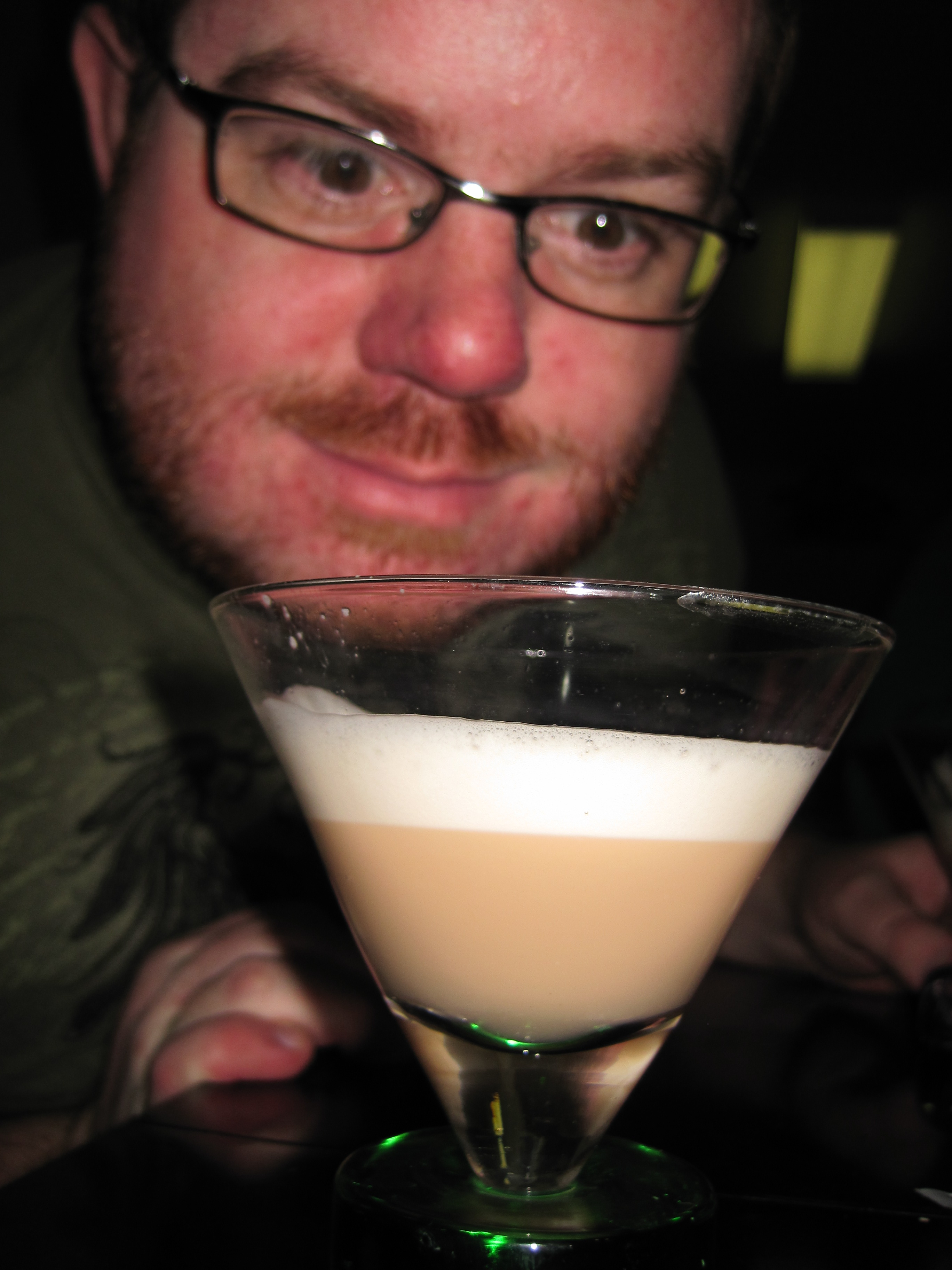
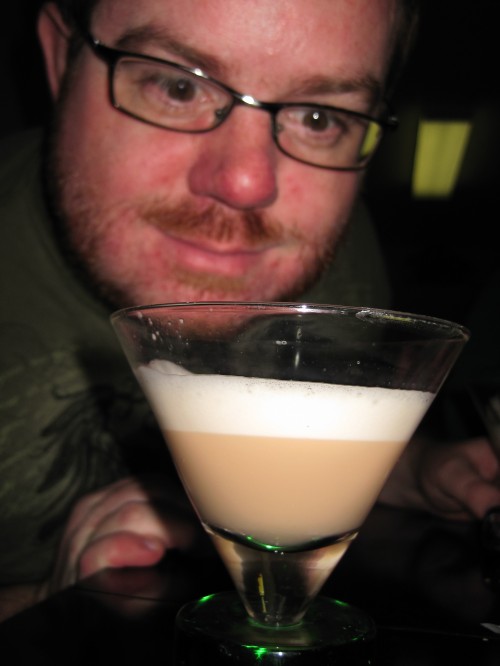
(Photo: Chris Noto looms over an Irish Whiskey Cocktail on St. Patrick’s Day.)

I’ve blogged about it twice over the space of more than a year, but last night I finally tried the nameless Irish Whiskey Cocktail that was spawned by a challenge the master distiller of Bushmills himself. (Proper credit: Though I mistakenly told everyone last night that the master distiller, Colum Egan, had come up with the recipe, more properly he challenged some top bartenders to create Irish whiskey-based cocktails, and this was the one featured in the article I read.)

The recipe is simple (all three links, above, will get you to it), but also time consuming. Since there were a goodly number of people I had convinced to try this new cocktail, I quadrupled the recipe and did it in a blender, rather than a cocktail shaker.

That means I used four ounces of Bushmills Irish Whiskey, two ounces of cherry liqueur, two ounces of orange juice, and four raw eggs.

Firstly, I’m glad that I used real cherry liqueur and not something like cherry brandy, because they are very different drinks, and this cocktail needed the heavy depth of the liqueur. Secondly, if you try this at home, add the eggs first, because the yolks can ‘plop’ a fairly hefty splash out of a blender if you’re not careful.

A couple of pulses later, and we had a nice, light brown, frothy drink. Poured into martini glasses, it easily served five or almost six, so quadrupling the recipe was no biggie.

Everyone was hesitant (even me), but we all gamely tried it.

Verdict: Delicious!

Although the drink was a tad on the strong side, it was delicious. There was no raw egg taste, and you could hardly taste any of the individual ingredients. Instead, they blended together to create a fully new flavour.

It was like a light, but very spicy egg nog. The whiskey provided the spice, I’m sure, but it tasted for all the world like a Christmas drink transposed to spring. It didn’t have the artificial sweetness or vanilla flavour of a commercial Christmas egg nog; instead it was light and frothy and the egg added a delightful creaminess.

Probably, some nutmeg or cinnamon wouldn’t have been amiss, to sprinkle on top, but I would be wary of too much experimentation.

The original recipe calls for straining into a chilled glass, and I do think that cold ingredients and cold glassware make for a better drink — as it warms, it’s slightly less appealing.

So for Round Two, I plopped a couple of ice cubes into the blender, hoping to lower the temperature. Then we realized that there was mint chocolate-chip ice cream in the freezer, so we added a couple of scoops of that.

Round Two was not a dismal failure, but it was definitely more disappointing than the original. Rather than a minty freshness, or a chocolatey-chip sweetness, the ice cream mostly added a weird colour to the drink. And without the strength of the whiskey coming through, the eggy nature of the drink was more apparent.

In fact, though the second attempt was more dilute, I found it smelled a lot more like raw egg, and it was less appetizing to drink. Stick to the original.

But stick to the original I will. This was a great drink, all in all. And it’s a bit of a fancy one to make, too, with the raw egg, if you like being a showoff.

What to drink on St. Patrick’s Day

Last year, I blogged about drinking options on St. Patrick’s Day, a post that is currently seeing a resurgence of popularity. Last year, I quickly ran through the standard Irish beer options, and quickly dismissed things like creme de menthe or Baileys.

Last year, I blogged approvingly about a new Irish whiskey cocktail, based (a bit) on a traditional Irish breakfast. I even linked to an article about it, and gave the recipe out.

This year, I’ve actually purchased the ingredients, and pledge to try it. I believe it will be my first time drinking raw egg. I bought free-range Omega-3 eggs, because it makes me feel like I’m minimizing my chances of contracting salmonella.*

Here’s the recipe:

  • 1 ounce Bushmills Irish whiskey
  • 1/2 ounce cherry liqueur
  • 1/2 ounce freshly squeezed orange juice
  • 1 whole egg.

Combine ingredients in cocktail shaker with ice. Shake very vigorously, for at least 10 seconds, to emulsify the egg. Strain into a chilled cocktail glass.

Of course, that seems fairly labour-intensive, so I’m thinking about quadrupling the recipe and doing it in a blender. I will report back on Thursday, when the brain-fog has cleared!

*Regarding salmonella, the numbers are in my favour: “Scientists estimate that, on average … only 1 of every 20,000 eggs might contain the bacteria. So, the likelihood that an egg might contain (salmonella) is extremely small – 0.005% (five one-thousandths of one percent). At this rate, if you’re an average consumer, you might encounter a contaminated egg once every 84 years.”

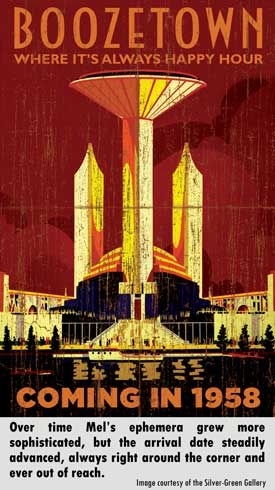
Can you tell me how to get to … Boozetown?

You’re sitting at a table with a number of other potential investors. As it’s 1952, you’re probably a man and so are all the other Mad Men-attired individuals. All of you are listening to Mel Johnson give his pitch:

Just imagine, he asks his audience, a resort entirely centered on the culture of alcohol. A boozer’s paradise built expressly to facilitate drinking and the good times that naturally follow. Where the bars, clubs and liquor stores never close. Where the police force is there to help drunks, not hassle them. Where even the street names salute sweet mother booze: Gin Lane, Bourbon Boulevard and Scotch Street. An adult playground like no other. Just imagine.

Johnson loved the drinking culture and travelled the world to experience it. As much as he enjoyed his adventures, he never found the one place that was it. The one perfect location where everyone could enjoy their drink and everything involved in the occassion. Thus, Johnson decided, a city devoted solely to drinking would have to be built.

At the end of 1950, Mel was a man obsessed. Made restless by his extensive post-war travels, he spent every waking hour sketching in the details of his dream. First, of course, he’d need to put a name to his drunkard homeland. He considered many possibilities, including El Dorado, Boozeville and Lush Land, before finally settling on the portmanteau BoozeTown.

During the first stage of BoozeTown’s existence, Johnson envisioned a resort consisting solely of themed bars. His headquarters and home would be a giant martini glass in the middle of the city.

The second stage would entail building an onsite brewery, distillery and perhaps even a winery to supply the many outlets in BoozeTown. Additional infrastructure would be built within the city to help patrons move about. Think moving sidewalks.

Finally, BoozeTown would focus on establishing a permanent population. This new city would surely, according to Johnson, attract artists famous and not-yet-famous alike.

Yes, BoozeTown was to be a drinker’s paradise.

Every bar and liquor store would be open 24 hours a day, seven days a week. Furthermore, you’d have the right to bring your drink with you anywhere you liked, including banks, post offices, and places of worship.

BoozeTown would have its own currency (BoozeBucks), security force (The Party Police) and newspaper (BoozeTown Bugle). There was almost no aspect of BoozeTown that Johnson had not planned for. Unfortunately, he was never able to raised the funds he needed.

By 1960, Johnson completely abandoned his plans for Boozetown.

Two years later, he was hospitalized for paranoid schizophrenia. He died in that same hospital four years after his admittance.

It is said his ghost still haunts the now-abandoned Bartonville Mental Hospital. No word on whether the spectre likes to drink or not.

(Read more about BoozeTown at Modern Drunkard.)

How to sabre champagne

In a special New Year’s Eve post, Amy films while I use a heavy kitchen knife on a $9 bottle of “sparkling wine.”

It’s open!

Now, I have posted about this before. So has Keith. And Wired has a “how-to” wiki that explores the difference between sabring a real French champagne, and an American one.

I have a sneaking suspicion that I’ll be posting about it again, too.

Awesomest way to open champagne

We are in the season of celebrations, no doubt. What are we to do, then, when we need to open a bottle of champagne, but want to impress everyone around us with our badassery? We follow the advice of Kathryn Borel Jr.:

For another way to open a bottle that is equally awesome, check out this previous post by Grant.

Back when journalism was all about the drunks

This is the same guy who was talking about how the tape recorder killed journalism, but in this video he’s reminiscing about the alcoholic days of writing and journalism. I often joke that I got into journalism because I thought I could drink at the office — boy, have those days changed.

Anyway, I guess I’m glad that I’m not passing out on my typewriter during shift.

Great wrestler, great drinker, great posse

I cannot vouch for the accuracy of any of this, but according to Modern Drunkard, one Andre the Giant was not just a fantastic wrestler (and actor), he was also a world-class drinker for the ages:

You won’t find it in the Guinness Book of World Records, but Andre the Giant holds the world record for the largest number of beers consumed in a single sitting. These were standard 12-ounce bottles of beer, nothing fancy, but during a six-hour period Andre drank 119 of them. It was one of the few times Andre got drunk enough to pass out, which he did in a hallway at his hotel. His companions, quite drunk themselves, couldn’t move the big man. Fearing trouble with cops, they stole a piano cover from the lounge and draped it over Andre’s inert form. He slept peacefully until morning, unmolested by anyone. Perhaps the hotel people thought he was a piece of furniture.

Think about it: 119 beers in six hours. That’s a beer every three minutes, non stop. That’s beyond epic. It’s beyond the ken of mortal men. It’s god-like.

There are at least a dozen similar stories. Are they exaggerated? Almost surely. But how much? Or how little?

Oh, and the posse? He’s got one.

Happy Birthday, Champagne

Apocryphally, today (Aug. 4) is the date that Dom Perignon (above) first invented champagne — in 1693. (Read a fuller story at Wired.) Now, I’ve never really been sure how you could pinpoint a day like this, since champagne takes a while to create. You harvest the grapes, you mash ‘em up, you add some yeast, presto-chango, put it in a bottle, secondary fermentation, and voila, champagne!

So when’s the date? The bottling date? The opening date? The grape harvest? Seems to me that Aug. 4 is a convenient excuse to drink champagne.

So that’s what I’m going to do tonight. Champagne is a delicious drink, and people should drink it more often than just at special occasions. But this is a special occasion, if we’re going to buy into the story — this is champagne’s 316th birthday.

And also, my friend Alawna’s 23rd. So she gets to celebrate a champagne birthday every year. Lucky!

What to drink on St. Patrick’s Day

green-beer

Tonight, Amy and I will have a selection of genuine Irish beers to choose from: Guinness, Harp, O’Hara’s, Smithwick’s and Kilkenny. I may also sneak a vial of green food colouring into the party we’re going to.

And I hope someone bites the bullet and brings some expensive Irish whiskey that I can sample.

There’s also Bailey’s — or creme de menthe for something that’s an ungodly shade of green.

But that’s not all your choices have to be (although, let’s be honest, that’s a pretty good set of choices!).

The New York Times is there, asking bartenders to stir Irish whiskey into a cocktail. I know! I know! But check out one of the ones that they came up with:

  • 1 ounce Bushmills Irish whiskey
  • 1/2 ounce cherry liqueur
  • 1/2 ounce freshly squeezed orange juice
  • 1 whole egg.

Combine ingredients in cocktail shaker with ice. Shake very vigorously, for at least 10 seconds, to emulsify the egg. Strain into a chilled cocktail glass.

Although the very idea is shocking to some (the Bushmills master distiller is quoted as saying “I’m sure my father never drank a cocktail in his life.”) the concept is interesting. In fact, the cocktails they came up with were guided by “the traditional Irish breakfast — eggs, bacon, black and white pudding, and toast”

Older posts «