
I’ve previously posted about the Weekly World News archives being hosted online by Google, but here’s a particular gem:
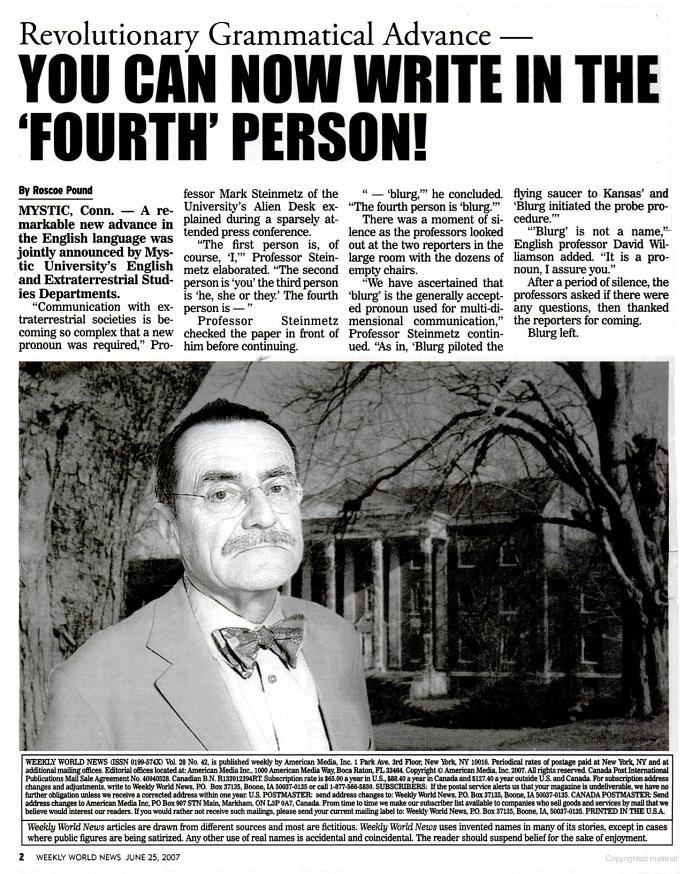
(from Winston Hearn, via Coudal)
I’ve previously posted about the Weekly World News archives being hosted online by Google, but here’s a particular gem:
(from Winston Hearn, via Coudal)
As the Winter Olympics winds down in Vancouver, I’ll be watching (I guess) the hockey final. For true athletics, though, you should pay attention to the 50km men’s cross-country ski event, which takes place a little earlier.
That’s 50km, people — more than a marathon. And cross-country skiing is hard. I know, I used to coach it.
One of the things I’ve loved over the past couple of weeks has been reading all the stories out of Vancouver from foreign journalists. Sure, a lot of them are sports-related, but with hundreds of journalists all covering the same set of events, and everyone looking for a little local colour to differentiate their broadcasts, there’s been some interesting stuff.
Usually, if you’re reading a light feature about a faraway city, it was either written by the hometown paper, or by a travel writer who maybe spent a weekend there. For the Olympics, though, there’s been plenty of other eyes on the city.
I particularly enjoyed these four pieces:
1. “Vancouver’s secondhand stores: a real treasure trove” — The L.A. Times.
In which the writer discovers that Vancouver is not a cultural wasteland:
I packed carefully for my trip to Vancouver last autumn: my smartest New York-bought parka, layers of excellent textures, skinny cords, comfy walking shoes of real leather, and sneakers for the gym only.
Puffed with pride, I strode the chilly city until, on a corner in the Kitsilano neighborhood, the zipper on my parka broke and I faced an Angeleno’s dilemma: spending a fortune on a replacement I might wear a few times a year versus getting something blah and forsaking my fashion-plate look.
2. “Narrating Canada’s Quest for Gold in Men’s Hockey” — The New York Times.
In which the Canadian television play-by-play broadcasters are profiled in the New York Times, to their apparent disbelief:
In both delivery and demeanor, Cuthbert and Miller are pleasantly unpretentious, each cut from a much plainer cloth than the colorful Don Cherry. Speaking separately, each said his first reaction to an interview request was that it must be a practical joke.
3. “Leaving behind a thank-you note” — MSNBC
In which an American anchor comes to grips with all the Canadian-ness he’s about to leave behind:
Thank you, Canada … For your unique TV commercials — for companies like Tim Hortons — which made us laugh and cry. For securing this massive event without choking security, and without publicly displaying a single automatic weapon. For having the best garment design and logo-wear of the games — you’ve made wearing your name a cool thing to do.
4. “Will London be as British as Vancouver is Canadian?” — BBC
In which a Brit just cannot seem to come to grips with all the Canadian-ness he’s seeing:
This is a country so secure in its patriotism, so comfortable with its international reputation for “nice”, that when the American women appeared close to tears collecting their silver medals, Canadian fans thundered “U-S-A! U-S-A!” in sympathy. (Would English football fans do that for players from a rival team?)
Any other favourites you’ve seen?
Hunter S. Thompson’s ode to debauchery in Las Vegas has, I’m sure, inspired many a road trip, trying to emulate the drug-fueled mayhem he encountered.
But how many of those road trips tried to tease out the threads of reality from HST’s psychedelic haze? At least one, it turns out. On the five-year anniversary of Thompson’s death, a reporter for the Las Vegas Review-Journal runs down the trail — and, surprisingly, it hasn’t all gone cold:
Some events are verifiable. In the 2008 documentary “Gonzo,” Thompson and Acosta can actually be heard living Chapter 9 as they pull into a Boulder City taco stand.
“We’re looking for the American dream,” Acosta tells a waitress, “and we were told it was somewhere in this area.”
The waitress turns to the cook, thinking she has just been asked directions to a nightclub.
“Hey Lou,” she says, “you know where the American Dream is?”
“That whole chapter is a transcription of that audiotape,” said “Gonzo” director Alex Gibney. “So it leads you to believe that some of this stuff is real.”
Other events — not so much. The reporter, Corey Levitan, manages to speak with some long-retired people who would have been in a position to encounter the worst depravities of ‘Fear and Loathing.’
“That is something I would have known,” [a hotel manager] said, “but I never heard that.”
Of course, in a book like this, truth may be in the eye of the beholder. One of the messages you can take away from Thompson’s style of “gonzo” journalism is that since true journalistic objectivity is impossible, perhaps accuracy doesn’t much matter either — not if you’re looking for the truth, at least.
Trying to predict the future seems to be a natural human tendency. What’s happening now is pretty interesting, sure, but figuring out what it all means requires looking into what will happen tomorrow. And that’s tough.
Even when we pour endless amounts of money into predicting something relatively scientific, like the weather, we fail more often than we succeed (at least, if we’re trying to make useful predictions on specific weather — like, should I go camping on a weekend, two months from now).
Predicting the stock market? A mug’s game.
Predicting elections? Requires polls so big you may as well just call a vote.
But there’s an endless market for people to prognosticate — and you saw tons of it this year, as one decade ended, and a ton of writers were hauled in front of their editors and told: “Why not do a story on what’ll change over the next decade.”
So it’s funny to go back a few years and see what people were predicting then, for now.
Which is exactly what the blog Three Word Chant has done, unearthing a 1995 Newsweek essay about why the Internet will fail:
Consider today’s online world. The Usenet, a worldwide bulletin board, allows anyone to post messages across the nation. Your word gets out, leapfrogging editors and publishers. Every voice can be heard cheaply and instantly. The result? Every voice is heard. The cacophany more closely resembles citizens band radio, complete with handles, harrasment, and anonymous threats. When most everyone shouts, few listen. How about electronic publishing? Try reading a book on disc. At best, it’s an unpleasant chore: the myopic glow of a clunky computer replaces the friendly pages of a book. And you can’t tote that laptop to the beach. Yet Nicholas Negroponte, director of the MIT Media Lab, predicts that we’ll soon buy books and newspapers straight over the Intenet. Uh, sure.
The problems identified by the cranky original author haven’t gone away. The internet is still a wild wilderness of competing voices, with poor navigation, anonymous sniping and zero accountability.
But he made the classic rookie futurist’s mistake: assuming that things will never change. Some sites have risen to the top with a reputation of accountability and accuracy (news websites, for example, if you try to forget about the financials). Other websites have business models based on making sense of the senseless (like Google, and other search engines). Still others seem to have self-assembled order out of chaos (three cheers for Wikipedia).
It’s humourous to read how much the essay got wrong. But it’s sobering when you think about how those criticisms, often, still exist. We’ve just jury-rigged ways around the worst of it.
So, knowing that the Canadian women curlers were playing a tough gold-medal match against Sweden — and that they were up against it in extra ends — but without any TV in my house, I checked a couple of websites to find out what the final result was.
Sadly for my patriotism, Canada lost 7-6 to Sweden.
Annoyingly, though, I clicked through three separate news sites that all had a variation on the same headline: “Settle for silver.” I guess they had to come up with something quickly — and at least they didn’t use “Silver lining” — but it still made a mockery of the idea of the Internet as a cacophony of different voices.
So I did a quick Google News search: “Settle for silver” and “Silver lining” each brought back a huuuuuge number of news articles — but crazily, they “… and 5,350 more” bit at the end was the exact same number. Does Google News max out at a certain amount of news?
So I checked “Good as gold.” Yup, precisely 5,350 more articles.
Weird. I refreshed it a couple of times, and the number changed, but each time I refreshed the page, the number changed slightly — but each search refreshed to the same number.
My favourite was when there was exactly 5,678 articles left. I felt like I was on the Sesame Street version of Google News.
So, the upshot? Either Google News arbitrarily stops searching after about 5,000 articles have been found, assuming (probably correctly) that you don’t need that much news, or frighteningly every single sports cliché is used exactly the same number of times.
I hesitate to Google “Gave it 110%”
The New York Times has a great video that goes back over the history of Olympic pictograms — those little stick-athletes doing all kinds of sports — and critiquing the good ones and the bad ones.
I tried to embed it, but you have to go to their site. Watch it here.
I don’t completely agree with everything — some of designer Stephen Heller’s judgments seem awfully arbitrary — but mostly, I can see what he’s saying. Some designers just tried too hard. Some just didn’t try at all.
It seems very difficult to strike a nice balance between ‘iconic and timeless’ and ‘new and different.’
The start of a regular feature? Perhaps.
If I do make Short Film Friday a regular feature (now that one of our other regular features seems to have become *ahem* irregular), don’t expect any commentary or on-going theme. It’ll be whatever film strikes me as being worthy to share — new, old, drama, documentary — no criteria, save one.
Short.

Today is not National Doughnut Day (that’s in June). But it is a Friday, and according to the woman at the bakery I went to this morning, that is by far the busiest day for bringing sweet treats to the office.
Frankly, since I work weekends, Fridays are about the only time I can share sweet treats with my workmates (bakeries are often closed on Mondays).
So, when I was called out on assignment this morning — and the assignment was cancelled at the last second — I dropped by Kuipers in Brandon for a dozen of their finest teeth-rotters. Sugar, cinnamon and assorted fillings would help ease the February blahs, I figured. And I was right (at least until the sugar crash).
And, I’ll admit that I asked for a few extra of the cinnamon twists and cinnamon rolls, just because I was inspired by one hard-workin’, cinnamon-lovin’ Lewis Meme.
Now, let’s all take a moment to think about the bakery workers of the world. There isn’t a neuron in my body that’s ready to fire at 4 a.m., but these hard workers are already up and at’em, kneading bread. It’s too easy, these days, to walk into a big box store for all your needs, including a loaf of cheap bread. For an extra dollar — or less! — why not stop by a small nearby bakery, support a local business, and pick up a loaf of their finest.
No, it’s not survives-nuclear-holocaust Wonder Bread. But it will be wonderful.
And if you happen to pick up some cinnamon buns while you’re at it, share them with the office.
by Amy Breen
Well, according to Conor Friedersdorf, who is himself a journalist.
On the website True/Slant, he attempts to list the best examples of journalism from 2009. In his words:
Throughout 2009, I kept a running list of the best journalism I encountered. Although I endeavored to remain as impartial as possible, note that I’ve been an employee of The Atlantic, that I’d eagerly write for numerous publications that received awards, that I have too many friends/acquaintances/professional contacts in journalism to disclose them all, and that the number of pieces I miss every year far exceeds the number I’m able to read.
In other words, this isn’t an infallible account of journalism’s best, but I aim to make it the best roundup that any one person can offer, one of these years I intend to do better than the committees who pick the Pulitzer Prizes and National Magazine Awards (the pressure’s on, especially since you guys charge entry fees), and if nothing else my effort encompasses writing that is well worth your time.
His list is long, guaranteed to keep you reading for awhile. I’ve only read a couple, but I can attest to the story from Rolling Stone about a blind teenager who caused havoc by tapping into phone lines. Friedersdorf also mentions the Wired story about Evan Ratliff trying to disappear, which Grant has blogged about.
Check it out for yourselves!
I got up bright and early this morning, ready to face a Friday with a happy heart. As I was eating breakfast, I was browsing the news sites, as I often do, when I caught site of this headline on the New York Times:
Radiation Bills Raise Question of Supervision
Perhaps I am still a little bit asleep, but until I read the first sentence of the article, I had seen the word “radiation” paired with the word “super-vision” … and I guess I had comic book fantasies, instead of something about cancer treatment and possible fraud.
Sigh.
Maybe you love Mennonites and want to name your first-born child after one.
Or maybe you’re writing a book set in a Mennonite community and need some characters.
Or perhaps, like me, you grew up in southern Manitoba, and Mennonite names make you feel at home.
Well, huzzah! There’s a website just for you: ShoutMennoniteNames.com:

From their “about” page, which they helpfully call “What?”
The site came about in February of 2009 when my boyfriend (who lives in Winnipeg), told me about a game that some of his friends had devised, in which players take turns shouting plausible-sounding Mennonite names at one another. I can only assume that they came up with this in February of another year, when the Winter Crazies were at their peak.
…
But let us back up for a minute. First of all, you should know, dear reader, that there are a whole lot of Mennonites in Manitoba. Also, Mennonites tend to be fairly predictable in their naming customs.
The site was created by Steven Cochrane, and it sounds like it’s about a year old. Happy First Anniversary, Mennonite site!
(via PaperAndGlue.net)
Gordon Lightfoot, a singer and Canadian icon. Not dead. Although, for an hour or so earlier this month, everyone thought he was.
Starting with one single tweet — “RIP Gordon Lightfoot” — the false news was picked up, retweeted, and amplified until it hit the mainstream media (all of which took a mere 10 minutes, frighteningly).
Lightfoot himself, apparently on his way to a dentist appointment when he heard the news of his own demise on the radio, was actually alive and well, and everything was quickly cleared up.
Now, though, the author of that first tweet — let’s call her Tweeter Zero — has written an essay in the Globe and Mail about how the whole thing got started, and how it brought the wrath of the internet down on her:
By the time I went back online, Gordon Lightfoot was officially undead (phew!) and the witch hunt was on (uh-oh!). Media guru and sleuth Ian Capstick was hot on my trail, and even had my picture and the dreaded tweet in question on his blog. Commenters were gleefully posting personal information about me: my full name, where I lived, whom I worked for. So I did what anybody in my situation would do. I opened a bottle of wine, and began to drink.
(Full disclosure: I was briefly acquainted with the aforementioned Mr. Capstick during my days at Canadian University Press.)
Lest you think the poor Tweeter Zero is fully to blame, she broadcast the message only to her meagre 100 Twitter followers, and she blames the origination of the whole episode on a telephone prank call (“But nobody seems to be interested in him. He used the telephone. And dude, that’s just so 20th century.”)
A lesson, perhaps, in the power and speed of the information superhighway.
Now, we came not to bury Gordon Lightfoot, but to praise him:

I remember in 1997 when the Cassini probe to Saturn lifted off. As the first (in a while) nuclear-powered spacecraft, there were all kinds of protests. After the launch, though, you didn’t hear much about Cassini-Huygens, because it kind of takes a long while to get to Saturn.
Then in 2004, images and data from the probe starting coming back. Wikipedia, of course, has a detailed page with many links, that will tell you all you need to know.
But if you really want to fall in love with Cassini, head over to the Boing Boing feature page. In honour of NASA deciding to extend the probe’s lifespan until 2017, they’ve put up a special feature, breaking down the science and what it means — while also managing to display some jaw-dropping images.
It’s the kind of feature that would do any mainstream magazine proud — and I’m happy to see it on a blog. Good work by all involved.
I have blogged about my desire to own a jet pack in the past. That pack, as cool as it may be, had some significant drawbacks. First and foremost, it was powered by water which causes some difficulty if I were interested in flying in, say, the Sahara. And if I’m laying out around $130K for a jet pack, I had better be able to use it anywhere I want.
So, move over Jetlev, make room for the Martin Jet Pack.
The 200 horsepower dual-propeller packs can travel at 60mph for up to 30miles on a full tank of fuel. They have been reached heights of 7,800ft in tests.
At 250lbs when empty, the jet pack is not heavy enough to require a pilot’s licence, although users will take part in a Martin Jetpack training programme.
The price will will be comparable to the Jetlev, but with almost none of the restrictions. You can bet I’m saving my pennies…
