Posts tagged: interesting

Shooting tourists

Not with guns, although some tourists can be pretty annoying. No, photographer Alan Powdrill has an interesting photo set of pictures he’s taken of tourists taking pictures.

It’s neat to see the full range of emotions one can have while taking a picture, from happiness to intense concentration at getting the right shot.

I particularly like this photo, with the red and white so contrasted:

Powdrill seems to capture people both close up and from afar, so I’m curious if he asked anyone if he could take their picture, or if he just sneakily shot them in order to get their “photo face.” (As an aside, I have a photo face that has been extensively made fun of — basically my mouth hangs open when I take a shot).

Check out the entire set at Powdrill’s website here.

(via TDW)

The Gulf of Mexico oil spill, explained by Al-Jazeera

Perhaps Western news organizations have produced their own video infographics, but Al-Jazeera’s was the first that I saw.

I’m glad to see an English Al-Jazeera, by the way, because I think it’s important to encourage a diversity of voices in the media. From what I’ve read, it was originally staffed with journalists pinched from the BBC, and I believe that news culture still exists.

Which, I suppose, is more than you can say for Fox.

How to live out of your car

If you have to, someday, live out of your car, you could do a lot worse than asking the Internet for advice.

That’s essentially what happened when Reddit user reconchrist found out, when he posted a “thank you” of sort, to the Reddit community, for keeping him feeling positive while he was living in his car.

Not only did her get a bunch of positive and encouraging replies, he actually got an astounding amount of free advice on how to live well out of your car.

The top post now is by user xenophone, who lists a bunch of good advice, but I’ve read through about half the thread, and I kind of feel that I could live out my car quite comfortably right now, if I had to. (Xenophone has also started an “ask me anything” thread about that experience.

Also, interestingly, isn’t it kind of sad in our supersized life that a car — our transport devices — are easily large enough for semi-permanent shelter?

Neat art installation

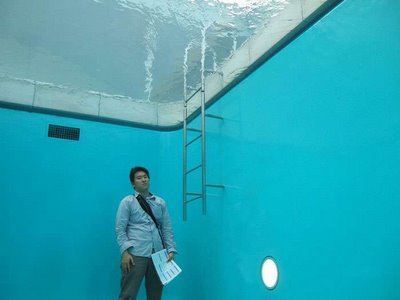
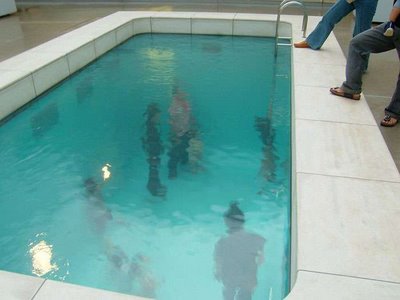
This is practically old news, but what the hell. Artist Leandro Erlich created a really cool faux pool for the Museum of Art of Kanazawa in Japan:

It’s been a permanent installation at the museum since 2004. Elrich created the effect by using two layers of clear glass with water in between them, followed by a layer of water on top.

I imagine that it would be incredibly surreal to be standing in a pool, under water, looking up at people. I think I would be slightly claustrophobic, and just a little paranoid that the water would come crashing down on me.

Elrich has a lot of interesting art installations at his website, like the Lost Garden.

(via TDW, via Dude Craft, via Crooked Brains)

Dear Facebook marketers, you can’t see me! nyah, nyah, nyah!

When I first started getting into newspaper design, I did what any modern person would do, and I Googled it. Luckily, Google led me to a community of news designers called Visual Editors (it’s a non-profit, and also a social network).

Run by Robb Montgomery, I’ve leaned on the community for everything from niggly Quark questions to recommendations for New York City accommodations. Someday, I hope to give back as much as I’ve learned.

Earlier today, Robb posted a blog entry about Facebook, with this intriguing tweet to promo it: “Facebook invades [your] profile to sell you stuff. Try this tip to stay invisible.”

I had to read this post, and he’s got a point worth passing along: Facebook loves it when you list your interests on your profile, since then it can target more ads to you. How does Robb stay “invisible”?

Look at my listed interests.

“Wonder, Discovery, Passion, Belief, Balance, Delight, Diversity, Surprise, Story, Truth, Grace, Redemption, Beauty, Innovation, Insight, Perspective”

I am sure the Facebook customer data algorithm would prefer to know much more specific things from my profile like my favorite sports, travel spots, music, foods, clothes, etc.

By listing ideals instead, Facebook has no idea what kind of ad to serve up to a person like me. So I get generic ads that I seem to ignore and never click on.

I bet the Facebook geniuses don’t get many folks who list “wonder” and “perspective” as interests. Instead they entice you to give them valuable market research data for free by appealing to your ego.

Not only is he right that most marketers focus on concrete things that are, as he says, “bands and brands,” there just aren’t a lot of people who tend towards the abstract on their social networking profiles.

Read the whole blog entry here.

I keep a pretty sparse profile on Facebook, but if did list interests, I think it would be much more mentally healthy to list aspirations and goals, not necessarily goods I would like to consume.

Unfortunately, I think Robb’s method for Facebook invisibility will last only until marketers get wise. I can already think of plenty who would jump on that — anything health and beauty related, for example (how many deodorants and body sprays already have names like “Intensity”?), or marketers who appeal to the spiritual, like churches.

By the way, I have good luck hiding many Facebook ads just using Firefox and AdBlocker.
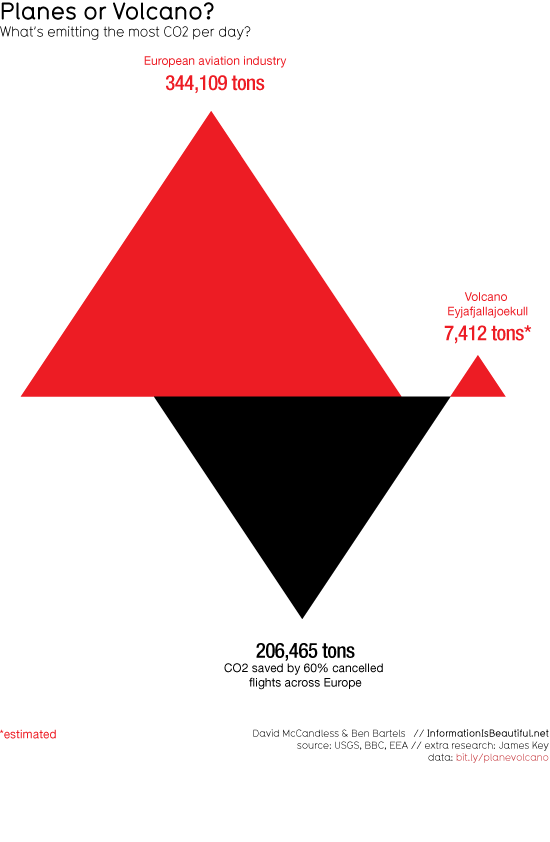
Iceland, home of the environment-saving volcano

Think all that ash being spewed across Europe is bad for the environment?

Well, it is — kind of. But it just might be better than all the airline flights that would otherwise be spewing their exhaust through the atmosphere.

InformationIsBeautiful does it up in graphic style for you.

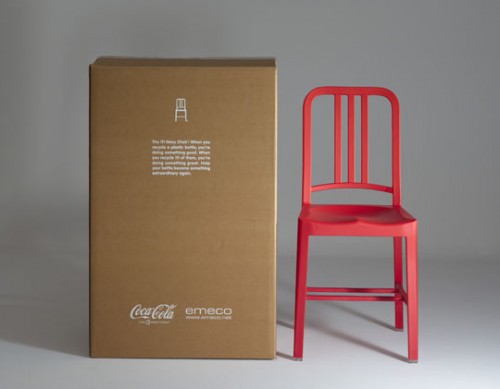
This chair is made from 111 recycled Coke bottles

Emeco has contracted with Coca-Cola to produce a recycled plastic version of their iconic “Navy” chair, originally designed for use on World War II submarines and ships. In fact, a word about the original, aluminum Navy chair:

The chair was commissioned in the 1940s by the U.S. Navy in World War II for use on warships: the contract specified that it had to be able to withstand torpedo blasts to the side of a destroyer. Together with Alcoa experts, Emeco’s founder, Witton C. “Bud” Dinges designed the 1006, a chair so durable that it far exceeded the Navy’s specifications: When Dinges threw one chair out of a sixth-floor window at a Chicago furniture show, it survived undamaged except for a few scratches. Most wartime chairs are still in perfect condition and are occasionally available on the U.S. civilian market as military surplus from mothballed Navy ships.

That’s some chair. To this day, it takes two weeks and 77 individual steps to make each one by hand. They list at between $415 and $1,120, if you’re interested.

So that makes the Coke version a downright bargain, at just $230. Here’s a list of dealers.

According to Emeco, it takes 111 recycled Coke bottles to make each chair, and it takes three minutes to put it through the mould. Although that’s Speedy Gonzales compared to the aluminum version, it’s apparently three times longer than your average patio chair.

They’ve even got a (strangely dull) video showing the tail end of the process:

When did it become boring to watch a robot make life-size chairs with plastic tabs that look like the ones I used to bend off of model car kits?

Touchable pornography for the blind

If you happen to be blind enough that you rely on braille, chance are that the mainstream porn industry has left you out, says Lisa J. Murphy.

The Toronto Star has a story on Murphy, a photographer who worked with CNIB (the Canadian National Institute for the Blind) to make books for kids that included touchable pictures of animals.

Now she’s working on something a lot more adult — porn:

Tactile Mind is half art object, half artisanal concept book. It contains explicit softcore images that are raised from its pages, along with Braille text and photos. The effect of the tactile, plastic “images” is a bit like that of an ancient Greek bas-relief. Or, somewhat less precisely, a smutty pop-up book.

Creating a tactile book is far from simple, Murphy says. She recruited some friends and photographed them wearing masks, streamers, Christmas lights, or nothing at all. That was the easy part.

Then she blew up the photos and built on top of them with clay, being careful to mimic the photo in three (well, two and a half) dimensions.

She baked them until they were hardened, and then covered them with a layer of special Thermoform plastic that molds to what it touches when heated up.

After being heated in a special machine, the plastic-finished product is ready to become a plate in the book. The whole process takes Murphy between 40 and 50 hours. That’s for just one image.

With the 3-D images, the book is about 13-15 cm thick, and retails for $225.

Octopus vs. sea lion

Here’s a video you don’t see every day: a sea lion attacking and eating an octopus.

(From National Geographic.)

Attention vegans: You should eat oysters

Christopher Cox makes a compelling case for the ethics of eating oysters. Although I’m not a vegan, I can understand what drives some people to avoid eating meat or other animal-sourced food.

In short: factory farming wrecks the environment, and killing animals is cruel. Cox makes the same arguments, but says they don’t apply to oysters:

Oyster farms account for 95 percent of all oyster consumption and have a minimal negative impact on their ecosystems; there are even nonprofit projects devoted to cultivating oysters as a way to improve water quality. Since so many oysters are farmed, there’s little danger of overfishing. No forests are cleared for oysters, no fertilizer is needed, and no grain goes to waste to feed them—they have a diet of plankton, which is about as close to the bottom of the food chain as you can get. Oyster cultivation also avoids many of the negative side effects of plant agriculture: There are no bees needed to pollinate oysters, no pesticides required to kill off other insects, and for the most part, oyster farms operate without the collateral damage of accidentally killing other animals during harvesting.

Also, they don’t feel pain. Unlike, say scallops. So avoid scallops.

But oysters? Heck, eat all you want, says Cox. Ethically, he says, they’re as great as plants: “Even if that animal looked like a bunny rabbit crossed with a puppy, it would be A-OK to hack it into pieces for your dinner plate.”

Yum!

Newspaper watch: What will next-gen journalists do?

I just wrapped up teaching a couple of intro journalism classes at Brandon University, and the best part of it (besides the inquisitive, engaged students) was the time that I got to spend delving into internet-based journalism. There’s a ton of really exciting ideas floating around out there, and the students and I spent the last few weeks of the semester brainstorming and debating what the future might hold.

So I can only imagine how awesome it would be to get involved with a new course at Columbia University that is offering a half Computer Science, half Journalism degree.

Yes.

The hope, according to this piece on Wired.com, is that these graduates will be able to bridge the gap between tech and journalism. Sure, many journalists love playing around with multimedia, video, and interactive websites. But who’s going to build the next generation of such technologies:

“Some people coming out of high school or college possess technical savvy, but more often than not, the skill set is bordered by an ability to use Wikipedia, Facebook and Gmail,” said Grueskin, noting that while Columbia journalism students are taught to edit multimedia and maintain websites, “almost all of those skills rely on using existing software or programs to do digital journalism. We hope and expect that graduates of this program will be more able to innovate and create the solutions the news business so sorely needs.”

Wired has a list of technological solutions that the grads might apply themselves to, including automated journalism, data visualization, deep data mining and something they call “digital trust.”

It sounds awesome. And I can’t wait to learn more about this course’s curriculum, and then to incorporate some of what they’re exploring into my own class discussions.

(Oh, and also I hope that it filters out into my day job.)

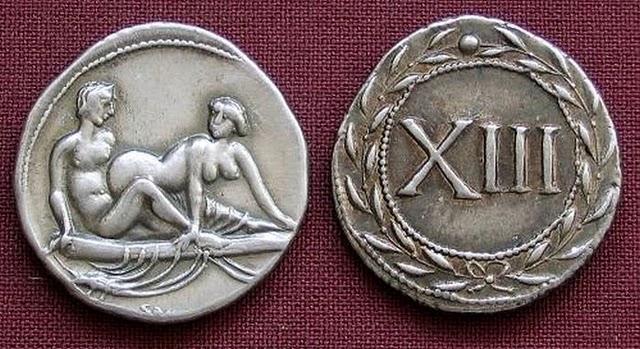
Brothel tokens from ancient Rome

These tokens are from ancient Rome, and they’re called spintriae. They were only manufactured for a few years (perhaps as few as 15) in the first century, and they have no real intrinsic value, being made from brass or bronze.

Oh, and they depict sexual activity, rather than the more-common profile of an emperor. View a gallery of them here.

All of that leads many people to believe that they were used as “tokens” in Roman brothels — you pay the cashier, then redeem your coupon upstairs.

But not everyone agrees. Both Salon and Cecil at the Straight Dope point to an influential 2007 essay by Geoffrey Fishburn called “Is that a spintriae in your pocket, or are you just pleased to see me?” (pdf).

I read it, and he makes some interesting points — there’s no evidence of Romans having a token-based sub-economy in any area, let alone brothels; there’s no real correlation between the numbers on one side of the coin and the acts depicted on the other; Romans didn’t have the same hangups about sex that we do, so the coins may not mean much of anything; and frankly, it’s so far back in time that we may never be able to definitively say what they were for.

In fact, they were so cheaply made that they may have just been intended as slightly titillating amusements — and they’re still good at that.

So let’s take a page from the Roman playbook. Here’s my modest proposal: Next time the Mint wants to do a commemorative run of quarters, why not the Kama Sutra edition?

Newspaper watch: Intentionally defacing your front page?

If you know anything about college sports, you probably know that Duke is the team that so many people love to hate. I don’t know why — does anyone? — but even I am aware of the animosity.

So the Indianapolis Star decided to do a story about the Duke-hate, and to illustrate the story, which ran big on the front of their sports section, they chose a picture of the Duke coach. And then, they defaced it with a ballpoint pen, printing a paper that looked like someone had drawn on it before it reached your mailbox.

Here’s what it looked like — for the first 30,000 copies, before someone got nervous and pulled the illustration in favour of a non-doctored photo.

The concept, I think, is incredibly creative, even if the execution is a little flawed. There’s a great discussion going on over on Charles Apple’s blog, which points out that, yes, it’s juvenile, but so are the feelings involved in sports rivalries.

Apple, himself an influential newspaper designer, also says that he would have toned down the image a little bit — he doesn’t think the long hair works, he thinks the bulls-eye is “ominous” and he would have added the image of a pen laying in the bottom of the story.

But overall, as he tweeted, he likes the idea.

Unfortunately, not everyone does. The coach, who one would assume might have developed some thicker skin, says he didn’t like his grandkids seeing it. And the newspaper management is falling all over themselves to backpedal — perhaps if they’d used Duke’s Blue Devil mascot, instead, they suggest, it would have been okay.

I’m not sure I buy that — the coach is a public figure, and ridiculing him is probably fair game.

Is the illustration appropriate for every newspaper, everywhere? Absolutely not. But I love that the Indianapolis Star is taking some risks, and doing something different.

Actual printed newspapers are staid and conservative by nature. But shaking up the design a little bit like this once in a while is a great idea.

Get up, get up … do math?

As Amy can attest, I require a fair bit of waking in the mornings. A clock “radio” doesn’t really do it for me — I need the loud, rhythmic pulsing of an electronic beep.

And even then, I have mastered the art of hitting the snooze button while still snoozing. As a teen, I became so frustrated by not being able to wake up that I would put the alarm clock on the top shelf of my room, as far away as possible from my bed, forcing myself each morning to climb up on a chair with wheels to slap the alarm off.

I could do that in my sleep.

For a while, I sincerely believed that they only possible alarm clock for me would be one that required me to go down the hall to a separate room to shut it off, and instead of a snooze button, in that other room I would be faced with an alphanumeric code that I would have to bring back to my bedroom and input correctly. This code would have to change every day.

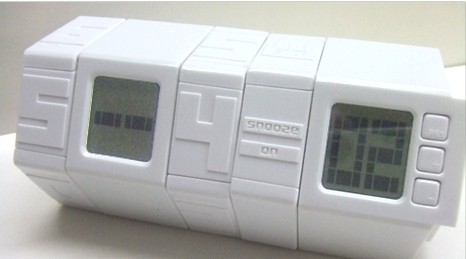
Perhaps this is the nearest thing to my dream:

With the alarm blaring, you have to twist the clock, lining up numbers to solve the equation. In this case, what, minus what, equals two? Obviously, it’s not 5-4. But that wouldn’t be so obvious in the morning.

Apparently it’s available here for about $30, but I can’t read Japanese.

(via Engadget)

This light bulb is anything but fragile

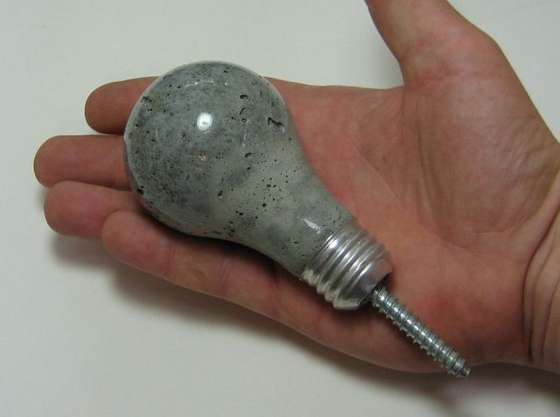
Huh, imagine this: A lightbulb made out of concrete:

It’s easy to pull out the innards, fill it with concrete, pop the screw-end back on (with a lag bolt), wait for the concrete to cure, and then pop the glass off.

What you’re left with is a light-bulb-shaped concrete thing, which you could screw into a wall as a hook or coat hanger. Yes, it’s a little industrial, but you could paint it any colour you wanted.

Full instructions here.

Dansette