Posts tagged: media

Local TV news contains only seconds of news every half-hour

Television stations in the United States get exclusive access to their frequencies so that they can broadcast news and entertainment. But they’re supposed to be acting in “the public interest” in return for that largess. Are they?

A study by the Norman Lear Center took a look, studying 11,000 stories on eight local television stations in L.A. over two whole weeks. They found that most of each 30-minute newscast was “frittered away,” in the words of one commenter. Strip out the ads, the weather, the sports and there’s not much left. Local government issues, for example, get a mere 22 seconds per half hour.

Here’s one video that takes an overview of the study:

The FCC Commissioner, commenting on the study, said that he was “flat out alarmed.”

Read more about it on the Norman Lear Center’s page — including the study itself and several more videos. As you can imagine, it’s gotten plenty of coverage in the non-television media, but I found about it on the L.A. Times, where columnist James Rainey was biting in his assessment that “local news is neither very local nor very newsy”:

You’re sure to learn about the Guitar Hero championships. (Slammin’ video. No analysis required.) But don’t expect to find out much about who’s running for Assembly or just how much library hours will be reduced by the latest city budget cuts. …

Try to recall an evening newscast that didn’t include an animal in a predicament or at least one story gift-wrapped in yellow police tape. A regular diet of this stuff might reasonably have you cowering in your house. Never mind that statistics (so meddlesome, those numbers that provide context) show crime in fairly sharp decline in recent years. …

The sports guy gets ever more jocular. And the weather gal never wants for time to show the latest cutoff low on the map in her latest low-cut top. …

As USC released the study last week, former KCBS reporter Bob Jimenez derided the way local news operations wallow in a culture of “kicks, guts and orgasms at 11.”

Rainey also dug into the files that local TV stations are required to submit to the FCC, files that are supposed to show how they are acting in the public interest, by covering important stories. Well, the stories that the stations deem as locally important and in the public interest are laughable. Or would be, if it weren’t so sad.

Roger Ebert critiques the “news”

It was posted almost ten days ago, but I just came across an interesting article by Roger Ebert for the Chicago Sun-Times.

In it, Ebert examines the bully-style tactics of Bill O’Reilly and how he, and other “news” figures like him are changing the way people not only receive their information, but the information itself.

I am not interested in discussing O’Reilly’s politics here. That would open a hornet’s nest. I am more concerned about the danger he and others like him represent to a civil and peaceful society. He sets a harmful example of acceptable public behavior. He has been an influence on the most worrying trend in the field of news: The polarization of opinion, the elevation of emotional temperature, the predictability of two of the leading cable news channels. A majority of cable news viewers now get their news slanted one way or the other by angry men. O’Reilly is not the worst offender. That would be Glenn Beck. Keith Olbermann is gaining ground. Rachel Maddow provides an admirable example for the boys of firm, passionate outrage, and is more effective for nogt shouting.

Ebert goes on to decry the way radio and television have changed — which struck me as a comment on “the good ol’ days” that I have no sympathy for — but his analysis of O’Reilly, and others like him, is spot on. The bottom line, in Ebert’s mind, is that the polarization in the media has to stop. I would have to agree.

Get your news fix

While much has been said here about the seemingly endless stories of newspapers closing up shop, little has been said about what remains. In that tradition, I will offer no commentary about the newspaper that have, to date, kept a traditional paper version and offer this great, interactive link:

Newseum: Today’s Front Pages

Truly, a news junkie’s playground.

Newspaper Death Watch: Fat Lady Singing edition

BREAKING: Computers may affect the future of the news business. This photo, and the others in this post, are from the Winnipeg Tribune Archives held at the University of Manitoba. Original caption, from 1977: "Winnipeg has entered the era of small, affordable computers which have turned sci-fi into kitchen counter reality and raised the possibility of a computer in every home."

BREAKING: Computers may affect the future of the news business. MORE TO COME. (This photo, and the others in this post, are from the Winnipeg Tribune archives held at the University of Manitoba. Original caption, from 1977: "Winnipeg has entered the era of small, affordable computers which have turned sci-fi into kitchen counter reality and raised the possibility of a computer in every home.")

A lot of other people are linking to this Jeff Jarvis rant, so when I got an email directing me to read it — stat! — I delved in.

Jarvis argues that the newspaper industry has had decades to see, recognize and react to the changes that were coming — from Craigslist to Google — and that since they failed to change, they deserve to fail.

My (lengthy) analysis, after the jump:

Read more »

Best April Fool’s Day Hoaxes of All Time

It’s an oldie but a goodie — the Top 100 April Fool’s Day Hoaxes of All Time!

There are almost too many good ones in that list to pick out here — I encourage you to read through the list and maybe post your favourite in the comments. I confess to having a soft spot for the many, many, many that were pulled as pranks by media institutions. I wish newspapers these days had half the sense of humour we used to.

Actually, back when I was at the Brandon Shopper & News, I helped pull a prank on our crosstown rivals, the Wheat City Journal. With the help of a departing staffer (whom I was replacing), we crafted a story about a Korean outfit who had come to Brandon in search of used compact discs. Partnering with a local charity, they were able to “resurface” old, scratched-up CDs that no longer played. Like retreaded tires, these newly-resurfaced CDs could be sold more cheaply than brand-new CDs, yet still at a profit.

Best of all, if Westman residents could chip in and donate their unused CDs to these Koreans, the local charity would get a cut of the profits — and it would all go towards the benefit of the Western Canadian Jaundice.

Hmmm …. Western Canadian Jaundice? WCJ? Wheat City Journal?

That’s right — we asked out readers to drop off used CDs at the address of our competitors’ offices. For the skeptical, we even had a website promoting the initiative.

Apparently, they got boatloads of CDs dropped off by well-meaning people. We had, of course, put “Happy April Fool’s Day” at the end of the article, but apparently people were in too much of a hurry to be charitable to bother finishing the story.

By the end of the day, after being yelled at by several layers of my bosses, we promised never to do it again. Sigh.

In that spirit of worker rebellion, I think one of my favourites in the list above is No. 96, the Boston Globe Price Cut:

Readers of the Boston Morning Globe in 1915 could have purchased their papers for half the cost on April Fool’s Day, if they had been alert. The price listed on the front page had been lowered from “Two Cents Per Copy” to “One Cent.” But almost 60,000 copies of the paper were sold before anyone noticed the unannounced price change. When the management of the Globe found out about the change, they were just as surprised as everyone else. The new price turned out to be the responsibility of a mischievous production worker who had surreptitiously inserted the lower value at the last minute as the paper went to print.

Newspaper Death Watch: Bad timing in Detroit edition

The future marches on for Detroit journalism.

The future marches on for Detroit journalism.

Oh, man — talk about bad timing and the face-palm of missed opportunities. Just check out the devastating start to a story in the New York Times called “Detroit’s Daily Papers Are Now Not So Daily“:

Maybe once a year, a city has a news day as heavy as the one that just hit Detroit: The White House forced out the chairman of General Motors, word leaked that the administration wanted Chrysler to hitch its fortunes to Fiat, and Michigan State University’s men’s basketball team reached the Final Four, which will be held in Detroit.

All of this news would have landed on hundreds of thousands of Motor City doorsteps and driveways on Monday morning, in the form of The Detroit Free Press and The Detroit News.

Would have, that is, except that Monday — of all days — was the long-planned first day of the newspapers’ new strategy for surviving the economic crisis by ending home delivery on Mondays, Tuesdays, Wednesdays and Saturdays. Instead, on those days, they are directing readers to their Web sites and offering a truncated print version at stores, newsstands and street boxes.

Read the story. There are people who will really miss the loss of a physical newspaper. But the Times does a good job of finding several different constituencies: there’s a woman who doesn’t have time to stop at the store for the new “abbreviated version,” as well as a retired woman who says she wants the physical product no matter what. And they also find a retired man who is ready to move online to find his news.

The papers’ servers crashed Monday, too, unable to keep up with huge demand for their “e-editions.” Maybe that bodes well?

Newspaper Death Watch: No help from above

A departing editor from the Boston Globe (he took a buyout) tells the local Alt-Weekly that, although he has high hopes for newspapers and journalism in the future, he just doesn’t think the current crop of managers has it in them:

The old business model’s broken, and it’s not coming back. Somehow or other, I believe there will be newspapers, and there will be journalists. But we have to figure out a new way to pay for it, and we haven’t figured that out-who’s going to pay what it takes to do excellent reporting and careful writing, and who’s going to buy it in what form when it’s done …. There’s a lot of innovation that’s going to go on. I just don’t think it’s going to be done by the management of papers as we now know them. I don’t think they have the imagination. I shouldn’t make a sweeping statement, but so far, what I see is just cutting and cutting and hoping some kind of miracle happens. I don’t mean that that’s the character of this company more than it is the character of any other. I just think that, for the most part, most newspaper management is in a state of shock. They’re not really going to be the ones to do it.

One of the commenters takes it even further, laying it on the Baby Boomers directly. Really rips into them, too:

Baby Boomer managers, and journalists … over the last 30 some years have had ALL the TIME in the world to innovate, and protect newspapers that are now about to go out of existance throughout this country (and others as well.)

Frankly, many aging boomers falsely believed that they were going to live forever, and did the best they could to keep their jobs over three decades, while at the same time, continuing to force younger reporters to skip from paper to paper, town to town, who’ve had to face the same “unimaginative” baby boomer executives, publishers, managing editors, and city editors, as well as having to deal with unresponsive boomer journalists who sought more to protect their careerist positions, rather than to innovate before it was too late.

Now, it is too late, and not only for baby boomers, who are lucky enough to even be offered “buyouts” rather than being laid off.

You can’t say that for the younger Generation X editors, reporters, etc., who now have NO newspaper to go to since the Baby Boomers, in their own greed and shortsightedness, have destroyed newspapers that lasted over 100 years.

Unimaginative? You bet.

It’s downright gruesome and sad to see one generation take down the entire newspaper industry and expect all of us to cry about the “good run” they had.

Great ride. But it’s the last ride for any other generation since younger generations cannot follow to even clean up the mess the Baby Boomer generations has left behind.

As for the newspapers ~ there won’t be any “mess” to clean up since papers are falling left and right ~ destroyed by the generation that once said never trust anyone over 30.

Great Job baby boomers.

Whether its fair to blame so-called “baby boomers” or not, I do think there’s a real fear in the upper echelons of the industry these days — and too many managers are afraid to take any chances. They just want to hold on until their pensions kick in. You can almost hear them chanting “Five more years, just five more years” with retirement so close they can smell it.

But, despite the anger that newspaper execs were asleep at the switch, I think there’s a burgeoning creativity online that bodes well. Newspaper inspire loyalty and love from people, and people really want to re-create their (former) success online. I have hope.

Newspaper Death Watch: Not the Internet, blame these three people

newsdesign

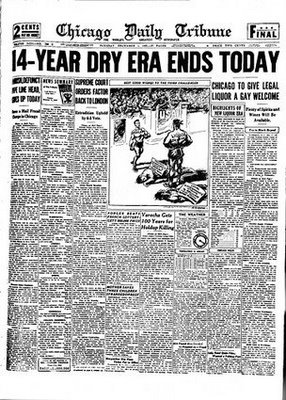
When newspapers lost their idiosyncratic design -- including the Chicago Tribune's daily front-page cartoons, above, or the San Francisco Chronicle's distinctive sports section on green newsprint -- newspapers also lost some of their vibrancy and urgency and individuality, said former editor John Walter.

Wow. I stumbled across a very interesting column on Poynter earlier today. Poignantly, it was written by a former newspaper editor and discovered on his computer after he died. His wife gave permission to Poynter to publish it.

John Walter writes that big-city newspapers are dead. But, with a love of specificity and drilling down that characterizes a good journalist, he doesn’t lay the blame at the feet of vague terms like “industry shifts” “changing reading habits” or an “advertising slowdown.” Instead, he singles out three specific individuals who made influential changes at their newspapers, with long-term ramifications that have caused newspapers to die.

Now, you can (and I do) argue with some of his contentions. The changes that he cites may have been introduced by these three individuals, but there’s no doubt that if they hadn’t done it, someone else probably would have. They just happened to be first.

Still, the column is a fascinating read. To briefly sum it up, he blames the loss of newspaper competition on A.J. Liebling. He blames the loss of idiosyncratic newspaper design on Ed Arnold. And he blames the loss of a journalism-first ethic on Al Neuharth.

But although it’s not central to his thesis, he starts off the column with a lengthy reflection on why he — a former editor! — no longer even subscribes. It’s a low-key but searing indictment of the state of the industry. I mean, just read:

I canceled my subscription. This was because I discovered that I foolishly had been paying full price for a home-delivered subscription and didn’t know that if you started a new subscription, you actually got 50 percent off for 12 weeks. So, we canceled our subscription and then started it up again, and had 12 good weeks at 50 percent off.

Then I called to cancel my subscription at the end of the 12 weeks, and they said they really didn’t want to lose me as a customer, so I could have another 12 weeks at 75 percent off, and I realized what a fool I had been to take the paper for 50 percent off.

So I signed up for 12 weeks at 75 percent off, and when those 12 weeks ended, I called up to cancel, and they said, sorry, they weren’t offering the 75 percent off subscription anymore, but I could have the Wednesday through Sunday papers for the same price that I had been paying for the full week at 75 percent off, so I took that for another 12 weeks.

Then, just the other week, when they said I now had to pay full price again for whatever subscription I wanted — Sundays only, or five weekdays, or Thursday and Monday, whatever — I said the hell with it.

I sympathize with him. I’ll bet that if you offered free subscriptions — free home delivery, anywhere in the city, no cost ever! — circulation managers would be depressed at the low rate of subscriptions. There just isn’t as much interest in day-old news anymore.

Anyway, the column is a good read — a perceptive diagnosis, if not yet a cure.

Bloggers are not parasites

This turned out to be a LENGTHY post. To save scrolling from people who want to get on with the next post, I’ve put it all “after the jump.” Also, it’s a real first draft, that just came pouring out, not a carefully considered post, so take that into consideration when posting comments!

Read more »

It’s all in the perception

Mildly alarmed, I clicked on a story through Google News which read, “Has Obama Snubbed the British Prime Minister?” It took me to an opinion piece in the Cleveland Plain-Dealer Leader [see comments] listing the ways in which Obama’s recent meeting with Brit PM Gordon Brown had been an unmitigated disaster.

Weird, I thought. That’s not what the other stories I read had mentioned at all. I thought it had gone, I dunno, okay?

Not according to the folks in Cleveland, who wrote, among other things:

Brown clearly took care in choosing his gift for President Obama, presenting him with a pen holder crafted from the timbers of the 19th century British warship HMS President. The HMS President’s sister ship, the HMS Resolute had previously provided the wood for the Oval Office’s desk. Therefore the PM’s gift was clearly not a last minute thought.

Obama, however, did not take the same amount of care in choosing the British leader’s gift - 25 DVDs of American classic movies. In fact, some believe he put absolutely no thought in to it at all for several reasons: Brown could get these movies anywhere himself, and US DVDs are typically incompatible with UK DVD players. Oh, and Brown is blind in one eye.

Yikes! The paper also quotes a British counterpart, the Daily Telegraph, as saying, “President Obama has been rudeness personified towards Britain. His handling of the visit of the Prime Minister, Gordon Brown, to Washington was appalling.”

Luckily, a Daily Telegraph story about the Obama-Brown meet’n'greet was right next to the Cleveland one on Google News’ little feed. So I clicked over to the Daily Telegraph.

I’m sure the folks in Cleveland accurately quoted whatever story they read, but I didn’t read that story. Instead, what I got was a spec piece entitled, “Has Gordon Brown’s Meeting With Barack Obama Restored His Fortunes?”

Apparently, if a gift of movies is a slight, all has been forgiven. Now the Telegraph asks whether Brown has watched “Raging Bull,” one of the 25 movies that he brought back from America, drawing comparisons between the pummelled pugilist made famous by Robert DeNiro and the occupant of Number 10 Downing.

But the punches they’re talking about don’t come from Obama’s snubs, rather from the public and the press back at home. In fact, read what the Telegraph has to say now about it:

The machinations about his press conference which was perceived by some - albeit no one in the Prime Minister’s travelling party - as a snub are unlikely to matter long term. It is clear that the White House belatedly realised that they had not thought out some of the arrangements before Mr Brown arrived, fuelling the theory that they did not really care about their guest. The phone call from the President to Mr Brown’s departing plane helped soothe some of the hurt.

It’s interesting to think that, even in an age of immediate global information, we still have these regional differences in our persepctives. It’s still that which is local that matters most to us — as well it probably should.

Similarly, I read recently about a breakthrough in stem cell production. If there’s anything more global than science, I don’t know what it is. Building on Japanese research, teams of Canadian and British researchers managed to find a way to turn adult skin cells into stem cells — without also risking the creation of cancer cells.

It’s a breakthrough — something for the scientists to be proud of, sure! But here’s how it was portrayed in the press:

From the Globe and Mail: “Canadians Make Stem Cell Breakthrough”

From the Scotsman: “Scottish scientists create ‘ethical’ stem cells

From Agence France-Presse, under the headline “Stem Cell Breakthrough Now Goes One Step Further,” the lede was “Pioneering work by Japanese stem-cell researchers two years ago has taken a major step forward.”

All of those are accurate - all those researchers “coulda bin a contender“ for the lede of the story - but this is just something to think about the next time you read a story that panders to your national/provincial/local pride.

So who’s buying ads these days?

In my industry, there’s much wailing and beating of chests as everyone bemoans the fact that ad sales are way down, and that means revenues are way down. But somebody’s still buying ads, right?

Turns out that Crown Royal (distilled not that far from me, really) has just launched its first American TV campaign in five years.

So, why now, in the teeth of a recession? “Ad Report Card,” one of my favourite columns over at Slate, has a theory:

I’m also fairly certain Crown Royal recognized a zeitgeist opportunity. This is a moment where the brand’s established image—down to earth, unflashy—meshed rather smoothly with external events. In uncertain times, vignettes about people sticking together and helping each other out become suddenly relevant. This is a campaign that seems well timed and conceived to take advantage of a shifting national mood.

Seth Stevenson, who writes “Ad Report Card,” draws some astute distinctions between a “brown” liquor like Crown Royal and a “white” liquor like Grey Goose:

If Grey Goose’s promise is that you’ll get laid on a yacht, Crown Royal’s promise is that your life will brim with purpose and community.

Which approach would you rather bet on these days? Grey Goose sold oceans of vodka in the boom years and became a signature drink of cosmopolitan excess. But the boom is over, and times have changed. America seems poised to transition into a brown spirits state of mind.

It’s not a very frequent column, but I always like to read a new “Ad Report Card.”

Girls love puns … and weiners

girls

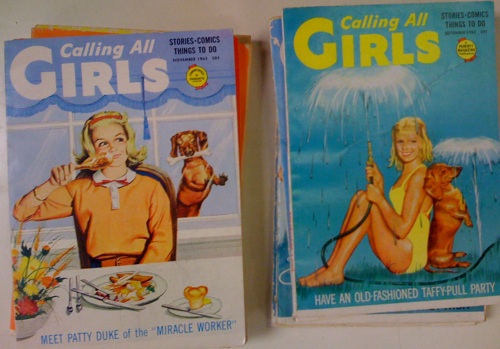
Here’s a collection of “Calling all Girls” magazines from decades past. Each of them features a delightfully cute dachshund, making for quite the little gender studies project, if one wished.

There’s also wonderful headlines like “How to lose weight and enjoy it!” and “How do you rate as a spectator?”

Ah, feminism. Where were you then?

(via Draplin)

Newspaper death watch: Rocky road edition

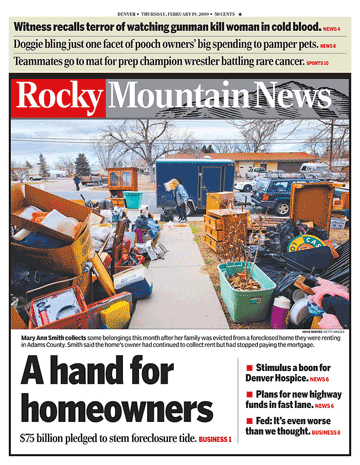
Closed. The Rocky Mountain News finds itself in the same position as the homeowners it recently reported on.

Closed. The Rocky Mountain News finds itself in the same position as the homeowners it recently reported on.

It was a long and winding road for Colorado’s oldest newspaper, the 150-years-young Rocky Mountain News. But in the end, they just couldn’t go on any longer.

The paper’s owner, Scripps, has announced that, unable to find a buyer, the doors on the Rocky will be closed for good Friday.

It’s tough times for the industry, sure, but I had kind of high hopes for the Rocky. According to their own story on the closure:

In the past decade, the Rocky has won four Pulitzer Prizes, more than all but a handful of American papers. Its sports section was named one of the 10 best in the nation this week. Its business section was cited by the Society of American Business Editors and Writers as one of the best in the country last year. And its photo staff is regularly listed among the best in the nation when the top 10 photo newspapers are judged.

The paper was one of the first to shrink to a tabloid size, in 1942, and it slimmed down dramatically in 2007, as well, moving to an almost magazine-like size, with lots of bold colour and photography.

The content was strong, and the presentation was impeccable. Just leaf through some of their front pages here.

Unfortunately, Denver’s a two-newspaper town, and that town just ain’t big enough for the both of them anymore. Don’t think that the Denver Post is going to be happy to see them go, though: in a bid to save money, the two newspapers have been sharing business services — from advertising to a printing press — for eight years.

The Post, by the way, recently wrangled wage and benefit concessions of nearly 12% from its unions, to try and save that business.

I remain confident that, when the dust settles, there will still be professional journalism, but we’re really witnessing a shakeup in the industry, and a lot of babies are being thrown out with the bathwater.

Sure, I killed my parents, but that was before I became a reality TV star!

Cyril Jacquet

Who vets reality TV contestants? Because a simple Internet search might have saved the producers of the Spanish-language version of The Amazing Race from a bit of embarrassment: seems one of their stars is a convicted murderer. When he was 15, he shot his mother to death, then waited at home for a few hours until he could empty the clip into his dad. As a juvenile, he served 3 years, and has a clean record.

The New York Times has a pretty good roundup of this developing gossip-scandal:

In an interview with the show’s host, Mr. Jacquet blamed “the media” for his troubles, and refused to elaborate on the murders, since, he said, that would only help the press in their “lynching” of him. He told the Spanish public that he is now happy with his life, and “my past is buried.”

Pretty poor word choices, methinks.

Newspaper death watch: Lazarus edition

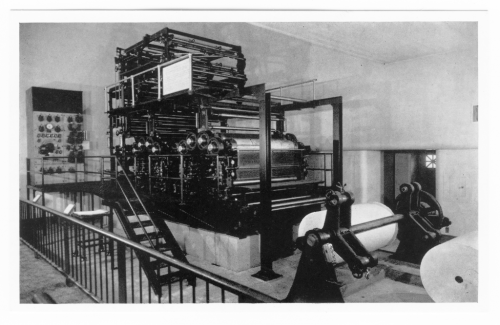
Ah, 1950s-vintage newspaper presses. Will someday the journalism business model be looked back at with as much nostalgia? (Image from the Chicago Postcard Museum.)

Ah, 1950s-vintage newspaper presses. Will someday the journalism business model be looked back at with as much nostalgia? (Image from the Chicago Postcard Museum.)

Everybody seems to be jumping on board the latest save-all-newspapers idea, which is to take them private and raise money as a charitable foundation so that they can live off a beefy endowment.

I can’t remember where I first heard the idea, but I do know that the St. Petersburg (Fla.) Times works on exactly that model, being funded by the non-profit Poynter Institute.

Now, it’s being pitched in the pages of the New York Times:

How large an endowment would a newspaper need? The news-gathering operations at The New York Times cost a little more than $200 million a year. Assuming some additional outlay for overhead, it would require an endowment of approximately $5 billion (assuming a 5 percent annual payout rate). Newspapers with smaller newsrooms would require smaller endowments.

Yikes! But not an impossible amount, I suppose. There’s a similar argument being made in the New Yorker, too, regarding specifically the Washington Post, with smaller (but still huge) numbers. Even snarky Gawker is on board.

I worry that this NPR-style business model would lead to newspaper pledge drives with crappy merchandise, but the flip side of that is perhaps your subscription could be written off?

Like endowed universities, which still charge tuition fees, non-profit newspapers might be able to earn money from other areas, but it seems like they would have to drop the advertising once and for all. I’ve argued before that, for readers, advertising is valued content, but I’m not sure how an ad-sales paper meshes with a public-service endowment paper.

Thoughts?

Dansette