Posts tagged: economics

Stephen Harper is scamming us

Stephen Harper, the “right honourable” Prime Minister of Canada, is acting a bit like a street criminal. No, he’s not actually stealing or dealing drugs or anything — he’s much too crafty for that. No, Stephen Harper is the guy causing the diversion while other people do the dirty work.

Look, we had to prorogue Parliament so that the government could “recalibrate,” right? We had to take a big long break so that everyone on the Conservative side could work real hard and get things ready for this Very Important Budget. We couldn’t afford distractions. Everything needed to be just right.

And what do we get? Oh, a very important budget, for sure. And a very important Throne Speech. So important that, boiled down to their essence, they say “No real changes. Nothing to see here.” It’s a mild-right budget, and the biggest changes are hinted at as coming next year, not this.

So why did we need to prorogue? Well, that’s an inconvenient question, isn’t it. Let’s distract people — let’s change the national anthem and introduce plastic money!

Do you realize what’s going on? Despite the merits of both ideas — I’m a fan — these are not real issues. These are distractions. These are the political equivalent of Stephen Harper flashing his boobs at you, while his boyfriend picks your pocket.

Why would he want to do this? Because some people are already sussing out what’s hidden in the budget’s fine print — and it’s not all good. In fact, cutting the deficit too early, which is what this budget is all about, is a classic way to create what they call a “double-dip” recession. Canada mostly avoided the first dip, so why are we so eager to get on the runaway train towards Part 2?

Oh, who knows — let’s all ogle the PM with his shirt up, over there.

Aw, heck, let’s take a closer look at both of those boobs of an idea that he’s waving in our faces.

1. Change the national anthem so that it’s less sexist.

This is a great idea — can we also get rid of the reference to God? How about the phrase “home and native land” as well? What about recent immigrants, aren’t they Canadian? And I’m sick of aboriginal protesters saying “home ON native land” every time there’s a territorial dispute.

Some more changes I’d like to see, if we’re going to open up this Pandora’s box: a) get rid of the “thee” and “thy” language; b) in fact, all the tortured phrasing is pretty flowery, and smacks of ivory-tower intellectual elitism; c) why does only the True North get a shout out? d) in such a short song, we sure to repeat “stand on guard for thee” a lot — more variety!

Oh, and it’s nice that we have an English and a French and a hybrid version. Let’s get the translators working on more, though. Why can’t we have semi-official Mandarin, Spanish and Ojibway versions?

(Curtis at Endless Spin has a nice look at how awful some other national anthems are, if we judge them by the sexist yardstick.)

2. Plastic money

Awesome idea — it’s cleaner, lasts longer and lets you do funky things like see-through spaces. It’s also damn tough to counterfeit. We should have done it years ago, when Australia did. But, if we’re really going to start making cash out of plastic, better get ready for a barrage of op-ed columns that make faux-insight about our “petro-dollar.”

Anyway, here’s the rub — I thought this was going to be a budget about innovation. That’s what the Throne Speech trumpeted. So why are we taking an admittedly innovative idea (plastic money) and outsourcing it to an Australian company?

We have a fantastic Royal Canadian Mint — which produces currency for Canada and a number of other counties. They even made the Olympic medals. Can’t we invest in a machine to make plastic money, as well?

Nevermind, let’s outsource those jobs.

Look — boobs!
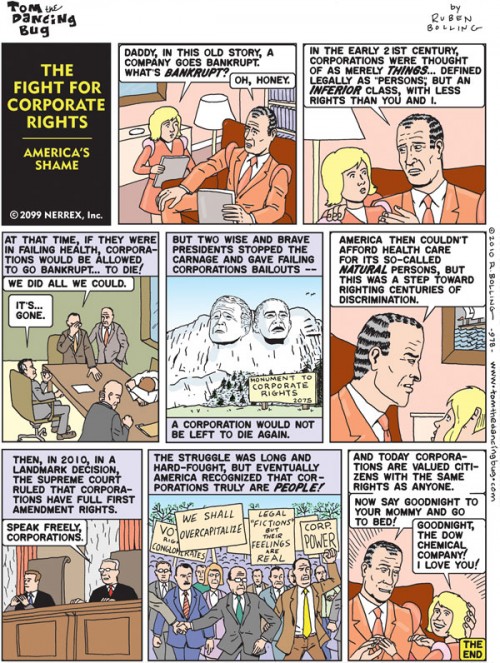
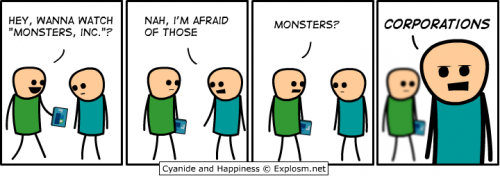
Corporations: Legal fictions, but their feelings are real

The whole thought of corporations being granted more and more civil rights just rubs me the wrong way. While I understand the utility of the limited-liability corporation and the fact that a company can get things done and can organize productive labour in a way that’s more efficient than individually possible, I just can’t articulate how frustrated it makes me when people seem to think that an economic “good” is the only thing that’s good.

I’m glad that I’m not alone in this. For example, I present to you a “Tom the Dancing Bug” comic strip, which I read in Salon:

And, after a friend of mine posted Sully from “Monsters, Inc” as his Facebook doppelgänger last week, I dug up this strip, too:

In Detroit, a house completely encased in ice

Wow — a group of artists in Detroit (where the foreclosure crisis is at its worst) are working to enclose a house completely in ice.

When you talk about “frozen” assets, you’re talking about money and possessions that you can’t use. This makes a legal and economic term absolutely physically real.

They’re getting positive reactions from the neighbourhood, as this video makes clear:

Check out the Ice House Detroit blog here.

Now I don’t know how to feel about the possibility of an economic meltdown.

The surprising truth about IKEA’s ownership

I have a meh relationship with Ikea. Their furniture can be pretty good, and their accessories are often fantastic, with great prices, but I hate that you have to spend a whole day going through the full store before you can buy anything. I don’t really mind the flat-pack and home setup, though.

Never have I considered their ownership structure before. I suppose I just assumed they were structure like any other large store — either they were privately owned, or they were publicly traded.

Well, according to this damning report in The Economist, the answer is neither.

Surprisingly, Ikea appears to be “owned” by a charitable foundation. According to the Economist, it’s a very private foundation, but it’s almost certainly the world’s richest, with several billion dollars more in assets than the Bill and Melinda Gates Foundation.

Unfortunately, it gives out barely any more — instead, hoarding all the cash that Ikea makes in this tax-free “charity” and investing it, in case Ikea later needs the money.

Read the whole thing here, and then see how you feel about “Scandinavian designs at Asian prices”

(Note: the Economist story is a few years old, but I doubt much has changed. I found it using GiveMeSomethingToRead.com)

A stock market bubble, played out in a school cafeteria

I’m kind of a sucker for the kid-with-a-criminal-streak-earns-brief-notoriety-then-comeuppance tales. There was a good one in Infinite Jest, where secondary character Tiny Ewell is revealed to have been the brief mastermind of, then the embezzeler from, a gang of youthful toughs.

But I also got a kick out of one that was printed today in the New York Times.

Writer Joshua Bearman had, in some ways, a similar childhood to mine. He was forced to take *shudder* nutritious lunches to school, while all his classmates had delicious candy.

Bearman, though, found a loophole that I never did — “selling” his classmates on the promise of future treats in return for snacks now.

Give it a read: “My half-baked bubble“

How to work for minimum wage — and tax free!

(minwagebackground18

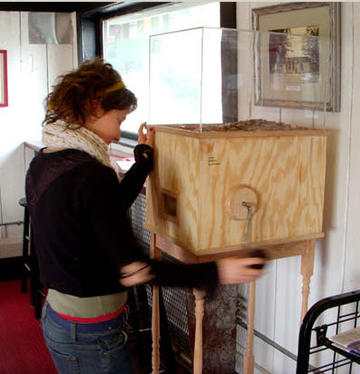
This art project made me laugh with recognition. Not only does it capture busy-work essence of most minimum-wage jobs, it really makes the point of how low-paying they are:

The minimum wage machine allows anybody to work for minimum wage. Turning the crank will yield one penny every 5.04 seconds, for $7.15 an hour (NY state minimum wage). If the participant stops turning the crank, they stop receiving money. The machine’s mechanism and electronics are powered by the hand crank, and pennies are stored in a plexiglas box.

Now, some quick back-of-the-envelope calculations:

Poverty activists where I am have long been agitating for a $10/hour minimum wage. That would be 1,000 pennies per hour. But, because there are 3,600 seconds in every hour, that’s still only a penny every 3.6 seconds. Try cranking that crank for a minute and a half, and I’ll bet it seems like the longest minute a a half of your life. Also, congratulations, you’ll have earned a whole quarter.

(via Boingboing)

Why the Twitter valuation is valueless

So Twitter, which has basically nothing in the way of revenue — at least nothing that I can see — is managing to raise $100 million dollars from venture capitalists who are betting that they can find a way to turn Twitter users into cash flow.

Does this remind anyone of the tech bubble at all, here?

Anyway, these investors are committing $100 million, and they are offering a “valuation” of Twitter that’s in about $1 billion. Which means their $100 million buys them about 10% of Twitter. Good for them.

But, this is problematic, because who is out there with hundreds of millions of dollars, clamouring to buy the other 90% of Twitter?

Or, to take the tack that 37signals is taking:

37signals is now a $100 billion dollar company, according to a group of investors who have agreed to purchase 0.000000001% of the company in exchange for $1.

In order to increase the value of the company, 37signals has decided to stop generating revenues. “When it comes to valuation, making money is a real obstacle. Our profitability has been a real drag on our valuation,” said Mr. Fried. “Once you have profits, it’s impossible to just make stuff up. That’s why we’re switching to a ‘freeconomics’ model. We’ll give away everything for free and let the market speculate about how much money we could make if we wanted to make money. That way, the sky’s the limit!”

Too funny.

So, who wants to make Absurd Intellectual an absolutely absurd valuation? After all, if you give me just a single, flat dime in exhange for 0.00000000000000000000000000000000000000000000000000000000000000001% of the blog, then I’ll be the richest damn person ever. On paper, anyway.

How about starting a bank?

Matt Mullenweg is one of the founders of Wordpress, the software platform that powers this blog — and many others.

But if he wasn’t working on Wordpress all the time, what would he be doing? He says, maybe he’d start a bank:

The name of my bank would be something supremely boring, like SafeBank. The idea behind it is that bad behaviour in the banking world has been largely inevitable because their compensation structures incented people to do overly risky things. SafeBank would maintain a reserve level 2-3x higher than Fed requirements and any other bank. SafeBank would have no bonuses. Critics would say this would make it impossible to attract top-shelf talent. Every time the bank gets attacked we’d turn it into an advertising opportunity to emphasize why we’re different. “We can’t attract top-shelf talent? We take your money and put it in a vault. We don’t need the million-dollar bonus geniuses on Wall Street to do that. SafeBank. Bank, safe.”

Drawing on the ethos of open-source and the software startup industry, Mullenweg says that he would grow his bank slowly and organically, but expects it would reach a tipping point where it would start to put pressure on the big banks to reign in their worst practices.

The bank would make money through data-mining, though even he expresses some discomfort from the privacy implications of some of that. Why couldn’t it just lend money at fair rates, the same way banks used to?

Aside from the fact that “SafeBank” wouldn’t have any bricks-and-mortar outlets, being an online-only entity, it strikes me as pretty similar in ethics to the way banks used to be.

Sounds like an interesting idea — I wonder if anyone will run with it. If you’re interested in it at all, go read the rest of his post — he’s got it seriously thought-out.

Better than casinos — Colorado tribe invests in algae biofuel

When it comes to economic development, I think Aboroginals/First Nations/Indians are hamstrung pretty badly. At least in Canada (I’m not 100% up on the American situation), I know that native tribes don’t actually own the land their reserves are situated on, and their types of business/industry are restricted.

Unfortunately, a lot of bands turn to casinos, which we could argue about all day, but which I don’t think are the magical money machines they’re made out to be. That’s especially true if you happen to be a remotely-located tribe.

However, the Southern Ute Indian Tribe, perched on top of massive coal and natural-gas deposits, is investing their efforts in a slightly different direction — renewable energy. From a story in the New York Times:

[The tribe] had to surmount many hurdles to find an alternative energy idea it considered suitable.

For example, any project that would displace land used for growing food was tossed out for philosophical reasons: the Southern Utes’ belief that energy and food should not compete in a world where people still starve. That eliminated discussion of corn-based ethanol.

And whatever was chosen had to be at least technically feasible, if not immediately profitable.

So they’ve turned to a University of Colorado startup that is trying to turn algae into vegetable-oil fuel. Plus, with an algae tank located next to a tribal natural-gas facility, they’re able to use waste heat and waste carbon dioxide to warm and feed the algae.

This is exactly the type of win-win-win situation that I love to hear about. Iron Eyes Cody, dry your tears.

Swoopo just might be an evil eBay

If you know what’s good for your pocketbook, you will not ever go shopping at Swoopo. It bills itself as “entertainment shopping” so that should be your first warning.

Your second should be the fact that, even though it looks like an auction site akin to eBay, there is a significant difference — you have to pay to play.

That’s right, on the Canadian version, each bid costs you 65 cents. (It’s a slightly different amount in different countries, but the idea is the same). So, the deals look great — I’m looking at a $1,900 laptop that’s going for less than $50 right now — but every time you want to make a bid, it costs you that 65 cents.

Also, depending on the auction, each bid only raises the price by a penny or two. So that laptop looks pretty enticing at $50, but if you click “bid” then it’s just going to go up to $50.02″ — and it’ll look pretty enticing to everyone else out there, too.

Also, each bid adds to time to the auction, so you can, uh, swoop in at the last minute and steal an auction. Nope, you have to bid and bid — at 65 cents each click — until everyone else decides that they’ve sunk too much money into it.

But here’s the insidious part: make 15 or 20 bids on an item, and suddenly you’ve got real money invested in it. And if you don’t win the auction, you’re still out the money — money that you don’t get back.

An article on Slate-associated The Big Money likens it to crack cocaine, and does a pretty good job of explaining it:

Consider the MacBook Pro that Swoopo sold on Sunday for that $35.86. Swoopo lists its suggested retail price at $1,799; judging by the specs, you can actually get a similar one online from Apple for $1,349, but let’s not quibble. Either way, it’s a heck of a discount. But now look at what the bidding fee does. For each “bid” the price of the computer goes up by a penny and Swoopo collects 60 cents. To get up to $35.86, it takes, yes, an incredible 3,585 bids, for each of which Swoopo gets its fee. That means that before selling this computer, Swoopo took in $2,151 in bidding fees. Yikes.

Something tells me I’m on the wrong side of the equation here.

Get into the movie business — for $50, you can be a producer

Brian Carroll is making a movie. Okay, he’s also a comic artist and he’s been making movies for 10 years, but now he wants to make a real feature film — with a budget of a quarter-million dollars.

That sounds like nothing for a movie, but it’s still a substantial amount of money. So, to fundraise, he’s selling shares in the movie — 5,000 at $50 apiece. Somehow, he guarantees that you’ll make your money back even if he doesn’t finish the movie, and even if it doesn’t sell, he’s pledging to pay you back within three years.

Frankly, that part sounds fishy — or over-optimistic.

I tried to check out some of his “investor graphs” and other documents, but in between me opening his website in a new tab (a couple of days ago) and blogging about it (today), the site’s gone haywire. According to what’s up there now, he raised over $18,000 in 24 hours — far above what he was prepared for. So, the site’s down for a bit, until he gets everything sorted out. He also mentions something about running stuff past a lawyer, which somehow both worries and alarms me.

I have high hopes for these sorts of microfinanced projects — I think there was an amateur Star Trek production done along these lines? — and I hope this works out. I’d check back in a couple of days to read what he has to say.

In the meantime, think about it. Fifty bucks is what you might drop on a night out where you have a couple too many drinks. It’s not an obscene amount of money. It’s not an unreasonable amount to spend. So if it’s burning a hole in your pocket, it might be okay to finance a film with it.

(Other microfinance projects tend to be third-world and “green” development projects, which is cool, too, but I like the idea of financing someone’s movie or music or TV dream — creating something that’s between Big Hollywood and Amateur YouTube.)

Another thing you could consider is buying into this film as a gift for someone.

Here’s a clip of a movie he made before, so you know what he’s capable of:

If you’re paid in gold, do you have to pay taxes?

Here’s an interesting anti-tax strategy: A Las Vegas man has been paying his employees in gold coin. Because the coins have a face value that is less than their actual worth (because pure gold is so valuable) they are claiming that they don’t have to pay tax, since the face value is so low.

I’ll explain that better: The Canadian Mint is selling a “50-cent” coin made of pure gold. But, if you click on that link, you’ll see that they’re selling it for $100. So if you’re owed a $500 paycheque, and you get handed five of those gold coins, let’s say you’d be satisfied. And, since they are technically 50-cent coins, you could claim that you really only earned $2.50.

The government begs to differ, and wants its back taxes.

Now, I’m not up on the Las Vegas or U.S. tax code, but if the gold-laden employees wanted to buy, you know, food and stuff with the hard-earned precious metals, presumably they’d have to sell it for real currency. And wouldn’t they need to claim the “profit” they made selling a 50-cent coin for $100 as a taxable income?

Perhaps that would be akin to the Canadian capital gains tax, and maybe it’s a lower rate than the income tax?

At any rate, it’s the government (through the mint) that decides a $100 coin is only going to be “worth” 50 cents, so it’s their fault, right?

After all, I pay taxes on the face value of the $500 I earn, not the worthless piece of paper the paycheque is printed on. So shouldn’t it work the other way around?

Or think about this: What if my boss was a celebrity — say Brad Pitt. And for some reason, he insists on paying me with personal cheques. So, on each of my paycheques, I also have a valuable autograph. After I cash them, I can also sell them on eBay. Should I be including that in my income tax?

I don’t know — I’ll be watching to see what the judge says, that’s for sure.

There’s some weirdness out there in the coin world, I’ll tell you. Just browsing on the Royal Canadian Mint site, I found that they offer a $4 silver coin for $43, which makes the gold 50-cent one look like a bargain! But check this out: they also offer a triangular coin (shaped kind of like a guitar pick) with a face value of 50 cents and a price of $35. And a hologram. Yes, a freaking hologram in the coin.

Oh, and a couple of years ago, they poured a 100-kilogram gold coin (the world’s largest) that’s got a face value of $1 million, and they were selling it for nearly three times that much.

Perhaps we know what happened to the missing gold? They probably used it up making coins in the shape of a Mobius strip, with a face value of eleventeen.

But here’s a video if you like gold coins:

Markets are great at telling us the price of things, but poor at telling us their value

Now this is an interesting read, if you’ve got some time on your hands, and aren’t looking for anything light. Despite the collapse of markets this year and last, there’s a still a deep-seated bias among people to ask that government work like a business, and to assign costs or incentives to things, then to arrange it so a market develops, which will magically produce the most-efficient result.

Well, maybe. Of course, this assumes that everything is priced correctly: think about greenhouse gas emissions, which are “free” (despite some carbon tax schemes) but come at a cost to the environment that isn’t accounted for in the market.

Market acolytes would tell you just to modify your assigned prices and incentives, and you’ll get a better and more efficient market. The problem isn’t the market, the problem is you.

Michael Sandel makes a convincing point that maybe markets don’t have all the answers after all — even if they’re set up perfectly. He looks at the case of kids being paid to read books:

While some children may be motivated to read books for the love of learning, others may not. So why not use money to add a further incentive? Economic reasoning would suggest that two incentives work better than one, but it could turn out that the monetary incentive undermines the intrinsic one …. The obvious worry is that the payment may habituate children to think of reading books as a way of making money, and so erode or crowd out or corrupt the intrinsic good of reading

That’s not all. He also talks about how market-lovers just can’t see that their way of looking at the world isn’t always the best. And says that some things are better off without having a monetary value assigned to them:

Some of the good things in life are corrupted or degraded if turned into commodities, so to decide when to use markets, it’s not enough to think about efficiency; we have also to decide how to value the goods in question. Health, education, national defence, criminal justice, environmental protection and so on - these are moral and political questions, not merely economic ones.

I’ve linked above to a partial transcript of an original BBC interview, which I am *really* looking forward to listening to, at some point.

Water-based computer calculates everything an economy needs

watermachine

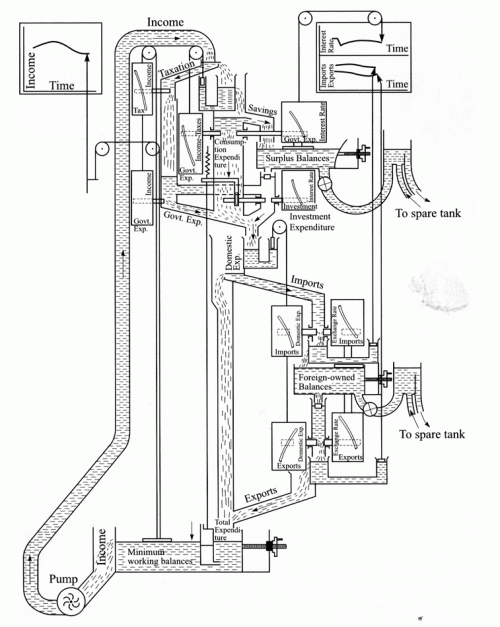
A blog post at the New York Times points me in the direction of the “Phillips machine.” Using water in place of cash, it is an intricate assembly of pumps, pipes and valves, mimicking the economy. But it’s not just a Rube Goldberg machine — it actually works! By adjusting various gates and flows, you can make the machine predict what would happen if you, say, raised or lowered interest rates. Or if you increased the money supply. Or changed the taxation rate — or any other of a dozen or more variables.

It was incredible for its time (it was unveiled in 1949) and it’s still pretty neat to think about.

You could easily write a computer program to do this today, but there’s something so visceral about seeing actual water flow which makes this better. Says the New York Times:

Though it’s tempting to view the Phillips machine as a relic of a bygone era, in one way it’s just the opposite; there’s something about it as fresh as the day it began gurgling. Look at its plumbing diagram. It’s a network of dynamic feedback loops. In this sense the Phillips machine foreshadowed one of the most central challenges in science today: the quest to decipher and control the complex, interconnected systems that pervade our lives.

Here’s a video of it, in action.

How would you define “money”?

banknotes

Wikipedia, from where I pulled that image above, has a medium-length article devoted to the concept of money. But a new blog at the New York Times is looking for a slightly snappier definition.

The blog is called “Vocab,” and I’ve been following it irreguarly since it started up just about a month ago. I recommend it, if you like words, as I do.

The latest entry asks readers to submit new definitions of the word “money”. As inspiration, the blog cites:

The 19th-century penny weekly “Tit-Bits” ran irregular competitions asking its readers to define various words. (The winning definition of a kiss, for example, was “An insipid and tasteless morsel, which becomes delicious and delectable in proportion as it is flavored with love.”)

How cute! I’ve been rabidly following the entrants for “money,” but many people seem to be ignoring the one stipulation: that the pithier, the better. Many of the definitions are over-involved. I’ve seen two, so far, that I really love, though:

  • Money — Faith-based publishing.
  • Money — Metadata about value.

Love it!

Dansette