Click to continue reading “Fun with numerological illiteracy”
A pilot neatly punctures 9/11 hysteria
“Newsflash,” writes professional airline pilot Patrick Smith, “Deadly terrorism existed before 9/11″. And I can’t think of a better way to get you to read his Salon column than to excerpt the first few paragraphs:
Here’s a scenario:
Middle Eastern terrorists hijack a U.S. jetliner bound for Italy. A two-week drama ensues in which the plane’s occupants are split into groups and held hostage in secret locations in Lebanon and Syria.
While this drama is unfolding, another group of terrorists detonates a bomb in the luggage hold of a 747 over the North Atlantic, killing more than 300 people.
Not long afterward, terrorists kill 19 people and wound more than a hundred others in coordinated attacks at European airport ticket counters.
A few months later, a U.S. airliner is bombed over Greece, killing four passengers.
Five months after that, another U.S. airliner is stormed by heavily armed terrorists at the airport in Karachi, Pakistan, killing at least 20 people and wounding 150 more.
Things are quiet for a while, until two years later when a 747 bound for New York is blown up over Europe killing 270 passengers and crew.
Nine months from then, a French airliner en route to Paris is bombed over Africa, killing 170 people from 17 countries.
That’s a pretty macabre fantasy, no? A worst-case war-game scenario for the CIA? A script for the End Times? Except, of course, that everything above actually happened, in a four-year span between 1985 and 1989.
Can you imagine the national meltdown if that happened now?
Now, if you need even more perspective, consider this:
how far are we willing to go to prevent weapons or bombs from getting on airplanes? In the past decade, terrorists on airplanes have killed just about 3,000 people — all on one day. Even if the Christmas Day bomber had succeeded, the number would be under 3,500.
Those are horrible deaths. But in that same period, more than 150,000 people have been murdered in the United States. We haven’t put the entire U.S. on lockdown — or even murder capitals like Detroit, New Orleans and Baltimore.
While reducing the murder rate to zero is very desirable, we also understand that the costs, in terms of liberty and resources, are too great.
That’s from a Washington Examiner article that (ahem) examines to what extent the airport nudie scanners are ineffective yet make some lobbyists a very large amount of money.
I haven’t yet had the opportunity to choose the train or car instead of the plane, in order to avoid intrusive security practices, but I’m seriously considering a trip to Europe via boat — half because I’ve always wanted to, half in the vain hope that I’d get profiled anecdotally as part of a bogus trend story.
Dumb: FDA threatens to ban alcoholic drinks with caffeine
Well, this just makes them look stupid. The U.S. Food and Drug Administration says that it has never sanctioned the sale of alcoholic drinks with caffeine in them, and, responding to a request from 19 state attorney-generals, the FDA, has sent a warning to manufacturers.
From this New York Times story — and from the original press release on the FDA web site — it’s clear that the organization is targeting energy-style drinks with alcohol added. The FDA says:
In the past year, Anheuser-Busch and Miller agreed to discontinue their popular caffeinated alcoholic beverages, Tilt and Bud Extra and Sparks, and agreed to not produce any caffeinated alcoholic beverages in the future.
The Times adds:
And MillerCoors agreed to stop selling its product Sparks. The brands under scrutiny — which include Joose from United Brands and Four from Phusion Projects — are being marketed to young people with social marketing tools.
However nobody seems to be asking the real question:
Why is this an issue at all? Haven’t we been drinking rum-and-Cokes for, well, over a century? I don’t know why it’s legal to sell Coke and rum, and to mix them together and then sell that product in a bar, but it somehow falls under the aegis of the FDA when caffeine is added to a cooler?
Why the Twitter valuation is valueless
So Twitter, which has basically nothing in the way of revenue — at least nothing that I can see — is managing to raise $100 million dollars from venture capitalists who are betting that they can find a way to turn Twitter users into cash flow.
Does this remind anyone of the tech bubble at all, here?
Anyway, these investors are committing $100 million, and they are offering a “valuation” of Twitter that’s in about $1 billion. Which means their $100 million buys them about 10% of Twitter. Good for them.
But, this is problematic, because who is out there with hundreds of millions of dollars, clamouring to buy the other 90% of Twitter?
Or, to take the tack that 37signals is taking:
37signals is now a $100 billion dollar company, according to a group of investors who have agreed to purchase 0.000000001% of the company in exchange for $1.
…
In order to increase the value of the company, 37signals has decided to stop generating revenues. “When it comes to valuation, making money is a real obstacle. Our profitability has been a real drag on our valuation,” said Mr. Fried. “Once you have profits, it’s impossible to just make stuff up. That’s why we’re switching to a ‘freeconomics’ model. We’ll give away everything for free and let the market speculate about how much money we could make if we wanted to make money. That way, the sky’s the limit!”
Too funny.
So, who wants to make Absurd Intellectual an absolutely absurd valuation? After all, if you give me just a single, flat dime in exhange for 0.00000000000000000000000000000000000000000000000000000000000000001% of the blog, then I’ll be the richest damn person ever. On paper, anyway.
Hint to companies: Give me a reason to do your bidding, not a threat
I recently signed up for online billing with my American Express card — and I do almost all my day-to-day banking online — but I’m often loathe to do so.
This story in the New York Times gives some of the same reasons that I have: I worry about missing a bill, I don’t want to have to go to 50 websites for all my bills, and there’s just something reassuring about the tangibility of a paper bill.
I finally caved with American Express mostly to get rid of the annoying nag screens every time I went to check my balance online, but the Times story irks me so much, I might go and sign up for a paper bill again:
In August, T-Mobile got serious about paperless billing. It started charging a $1.50 monthly fee on all accounts that continued to receive a paper bill.
In the story, it’s said that T-Mobile will “only talk of trees to be saved, not dollars,” but they send out 16.5 million invoices a month, so multiply that by paper, envelopes and stamps, and you’re into the big bucks for sure. It’s a no-brainer for a company that wants to save money.
But charging your customers $1.50 for a service you promised them for free? Especially when it’s a bill?! No wonder there’s a backlash! (The Times story mentions a class-action lawsuit.)
So here’s a hint, to any companies looking to save money by going paperless:
We consumers know that you’re saving money. Pass those savings on to me! Give me a dollar off my bill, and I’ll switch to paperless in a flat-out instant.
Geez, it’s obvious.
Is there an app for turning on your brain again?
Uh-oh. I’ve made fun of the endless stream of “there’s an app for that” products for a while, but life is beginning to imitate humour just a little too much for my taste.
First, I saw this intelligent post over on Boing Boing Gadgets about how blogger Lisa Katayama lost her mind to her GPS:
I started to forget how to get places without it. The map in my brain became a distorted blur. And then my driving became more reckless. I invented this game where I tried to beat the estimated arrival time that the GPS gave me. Often, that entailed running yellow lights and exceeding the speed limit. Sometimes, the GPS fell off of its suction cup on the windshield and onto the floor, and I would have to fumble around with my right hand while steering the wheel and shifting gears with my left.
The string of comments is insightful — people comment that with cell phones, they no longer need to remember phone numbers, they no longer recall birthdays thanks to Facebook, even simple math is a skill that’s being forgotten. “Technology makes us lazy and dumb in specific ways so that we can (theoretically) use that brain-space for something else. Doesn’t always work that way,” says one.
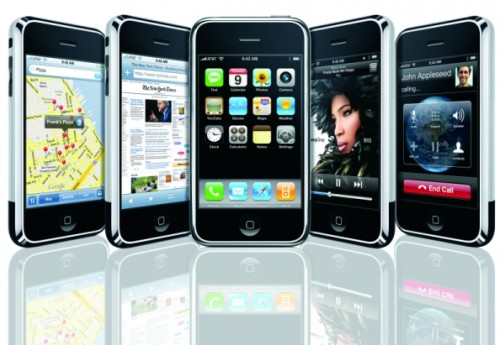
Of course, this has been an argument since at least the invention of the pocket calculator. But I think the smartphone explosion — characterized by the iPhone, though not exclusively Apple’s fault — has really exacerbated the issue.
Because just now I read this little vignette:
“I’m running an app on my iPhone that tells me how much I can drink before I get into my car. And the lady behind the bar has poured you 8 ounces, not 6.”
“So you trust your iPhone to tell you precisely when to stop?” I asked.
“Oh, yeah. I also run a calorie app,” said Oliver, a little too enthusiastically.
“What’s a calorie app?” I said, dumbly.
“It’s an app that tells me exactly how much I should eat every day,” he replied. “But it’s a bit of a problem to be honest, because when it tells me I’m 300 calories under my limit, I then order a dessert, even though I don’t actually feel like eating a dessert.”
“So you let these apps tell you what to do and how to live?” I asked, feeling a weird frown forming above my shades. “Don’t you realize that half of this techy stuff was designed by people who barely see the light of day, adore only numbers and secretly want you to be a little more like them?”