Posts tagged: depressing

This is what we call cognitive dissonance — too bad it’s in Congress

I like Gail Collins normally, but this time she really nails it: Apparently Congress is ready to strip suspected terrorists of their Miranda rights, their citizenship, their right to fly and their privacy — but not their right to buy guns.

“I think you’re going too far here,” said Senator Lindsey Graham of South Carolina at a hearing of the Senate Homeland Security Committee on Wednesday. He was speaking in opposition to a bill that would keep people on the F.B.I. terrorist watch list from buying guns and explosives.

Say what?

Yes, if you are on the terrorist watch list, the authorities can keep you from getting on a plane but not from purchasing an AK-47. … People who are perfectly happy to let the government wiretap phones go nuts when the government wants to keep track of weapons permits.

*head-slap*

Read her full column here.

Sure, you have the option, but we’re going to make it difficult to figure out

Have you ever been confronted by a choice that you had to read three or five time in order to figure out?

If you suspect that sometimes, the question is deliberately confusing, so that you might make the “wrong” choice by accident, you are probably right.

Now there’s a term for it: An Evil Interface.

An evil interface means “the act of creating deliberately confusing jargon and user-interfaces which trick your users into sharing more info about themselves than they really want to.” according to this post on the EFF site.

Facebook is notorious for confusing and misleading “privacy” options — options that you have to check and re-check every time they alter something. Other examples of evil interfaces may include “aggressive pop-up ads, malware that masquerades as anti-virus software, and pre-checked checkboxes for unwanted “special offers”" says the EFF.

Do I have plenty to say about this? Yes. But for now I just wanted to throw that term out there.

No, you don’t need that

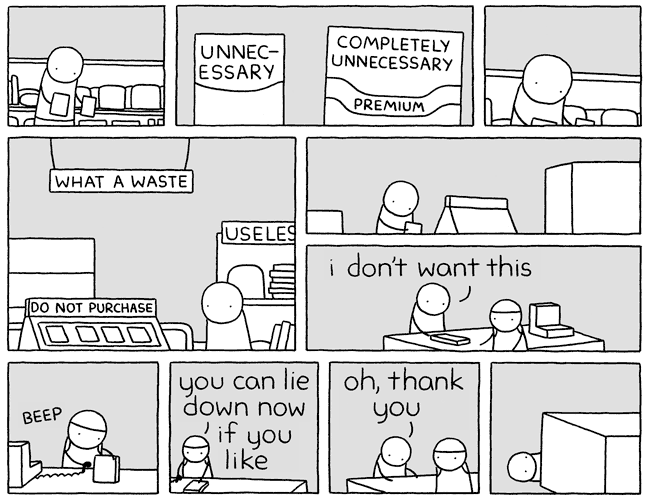
Speaking of advertising, we all know that it’s whole purpose is to make you want to buy something. So what if you don’t need that something? Well, effective advertising creates a need.

So what about the cognitive dissonance that erupts when you realize that these artificial needs don’t actually fill a void in your life?

This is the latest Pictures For Sad Children strip — a site I’ve just discovered, thanks to The Daily What.

Kind of reminds me of They Live (classic clip).

The ‘Twilight’ of an historic town

I have never read the “Twilight ” series of books and never intend to. Normally, I would say that makes me unqualified to criticize.

But when fiction spills out into the real world, then, then I can criticize freely. And I would like to start off by saying that I think Stephanie Meyer and her legions of fans are wrecking parts of that real world.

In the series, Meyer chose to make the home of the vampires the real-life town of Volterra. Now, the town has found itself besieged by fans of the book (and the movie, filmed nearby) who want to see where Edward lived.

Der Speigel has a story about it, but in short, they’re whoring themselves out, with tours and tours and tours. Not everyone’s happy, and some in the town think they can bait-and-switch the girls, offering a little culture with the vampire schtick, and hoping that the culture is what’ll stick.

Who knows. But what I do know is that this line in the story made me very sad:

Since Volterra has no train station, they come from nearby Florence or Siena by bus and carve “Edward Forever!” into the walls while laughing giddily.

Sigh. I may have been just as obsessed with “Lord of the Rings” as any teen girl is with “Twilight.” But I don’t recall desecrating any druid burrows by carving my own runes into them at the time.

Google enters the uncanny valley

When dealing with computer-animated characters, there’s an interesting psychological effect in the viewer. Poorly drawn or rendered characters end up looking like cartoons, even if they are still recognizable as “people.” Really photorealistic characters look, well, almost real.

But somewhere in the middle lies the uncanny valley. When something looks almost real, but not quite, it creeps people out. If it looks less real, they breathe a sigh of relief and think “cartoon.” If it looks more real, they think “well, this is real.”

But if something’s off, and they can’t quite put their finger on it, people just get the heebie-jeebies.

I’m going to theorize that the same thing holds true in other realms, and to prove it, I will present to you, via Gizmodo, the latest incarnation of Google Earth, featuring New York City in near-perfect 3-D rendering:

I haven’t exactly been able to figure out why, but it creeps me out. I love Google maps and even Street View — even zooming in close on my own home. But this is almost too much.

And yet, I’ve also seen much better zooms in television shows and movies, where they actually zoom in and show things perfectly, so there aren’t flat cars on the streets, for example.

In between, in the uncanny valley, is this new Google Earth.

But perhaps I’m just in an uber-creeped-out frame of mind already, because I just learned that IBM wants to make Minority Report come to life, with its advanced “crime prediction” software.

Stats on air marshals are eye-popping

There was an incident involving air marshals yesterday night — a suspicious man was confronted, there was chatter about him “lighting his shoe” and military jets were scrambled to shadow the jet, which eventually landed safely in Denver.

The story emerging today is that it was a diplomat from Qatar, who wanted to sneak a cigarette in the bathroom, and claimed he had diplomatic immunity to do so. According to this New York Times story, the Qatari made “sarcastic comments that the marshals took as a threat.”

My first thought: No way was anything threatened except the authority and egos of the marshals. Despite someone breaking the rules, I very seriously doubt that anyone thought this was a legit terror threat.

But now I’m thinking maybe the air marshal authority should be challenged. Boing Boing points me to a statement made by U.S. Congressman John J. Duncan Jr. (R-Tenn.) — a politician that they describe as a “paleoconservative Republican.” He’s calling for the abolition of the air marshal service.

Why? How about because it costs $860 million a year to send 4,000 air marshals on their flights. Number of arrests since the program started? About 4.2 a year.

Yes, you read that right. It takes 1,000 people and $200 million to arrest a single person — and those are mainly rowdy drunks that, in previous years, passengers and airline employees would have been able to handle. I mean, it’s not like they have weapons, right? They don’t even have metal utensils.

Worse? As Duncan points out, there have been more air marshals arrested — for things like smuggling, domestic violence and drunk driving — than arrests they have made.

Duncan quotes Professor Ian Lustick of the University of Pennsylvania:

“Nearly 7 years after September 11, 2001,” he wrote this last year, “what accounts for the vast discrepancy between the terrorist threat facing America and the scale of our response? Why, absent any evidence of a serious terror threat, is a war to on terror so enormous, so all-encompassing, and still expanding? The fundamental answer is that al Qaeda’s most important accomplishment was not to hijack our planes but to hijack our political system.”

Local TV news contains only seconds of news every half-hour

Television stations in the United States get exclusive access to their frequencies so that they can broadcast news and entertainment. But they’re supposed to be acting in “the public interest” in return for that largess. Are they?

A study by the Norman Lear Center took a look, studying 11,000 stories on eight local television stations in L.A. over two whole weeks. They found that most of each 30-minute newscast was “frittered away,” in the words of one commenter. Strip out the ads, the weather, the sports and there’s not much left. Local government issues, for example, get a mere 22 seconds per half hour.

Here’s one video that takes an overview of the study:

The FCC Commissioner, commenting on the study, said that he was “flat out alarmed.”

Read more about it on the Norman Lear Center’s page — including the study itself and several more videos. As you can imagine, it’s gotten plenty of coverage in the non-television media, but I found about it on the L.A. Times, where columnist James Rainey was biting in his assessment that “local news is neither very local nor very newsy”:

You’re sure to learn about the Guitar Hero championships. (Slammin’ video. No analysis required.) But don’t expect to find out much about who’s running for Assembly or just how much library hours will be reduced by the latest city budget cuts. …

Try to recall an evening newscast that didn’t include an animal in a predicament or at least one story gift-wrapped in yellow police tape. A regular diet of this stuff might reasonably have you cowering in your house. Never mind that statistics (so meddlesome, those numbers that provide context) show crime in fairly sharp decline in recent years. …

The sports guy gets ever more jocular. And the weather gal never wants for time to show the latest cutoff low on the map in her latest low-cut top. …

As USC released the study last week, former KCBS reporter Bob Jimenez derided the way local news operations wallow in a culture of “kicks, guts and orgasms at 11.”

Rainey also dug into the files that local TV stations are required to submit to the FCC, files that are supposed to show how they are acting in the public interest, by covering important stories. Well, the stories that the stations deem as locally important and in the public interest are laughable. Or would be, if it weren’t so sad.

Save the newspaper?

Oh dear. Isn’t there some sort of famous saying, where once they start making fun of your plight, you’ve lost all sympathy?

(via BB)

Look at this beer coaster

Just look at it:

Yes, that’s a beer coaster. And yes, it’s an advertisement.

Okay, I’m used to beer coasters that are ads for, you know, beer. Or pubs or something. Or even public service announcements telling me to call a cab or to wear a condom.

But this, I’m guessing as part of a run-up to Valentine’s Day, is an ad for a local jeweler. And this beer coaster incorporates a ring sizing chart.

Now, not to be churlish, I actually have no idea what my ring size is, and it’s kind of cool to know. I might appreciate some kind of placemat that also doubled as a hat-size indicator. But this ring sizer isn’t aimed at me. In case you can’t read it, let me tell you what it says:

Deluxe Combination
Ring Sizer / Coaster
Let him know your
ring size, and leave
the rest to us.

That’s right, ladies, if you want to wear a band of domesticity, your future mate is likely too thick-skulled to realize it on his own. Hint, hint and hint until he finally caves and buys you the symbol of him love.

I’m just surprised that it doesn’t have a diamond quality chart on the reverse, along with an inflated “How else can 72 months’ salary last forever?” slogan.

Corporations: Legal fictions, but their feelings are real

The whole thought of corporations being granted more and more civil rights just rubs me the wrong way. While I understand the utility of the limited-liability corporation and the fact that a company can get things done and can organize productive labour in a way that’s more efficient than individually possible, I just can’t articulate how frustrated it makes me when people seem to think that an economic “good” is the only thing that’s good.

I’m glad that I’m not alone in this. For example, I present to you a “Tom the Dancing Bug” comic strip, which I read in Salon:

And, after a friend of mine posted Sully from “Monsters, Inc” as his Facebook doppelgänger last week, I dug up this strip, too:

Democracy’s next step — for corporations

Murray Hill — Incorporated — is running for Congress.

If you really love him, say it with syrup

This video was a little too on-the-money when it comes to advertising that tries to get you to consume high-calorie, high-fructose, high-salt, high-fat, high-profit processed foodstuffs.

I read somewhere the other day that, even though millions of people go hungry every day, millions more are obese. As a planet, we produce something like 4,000 calories per person per day — or, twice as much food as the planet needs. Unfortunately, ads like the ones spoofed in this video encourage such overeating that we end up with not enough to go around.

But who am I to talk. I just came back from the gym, where I pedalled a bike for half an hour, feeling guilty because my “lunch” had been the remains of a bag of Joe’s Tasty Travels Toasted Praline Almonds (full list of ingredients: almonds, sugar). The kicker is that, on the back, under the depressing Nutrition Facts box, it says “Packed By: Downright Healthy Foods L.P., Toronto.”

Feeling down in the dumps today? Here’s why

Welcome to “Blue Monday” — officially, the most depressing day of the year. From the Daily Mail:

A combination of Arctic temperatures, Christmas debt and the next pay day feeling like it’s months away leaves many of us depressed and unable to face work.

They cite a study conducted by a company that helps companies battle absenteeism.

Well, I dunno about you-all, but I’m feeling great! It’s my Friday, I’m looking forward to three mild days off, I got a bit of a promotion at one of my jobs, the days are getting longer each and every morning, and things are just ticking into place!

But if you’ve been stricken by the Blue Monday blues, I’m happy* to head out for a pint with you.

*(tee hee!)

School over-reaction both depressing and ironic

I came across a story on Boing Boing that was equal parts depressing and ironic.

Depressing: The vice-principal of a San Diego school called in the bomb squad after seeing a student’s science project, fearing that it was dangerous.

Ironic: The school is Millennial Tech Magnet Middle School, which emphasizes technological skills.

This incident seems to highlight both the ridiculous paranoia taking over our culture, and the obliviousness some educators seem to have concerning what their students are doing.

Even more depressing? This quote from the story from Sign on San Diego:

The student will not be prosecuted, but authorities were recommending that he and his parents get counseling, the spokesman said.

Yes, let’s discourage the kid from creating more science projects by telling him he needs counseling, for, you know creating something for the school that emphasizes technology.

Best jobs, worst jobs

Check out a list in the Wall Street Journal, which has 200 jobs, ranked from “best” to “worst.” It’s good news if you’re an actuary, very bad news if you’re a roustabout.

Actually, they have a surprisingly detailed methodology on the CareerCast.com site, where the study comes from.

I can’t find “Journalist” or “Blogger” anywhere on the list (they must be #201 and #202 - ha!) but there’s loads of interesting comparisons.

For example, “Author (books)” ranks #74 — just above “Hotel manager.”

Pity the poor “Photojournalist” though, who comes in a lowly #189. That’s 12th-worst. Oops, there’s “Reporter (newspaper)” at #184. Yikes. The difference between a Photojournalist and a Reporter? Apparently, “Firefighter,” “Sheet Metal Worker,” “Emergency Medical Technician” and “Stevedore.”

Depressingly, “Nuclear Decontamination Technician” comes in at a relatively lofty #165.

Dansette