Posts tagged: history

A subway for the cows

Gothamist has a great story, um, digging into the rumour that there exist hidden tunnels underneath New York City that exist solely for the purpose of herding cattle. Yes, you heard me right:

According to Edible Geography, historian Betty Fussel discovered that cattle traffic was so heavy in the 1870s that a tunnel was built to increase the flow to slaughterhouses along 12th Avenue and 34th Street. The underground passages were eventually made redundant when refrigerated train cars were introduced, but they’re rumored to still be there!

There’s one reference to the tunnel from 1997, when author Brian Wiprud wrote about “watching a crew install a drainage basin on Greenwich Street when they came upon a wall of wood about ten feet down. A laborer went into the hole with a torch and came out saying it was an oak-vaulted tunnel ten feet wide by eight feet high that trailed off an undetermined distance in either direction. It was then that an old man from the neighborhood stepped up to the trench and said, ‘Why, I see you found the cattle tunnel.’”

An “oak-vaulted tunnel ten feet wide by eight feet high” which may run for several blocks would certainly, I think, become a major tourist attraction. Cities like Moose Jaw (the Tunnels of Moose Jaw and their tenuous connection to Al Capone) and Seattle (tired of the flooding, the city raised the streets a full storey, turning first-floor display windows into basements) have already capitalized on underground attractions.

New York City, by the way, ha had recent success turning an abandoned elevated rail track into a park (the High Line), so one wag on the Gothamist site suggested turning these tunnels into the “Low Line” — which is doubly funny when you think of cows lowing.

Urban exploration of this sort has long fascinated me. I remember living in Toronto and never quite finding the time to go looking for one of its famed, forgotten subway stations. I regret now that I never did.

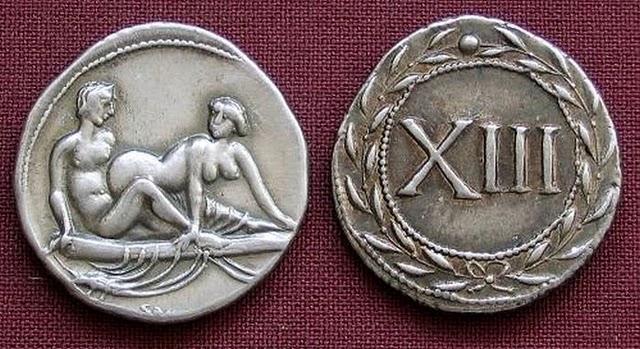
Brothel tokens from ancient Rome

These tokens are from ancient Rome, and they’re called spintriae. They were only manufactured for a few years (perhaps as few as 15) in the first century, and they have no real intrinsic value, being made from brass or bronze.

Oh, and they depict sexual activity, rather than the more-common profile of an emperor. View a gallery of them here.

All of that leads many people to believe that they were used as “tokens” in Roman brothels — you pay the cashier, then redeem your coupon upstairs.

But not everyone agrees. Both Salon and Cecil at the Straight Dope point to an influential 2007 essay by Geoffrey Fishburn called “Is that a spintriae in your pocket, or are you just pleased to see me?” (pdf).

I read it, and he makes some interesting points — there’s no evidence of Romans having a token-based sub-economy in any area, let alone brothels; there’s no real correlation between the numbers on one side of the coin and the acts depicted on the other; Romans didn’t have the same hangups about sex that we do, so the coins may not mean much of anything; and frankly, it’s so far back in time that we may never be able to definitively say what they were for.

In fact, they were so cheaply made that they may have just been intended as slightly titillating amusements — and they’re still good at that.

So let’s take a page from the Roman playbook. Here’s my modest proposal: Next time the Mint wants to do a commemorative run of quarters, why not the Kama Sutra edition?

So maybe the Bible did have it right

Let’s gather up a bunch of (seemingly) random scientific discoveries to see what we can make of them:

  1. Paleoclimatologists have discovered physical evidence of a shift in climate in Egypt that took place during the reign of Pharoh Ramses II.
  2. One of the biggest volcanic eruptions in human history took place around 3,500 years ago when Thera on Santorini exploded.
  3. The city of Pi-Rameses, which was the capital of Egypt during the reign of Pharaoh Rameses II, seems to have been abandoned around 3,000 years ago.

Three bits of information for which there is valid, verifiable, physical evidence. Compare these against the story of the Biblical plagues of Egypt.

According to Exodus, there were plagues of blood, frogs, lice, flies, livestock death, boils, hail, locusts, darkness and the death of the firstborn. In that order. All in all, it doesn’t sound like much of a good time.

When the climate changed all those millenia ago, there would have been consequences for the Nile:

The rising temperatures could have caused the river Nile to dry up, turning the fast flowing river that was Egypt’s lifeline into a slow moving and muddy watercourse.

Slow-moving, warm water is the ideal environment for Oscillatoria rubescens, also known as Burgundy Blood algae. When this algae dies, it stains the water red and could have easily given rise to the story of the first plague wherein the waters of the Nile turned to blood.

The scientists also claim the arrival of this algae set in motion the events that led to the second, third and forth plagues – frogs, lice and flies.

Frogs development from tadpoles into fully formed adults is governed by hormones that can speed up their development in times of stress.

The arrival of the toxic algae would have triggered such a transformation and forced the frogs to leave the water where they lived.

But as the frogs died, it would have meant that mosquitoes, flies and other insects would have flourished without the predators to keep their numbers under control.

Right, so that accounts for plagues two through four. With a rising insect population and unhealthy water, is it any mystery about dying livestock and boils? Insects are well-known carriers of all manners of disease and a polluted water source would have only compounded the problem. That solves plagues five and six.

So far, all the plagues have been a logical, biological, progressive cahin of events springing from a documented climate change. What about the rest of them? That’s where the volcanic eruption of Thera comes in.

One of the biggest volcanic eruptions in human history occurred when Thera, a volcano that was part of the Mediterranean islands of Santorini, just north of Crete, exploded around 3,500 year ago, spewing billions of tons of volcanic ash into the atmosphere.

Nadine von Blohm, from the Institute for Atmospheric Physics in Germany, has been conducting experiments on how hailstorms form and believes that the volcanic ash could have clashed with thunderstorms above Egypt to produce dramatic hail storms.

The documented eruption of a volcano thus accounts for the plague of hail. Now we might seem to be stymied. The next plague — that of locusts — surely can’t be tied to a volcano. Or can it?

Apparently, it can. The ash in the atmosphere would have contributed to more climatic changes, exactly the sort that create the conditions needed for locusts. Additionally, the ash clouds could have contributed to the plague of darkness.

All that’s left is the plague of the death of the first borns. Which, to me, doesn’t sound like a plague. If it is, it’s a heck of a specific one. Nonetheless, if we assume this “plague” also occured, we can hypothesize that what with the bad water and crazy weather, a blight or fungus or something could have affected the crops.

Culturally speaking, it would have been the male first born that would have first shot at the produce and, thus, been the first to fall afoul of the nasty whatever it was.

If, as some scholars believe, the plagues we centered around Pi-Rameses, we can certainly understand why the city was abandoned. It wasn’t like the place was a barrel of laughs 3,000 years ago.

(All quotes and most details from this article in the Telegraph)
The Second World War — as if it were conducted via Facebook

This is both really creative and really funny, but it is also really long, so I’ve hidden the whole image after the jump.

Click to see!

Read more »

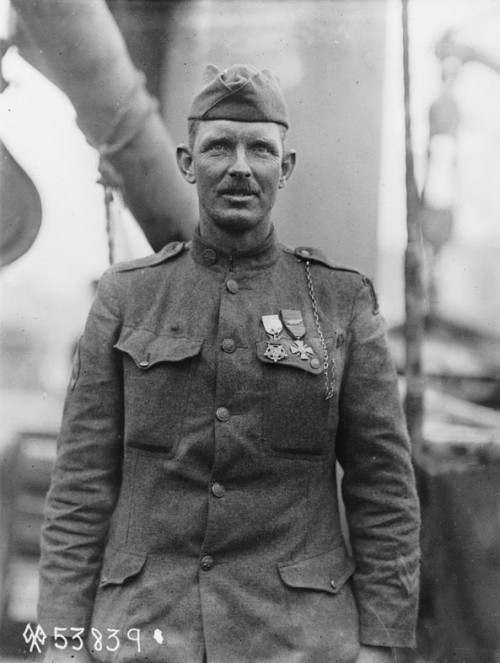
Alvin York, the man who could not get shot

In all actuality, during WWI, Sgt. Alvin York stood every chance of getting shot but somehow managed to avoid dying by gunfire. Sure, this might describe hundreds, if not thousands, of WWI soldiers, but how many of themsingle-handedly captured 132 German soldiers at once?

Born and raised in Tennessee, York spent his youth in the mountains with a gun, probably shooting at anything that moved. It was time that could be considered well-spent when he found himself, in the war, part of an offensive in France aimed at breaching the German lines.

The Germans attacked York’s unit, killing most of them, leaving only a few soldiers guarding some prisoners (and unable to engage in battle) and Sgt. York. York, in an exposed position, was faced with over 100 Germans attacking him and him alone.

Rather than curling up into the fetal position and waiting for his ultimate end, as most of us would likely do, York manned up.

Lying down on the ground, he began to systematically pick off the machine gunners that were pinning him down. Whenever he saw a head, he made it a target. Eventually, a number of soldiers decided to attack him with their bayonets. As they charged, York drew his service pistol and started to shoot the enemy combatants bearing down on him. Relying on his experience turkey-hunting, he shot the soldiers at the back of the line, so as not to alert the one in front that they were running out of comrades.

Eventually, York began to call for the enemy’s surrender. If they shot at him instead, he would pick them off sharp-shooter style. In the end, they began to surrender.

As he was marching his prisoners back through the German lines (they were some ways behind them), other German soldiers, believing there were more forces surrounding them, began to surrender as well.

There’s lots more to the story, but it’s a Friday and you get the idea. You can read York on Wikipedia (obviously) or at Today I Found Out (which includes the story in York’s own words).

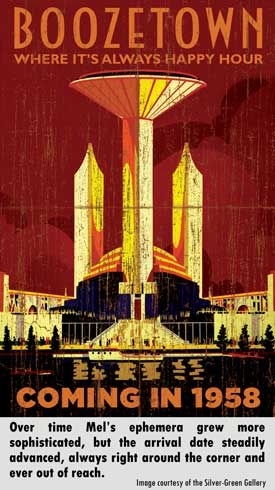
Can you tell me how to get to … Boozetown?

You’re sitting at a table with a number of other potential investors. As it’s 1952, you’re probably a man and so are all the other Mad Men-attired individuals. All of you are listening to Mel Johnson give his pitch:

Just imagine, he asks his audience, a resort entirely centered on the culture of alcohol. A boozer’s paradise built expressly to facilitate drinking and the good times that naturally follow. Where the bars, clubs and liquor stores never close. Where the police force is there to help drunks, not hassle them. Where even the street names salute sweet mother booze: Gin Lane, Bourbon Boulevard and Scotch Street. An adult playground like no other. Just imagine.

Johnson loved the drinking culture and travelled the world to experience it. As much as he enjoyed his adventures, he never found the one place that was it. The one perfect location where everyone could enjoy their drink and everything involved in the occassion. Thus, Johnson decided, a city devoted solely to drinking would have to be built.

At the end of 1950, Mel was a man obsessed. Made restless by his extensive post-war travels, he spent every waking hour sketching in the details of his dream. First, of course, he’d need to put a name to his drunkard homeland. He considered many possibilities, including El Dorado, Boozeville and Lush Land, before finally settling on the portmanteau BoozeTown.

During the first stage of BoozeTown’s existence, Johnson envisioned a resort consisting solely of themed bars. His headquarters and home would be a giant martini glass in the middle of the city.

The second stage would entail building an onsite brewery, distillery and perhaps even a winery to supply the many outlets in BoozeTown. Additional infrastructure would be built within the city to help patrons move about. Think moving sidewalks.

Finally, BoozeTown would focus on establishing a permanent population. This new city would surely, according to Johnson, attract artists famous and not-yet-famous alike.

Yes, BoozeTown was to be a drinker’s paradise.

Every bar and liquor store would be open 24 hours a day, seven days a week. Furthermore, you’d have the right to bring your drink with you anywhere you liked, including banks, post offices, and places of worship.

BoozeTown would have its own currency (BoozeBucks), security force (The Party Police) and newspaper (BoozeTown Bugle). There was almost no aspect of BoozeTown that Johnson had not planned for. Unfortunately, he was never able to raised the funds he needed.

By 1960, Johnson completely abandoned his plans for Boozetown.

Two years later, he was hospitalized for paranoid schizophrenia. He died in that same hospital four years after his admittance.

It is said his ghost still haunts the now-abandoned Bartonville Mental Hospital. No word on whether the spectre likes to drink or not.

(Read more about BoozeTown at Modern Drunkard.)

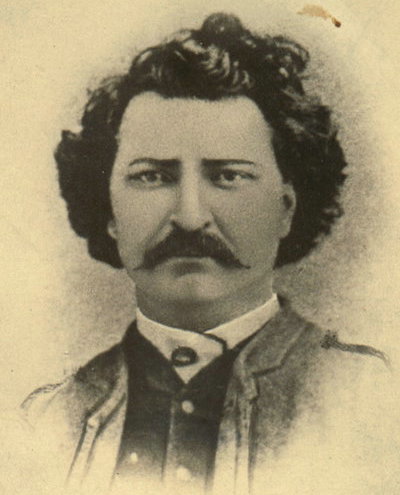
Happy Louis Riel Day

You know, sorry USofAians, but President’s Day is pretty generic. And Family Day is namby-pamby. (Sorry, Alta and Ont, but it is — I mean, could you have been any more pandering?)

But Louis Riel Day has something you can sink your teeth into. Here’s a complex person with a rich and interesting past. Here’s a reason for Manitoban kids to get interested in history — at least a little.

Exile, fugitive, hanged for treason — and elected to Parliament three times, though I don’t think he ever got to go there. That’s Louis Riel.

Last year, I linked to some Louis Riel T-shirts that you could buy, if you’re interested in marking the occasion in sartorial style. But this year I’m going to take a cue from the student newspaper at the local university. In The Quill’s list of the best ways to spend Louis Riel Day, one of the suggestions was “Occupy a case of Fort Garry.”

Now that’s a holiday tradition I can get behind.

History comics way funnier than you would think

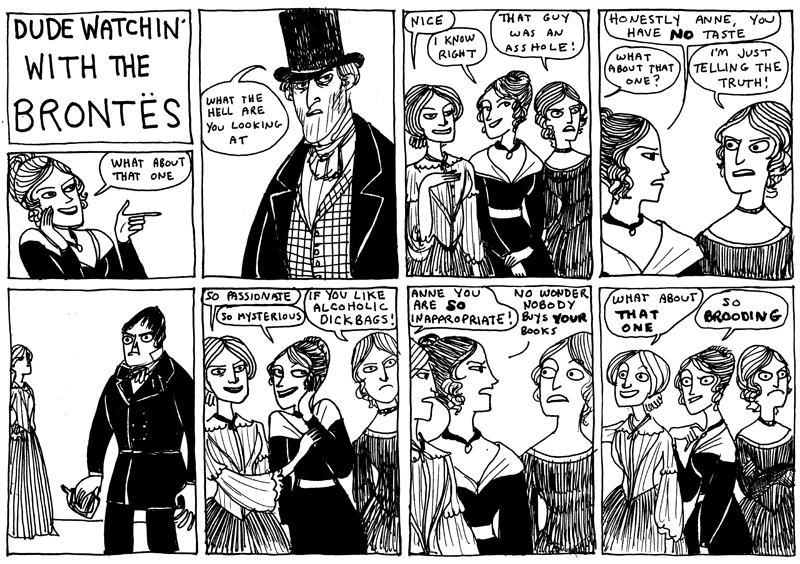
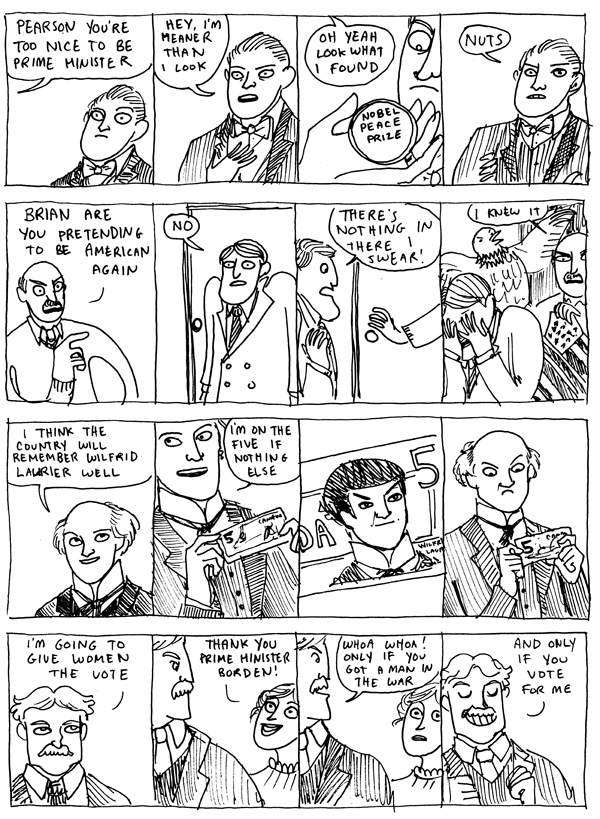
Hark! A Vagrant is a website of comics written and drawn by Kate Beaton. They are irreverent, charming, and often hilarious.

Beaton has a degree in history, and her comics reflect that. They all have something to do with moments in history, or famous people (from Beethoven to to an imagined exchange between Jules Verne and Edgar Allan Poe). I liked this one of the Brontë sisters:

And this one, of Canadian Prime Ministers:

Funny stuff.

RIP Howard Zinn

Howard Zinn died of a heart attack, says his daughter. I hope his legacy, “A Peoples’ History of the United States” lives on.

You owe your life to Stanislav Petrov

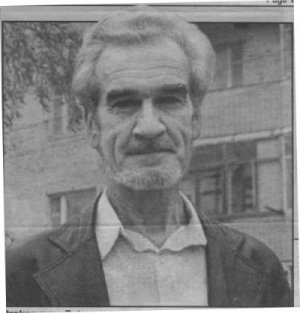
Stanislav Petrov, the unassuming man who saved the world.

You’ve probably never heard of him, but the odds are that you owe your continued existence to Stanislav Petrov. He saved the world. And he did it by (1) thinking, and (2) doing nothing.

It was the depths of the Cold War and tensions were running high between the U.S. and the Soviet Union. About three weeks earlier, on September 1, 1983, the Soviets had mistakenly shot down a Korean passenger plane (KAL Flight 007), killing all 269 people on board including an American politician.

Petrov, a lieutenant colonel with the Soviet military, was in charge of monitoring Soviet satellites watching for American military aggression. On September 23, 1983, while working a double shift, Petrov’s monitoring station went red. The Americans had fired missiles at the Soviet Union.

Protocol stated that Petrov was to push a single red button that would launch a counter-offensive, thereby initiating a full-scale nuclear war. Despite the pressure of the situation, his position and the expectations of those in the bunker with him, Petrov did nothing, reasoning that the “attack” did not make sense.

He was correct. It was a false alarm. Yet, the fate of the world had been held in one man’s hands for those few minutes.

And he was covering another officer’s shift.

(Read more about the situation on Petrov’s wikipedia entry. You probably should, as this post is a bit simplified.)

An Egyptian fascination

As a child, I was entranced by all things Egyptian. In fact, although it isn’t on my list, visiting the pyramids at Giza probably slides in at number 26. Yes, I still retain that little bit of childish enthusiasm for Egyptian history. I mean, I like the history and all, but I don’t read as much about it as I should — we can consider it an attention-deprived interest.

It was, therefore, a bit of a thrill (maybe ‘thrill’ is too strong of a word - let’s say I was titillated) during a recent holiday to an amusement park to walk through a recreation of an Egyptian archeological dig. Being the kind of Dad who will try to find educational aspects even in line for a rollercoaster, I pointed out a jackal-headed statue to my 9 year old. “Check it out,” I said. “That’s one of the Egyptian gods.”

He sighed. “Yes, Dad. That’s Anubis.” Then, pointing to various paintings on the walls, he said “And that’s Thoth. And that’s Ra. And that’s Osiris. I don’t see Isis.” The next few minutes consisted of a lecture on the family tree of Egyptian gods.

“How do you know all this?”

Another long-suffering sigh. “Dad. I’ve only been studying to be an Egyptologist since grade 2.”

“Oh.”

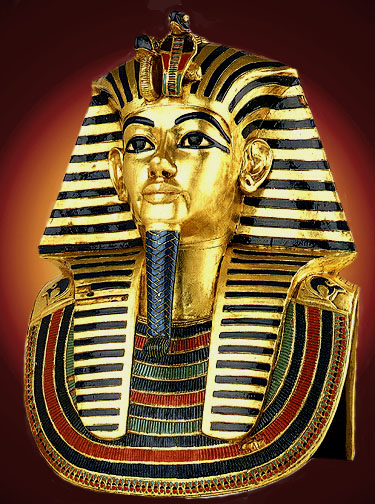
This long-winded story brings me to my point: how cool is it that a bunch of artifacts from King Tut’s tomb are on display in Toronto? Tickets to see these ancient bits of history are surprisingly reasonable and I’m tempted to fly to Toronto for a weekend only to take in the exhibit.

Part of me wonders why I would consider spending a few hundred dollars to see a handful of items that were buried thousands of years ago. The other part of me wonders how much I will regret it if I don’t spend the money.

After all, it is King Tut.

(As a post-script, by writing this posting, I think I’ve talked myself into making the trip.)

The luckiest (?) man on Earth has died

“Lucky” may not be the best word to describe Tsutomu Yamaguchi, but it must apply in some sense of the word. Although “hard to kill” certainly is valid, but even Yamaguchi could not avoid the reaper forever and has died at the age of 93.

What makes Yamaguchi notable is that although others have been identified, he was the only person officially recognized to have survived the atomic bombings of both Hiroshima and Nagasaki.

As the Washington Post explains:

Yamaguchi was in Hiroshima on a business trip for his shipbuilding company on Aug. 6, 1945, when a U.S. B-29 dropped an atomic bomb on the city. He suffered serious burns to his upper body and spent the night in the city.

He then returned to his hometown of Nagasaki, about 300 kilometers (190 miles) southwest, which suffered a second U.S. atomic bomb attack three days later.

Although it is a tragic chapter in modern history, it would have certainly allowed Yamaguchi to place any daily irritations into a perpective very few of us can comprehend.

Scientific papers for the historically-minded, or vice versa

The Royal Society has been publishing scientific papers for almost 350 years, which is a long freaking time. To be more specific, they started publishing in 1665.

To celebrate next year’s big birthday, the Royal Society has launched Trailblazing, an interactive site that includes 60 of the more than 60,000 papers they have published. And these aren’t just any papers — these are truly inspired.

Some examples are:

  • In 1666, the same year as the Great Fire of London, Boyle described the first transfusion of blood. Although his paper described a transfusion between two dogs, it inspired attempts at a transfusion between a sheep and a human. The whole idea was eventually outlawed and it was about 200 years later before it was finally understood and refined.
  • The famous experiment of Ben Franklin’s whereby he flew a kite in an electrical storm took place in 1752. His discoveries led him to invent lightning conductors for tall buildings, saving many from destruction by fire.
  • In 1891, Galton provided a proof that fingerprints were unique and developed a system of classification that is still used by Scotland Yard today.

The best part of this site is that you can download the original articles in PDF format. Thus, if you are into science, history, the history of science or scientific history, I can’t recommend this site enough.

“Yeah, that article about atomic particles in the most recent Nature was alright, but I prefer Paul Dirac’s ‘Spinning Electrons’ article from 1928.”

Old Time WTF?

klanfun

In this day and age, when everyone had a phone with a camera in it or a camera with a phone in it or some other digital doo-dad that includes a phone, it’s no wonder that we see all sorts of strange photos online that make us say WTF? (Except, you know, the full version.)

At WTF Photos from Old Times, there are photos from way back that have a greater WTF factor than almost anything today because they are: (1) so bloody weird and provide absolutely no context; (2) fashion and/or style has changed so much that we simply cannot wrap our heads around what we are seeing; or (3) society has just changed too much.

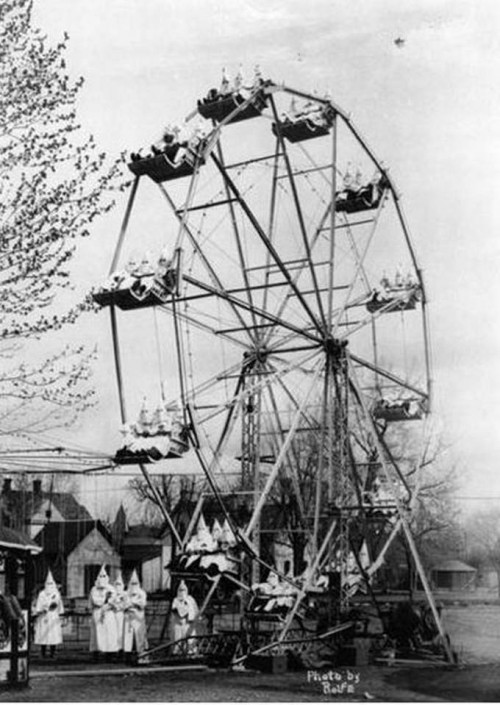
Take the above photo as an example. Who in their right mind today would think to take a picture of a bunch of klansmen out having fun at the county fair? (Ok, maybe some would think of it, but who would actually do it?) And photos of circus freaks simply isn’t politcally correct any more.

All in all, WTF Photos is not only a journey into the weird, but an examination of social change through the ages. (Actually, I just threw that last part in — I’m all about the strange stuff.)

“Mad Jack” Churchill, archer of WW2

"Mad Jack" Churchill can be seen on the right, sword in hand, leading the charge

"Mad Jack" Churchill can be seen on the right, sword in hand, leading the charge

Captain “Mad Jack” Churchill - the only man known to have killed an enemy in WWII with a long bow. Seriously, do I need to follow that up with anything?

Fine. How about a bit of a bio…

Jack Malcolm Thorpe Fleming Churchill was an Englishman born in Hong Kong (1906) who appears to have wished himself Scottish. A life-long soldier, he spent peacetime years bored and mastering the bagpipes.

As soon as Germany invaded Poland and the Second World War was started proper, Churchill enlisted immediately. His eccentricity manifested itself again with his insistence that he always carry a sword, bow and arrows with him into combat. Famously, he once remarked that “any officer who goes into action without his sword is improperly dressed”.

When England put out a call for commandos, Churchill signed on despite not knowing what commandos were. It sounded dangerous and he had heard there would be action — that was good enough for him.

Among his exploits were such scenes as playing the bagpipes from the lead boat landing at a German position in Norway (prior to leading the attack, of course); escaping from a concentration camp, and being the only known soldier to kill an enemy combatant with a bow.

Of particular note in Churchill’s WWII career is one particular raid that took place in 1943. With the assistance of one rifleman (that’s a total of two soldiers for those of you doing the math), Churchill managed to capture 42 prisoners and a mortar squad during the course of one night, walking them out of town the next morning.

When the war in Europe was nearly done, he asked to be redeployed to the Pacific. By the time he arrived, however, the war was over. A soldier through and through, Churchill was not pleased with the end of the war. He is said to have complained: “If it wasn’t for those damn Yanks, we could have kept the war going another 10 years!”

(Lengthier articles about “Mad Jack” Churchill can be found at Damn Interesting and Wikipedia.)

Dansette