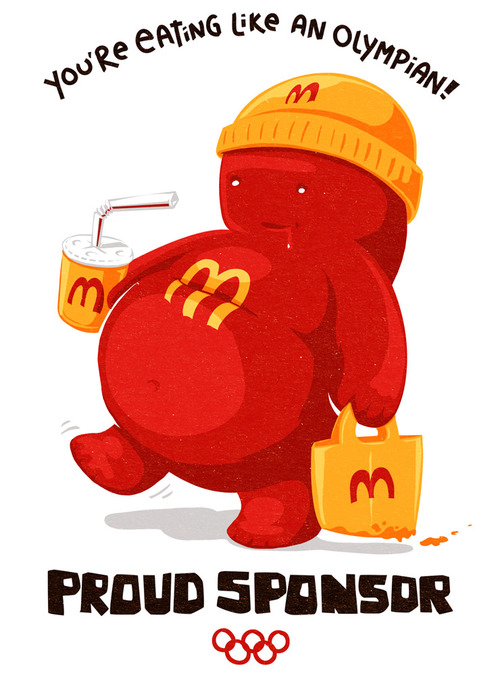
I’ve always found it sort of sad that the Olympics are brought to you by mega corporate sponsorship in the first place, but the choices of some of the sponsors are so at odds with the pure athletic lifestyle that it’s even worse than sad, somehow. And perfectly summed up in this hilarious image from The Daily What.
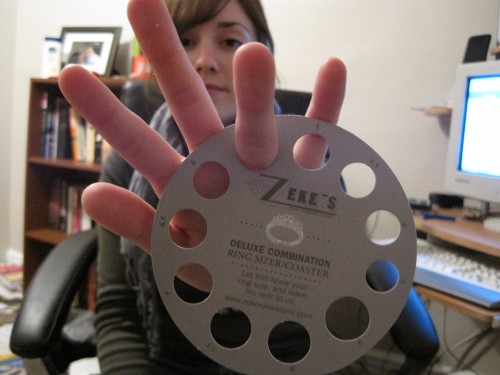
Yes, that’s a beer coaster. And yes, it’s an advertisement.
Okay, I’m used to beer coasters that are ads for, you know, beer. Or pubs or something. Or even public service announcements telling me to call a cab or to wear a condom.
But this, I’m guessing as part of a run-up to Valentine’s Day, is an ad for a local jeweler. And this beer coaster incorporates a ring sizing chart.
Now, not to be churlish, I actually have no idea what my ring size is, and it’s kind of cool to know. I might appreciate some kind of placemat that also doubled as a hat-size indicator. But this ring sizer isn’t aimed at me. In case you can’t read it, let me tell you what it says:
Deluxe Combination
Ring Sizer / Coaster
Let him know your
ring size, and leave
the rest to us.
That’s right, ladies, if you want to wear a band of domesticity, your future mate is likely too thick-skulled to realize it on his own. Hint, hint and hint until he finally caves and buys you the symbol of him love.
I’m just surprised that it doesn’t have a diamond quality chart on the reverse, along with an inflated “How else can 72 months’ salary last forever?” slogan.
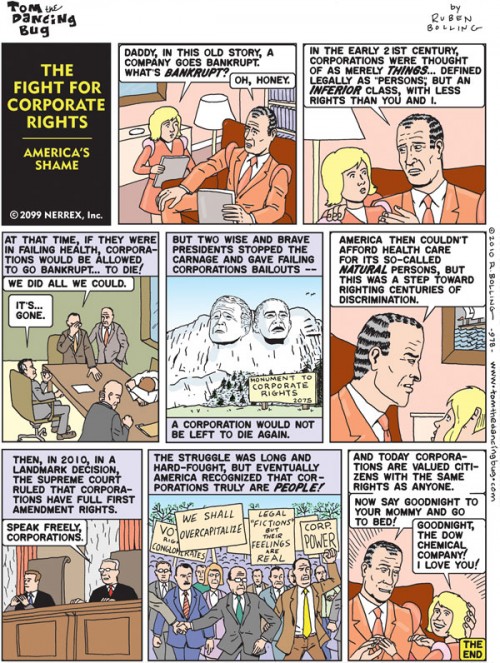
The whole thought of corporations being granted more and more civil rights just rubs me the wrong way. While I understand the utility of the limited-liability corporation and the fact that a company can get things done and can organize productive labour in a way that’s more efficient than individually possible, I just can’t articulate how frustrated it makes me when people seem to think that an economic “good” is the only thing that’s good.
I’m glad that I’m not alone in this. For example, I present to you a “Tom the Dancing Bug” comic strip, which I read in Salon:
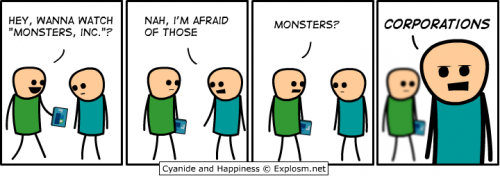
And, after a friend of mine posted Sully from “Monsters, Inc” as his Facebook doppelgänger last week, I dug up this strip, too:
Snowed: Deceptive Advertising by Ski Resorts, by two Dartmouth College economics profs, shows that ski resorts in the U.S. inflated their snowfall amounts near weekends, when they thought they could attract more skiers. Ski resorts that were closest to population centres, and therefore had the most to gain, inflated their numbers the most. Weather Service data doesn’t show a “weekend effect” that would explain the resorts’ numbers.
According to Zinman, resorts reported 23 percent more snow on weekends. And the resorts that had the most to gain by fluffing up their numbers did more of it.
According to Zinman, resorts with more people living within driving distance inflated their numbers more, as did resorts that don’t offer money-back guarantees.
The researchers didn’t single out specific resorts in their report, choosing instead to make broad statements about the industry as a whole.
Most interestingly, half way through their study, they watched as a new iPhone app was released, which allowed skiers on the slopes to report numbers back themselves. What happened? Suddenly caught, the ski resorts immediately stopped inflating their numbers.
“I am so proud to announce my new partnership with Polaroid as the creative director and inventor of specialty projects,” said Lady Gaga. “The Haus of Gaga has been developing prototypes in the vein of fashion/technology/photography innovation-blending the iconic history of Polaroid and instant film with the digital era-and we are excited to collaborate on these ventures with the Polaroid brand. Lifestyle, music, art, fashion: I am so excited to extend myself behind the scenes as a designer, and to as my father puts it-finally, have a real job.”
“Lady Gaga’s broad creative talents and the way she connects with her fans in her own, unique manner made her a natural choice for Polaroid,” said Stephen Miller, co-CEO of PLR IP Holdings. “Polaroid has had a special connection with its customers for years, we are delighted to be partnering with Lady Gaga to continue with that tradition and bring new and exciting products to the next generation.”
If you cut through the media-release-ese, what you get is:
Lady Gaga: Polaroid is paying me big bucks because I’m relevant and ‘today’ while they may as well be making horseshoes.
Polaroid: Our core product is so obsolete, we shut down the factory, leaving us nothing except our brand in the digital era. Lady Gaga, herself, if pretty much all brand. We see this as “hitching our wagon to a winning horse,” to use a horseshoe metaphor ourselves.
Look for cross-branded products in late 2010. Now, will they be called “Gagaroid” or “Polagag”?
I have a meh relationship with Ikea. Their furniture can be pretty good, and their accessories are often fantastic, with great prices, but I hate that you have to spend a whole day going through the full store before you can buy anything. I don’t really mind the flat-pack and home setup, though.
Never have I considered their ownership structure before. I suppose I just assumed they were structure like any other large store — either they were privately owned, or they were publicly traded.
Well, according to this damning report in The Economist, the answer is neither.
Surprisingly, Ikea appears to be “owned” by a charitable foundation. According to the Economist, it’s a very private foundation, but it’s almost certainly the world’s richest, with several billion dollars more in assets than the Bill and Melinda Gates Foundation.
Unfortunately, it gives out barely any more — instead, hoarding all the cash that Ikea makes in this tax-free “charity” and investing it, in case Ikea later needs the money.
Read the whole thing here, and then see how you feel about “Scandinavian designs at Asian prices”
(Note: the Economist story is a few years old, but I doubt much has changed. I found it using GiveMeSomethingToRead.com)
Check out this blog, WTFComcast, which is dedicated to posting snapshots of movie descriptions from Comcast’s on-demand service. Except, the movie descriptions are clearly written by someone with:
a) a personality
b) a sense of humour
So it’s downright weird that it would come through on a corporate screen like this:
Part of the attraction here (aside from the humourous movie descriptions) is the sense of wonder I get. Like watching Philippe Petit dance across a dangerous tightrope, you’re rooting for this anonymous reviewer, but you just can’t help but dread it ending badly.
And if/when this blog ever goes silent, you’ll be left with an unanswered question: was the reviewer reprimanded? fired? Or did corporate culture finally grind all sense of personality away, leaving just an office drone.
Good luck, if you think the future of magazines is this touchscreen uber-Kindle. Of course, it might be exactly like this. Except there will be ads you can’t fast-forward through. And you’re going to have to watch that cover animation EVERY SINGLE TIME YOU LOAD THE ISSUE, just like the start of a DVD.
And speaking of DVDs, I hope you like opening a magazine and clicking through multiple pages of copyright notices that can’t be ignored. And “special offers” for other magazines by the same publisher.
And every time a friend shares an article with you, I hope you love the legalese that “Sports Illustrated does not endorse the opinions that may be emailed herein.”
Also, if it is exactly like this, with this much content, and this little annoyance, and this few ads … well, I hope you like paying $500 a month for your magazine.
I was absolutely enthralled when Amy showed me the latest Toshiba commercial, which features an ordinary-looking chair, hitched to a weather balloon and sent to the edge of space. Watch it below — and stay past the product ID for the heart-stopping finale:
I’ve watched it now easily a dozen times — and it never stops giving me a thrill at the sense of possibility that it embodies.
So much was I interested in it that I found and watched a “making of” video, too. Although a lot of blogs cite the facts given in the Toshiba press release (it reached 98,268 feet (about 18.6 miles), and hit -90 degrees, using eight cameras, weighing four pounds, it took 83 minutes to go up, and 24 minutes to come back down) there was some other interesting info in the making-of:
Wow — that rig fell for 24 minutes, reaching a speed of Mach 1, and they managed to get HD footage out of the wreckage? I’m guessing it was a solid-state flash drive.
I was seriously impressed.
Then I saw this — an art project by Simon Faithfull from 2004:
I’m not the first to notice the similarity. This site quotes a Toshiba marketing manager as saying that Faithfull was involved from the start as “absoutely part of the team.” But his answers get a little weaker when he’s asked how a “a company which prides itself on innovation align [can] its slogan with a project that is clearly a near copy of something done 5 years ago.” So how does he square it?
“We weren’t saying that the innovation was sending the balloon up. No one had done it in HD before and not as an advert before. We didn’t use a music sound track or any celebrity voices. That’s the innovation. The fact that we created it as an advert”.
Riiight. So taking a piece of art and re-creating it in high-def “as an advert” qualifies as innovation now?
I still love the ad. But now I’m mostly glad that they’ve introduced me to the work of Simon Faithfull. From an article in The Telegraph:
“I made my first Escape Vehicle back in 1996,” says Faithfull down the line from his home in Berlin. “It was a chair, fitted with rockets and designed to be a heroic failure. But I wasn’t prepared for how anticlimactic it was when the chair just turned upside down and exploded.” It’s like a Top Gear experiment as filmed by a desperate castaway. Even though you know the chair – looking so lonely against a wide, pink sunrise – will fail to leave our planet’s atmosphere (possibly even the ground) it’s hard to suppress that little flutter of irrational hope that perches in the soul.
Faithfull’s Escape Vehicle No 2 was, he says, “a truly pathetic object” – inspired by a Victorian plan for a flying machine. But by Escape Vehicle No 4 Faithfull’s ideas were really taking off. His boiler suit tethered to a hot-air balloon made of dustsheets “actually flew off, and disappeared!” he says. “Although it later came down on an elderly couple’s patio while they were taking tea in the garden.”
But it’s the 25-minute film of Escape Vehicle No 6 that sends the emotions on the giddiest trip. You watch, in horrified fascination, as a generic office chair rises 18 miles (over South East England) dangling from a weather balloon.
The sound of static is ritualistically punctuated by a bell-tolling noise (which is actually sending back a GPS signal) as the chair twitches vulnerably in an environment where there’s no oxygen and the temperature is minus 60 degrees. Suddenly there’s a violent spasm and a leg hurtles off into the void.
“At that point, the pressure has burst the balloon off camera,” Faithfull says, “and the chair is actually falling. Only you can’t tell because there are no reference points.” While captivating at its most basic, physical level, Faithfull’s work also speaks of the futility of human attempts to escape “the trivial, the mundane and the self”. And also of the beauty in the soul’s constant attempts to soar beyond “the forces of everyday reality”.
If you’re Canadian (as I’m sure most of our readers are) and have watched TV in the last few months, than you’ve seen the fight going on between broadcasters and cable/satellite.
In the attack ads, the broadcasters are claiming they want their fare share from cable to “Save Local TV” and the cable companies are accusing the broadcasters of imposing a “TV Tax”.
The ads are aimed at us, the Canadian public, and either side wants us to choose. And it’s a little confusing who to believe. When I watch the commercials, all I know for sure is that both sides claim to be looking out for my best interest, but are ultimately looking out for themselves.
So I was glad to come across this video by the Writer’s Guild of Canada, which tries to sort out and explain what’s going on, and my assumptions were right: both sides are looking out for themselves, and not really caring about the consumer in any real capacity.
Okay, I reply, how about if you buy this one widget at $60, I’ll throw in a few more — free!
Sounds better, you muse. How many free ones will you give me?
I dunno. How about a thousand.
A thousand! Wow! But then you think about it for a while. After all, what if you need more than a thousand?
I hum and haw for a little bit. The first one was $60. But the other thousand were free. I can’t keep giving away free ones. But obviously they don’t cost me all that much. How about 35 cents each? Would that be fair?
We shake on it.
Weird pricing, right? But not really, if you change “widgets” to “minutes.” Congratulations, you just bought a cell phone plan.
And no, there doesn’t appear to be much logic behind it, although the New York Times devotes three pages trying to find some.
Okay, the good news, as the headline on this blog post states, is that the government (in the States, but Canada won’t be far behind) is investigating whether airline “fees” are really just backdoor ways to raise ticket prices. So, if the “ticket price” is $199 but there are $250 in unavoidable fees, shouldn’t the ticket price really be $449?
The bad news? The government is only interested because ticket prices are subject to tax, and add-on fees, by and large, aren’t.
So, you may get your wish that the ticket price you’re quoted is the price you pay. But you’ll end up paying a little bit more, because you’ll be on the hook for taxes on the full amount, now.
Personally, I think it’s a fair trade-off. As a story in the New York Times notes, those taxes are what pay for things like airports, which, you know, are pretty important to airlines:
Robert W. Mann, an industry analyst, said airlines were making a mistake by giving passengers another reason to resent them, and by creating a new incentive for them to search harder for the lowest possible fare. …
“It’s different than buying a car, and adding on the options packages,” he said. “It’s almost as if airlines have turned this on its head and said, ‘We’ll sell you the Toyota, but the four tires are extra.’ ”
Something about this map really depresses me. In a world that celebrates diversity and individual achievement, why is there so much sameness, sameness, sameness.
The furthest you can get from a McDonald’s in the United States is a spot in South Dakota between the hamlets of Meadow and Glad Valley. From there, it’s 107 miles to the nearest McDonalds.
Realize that the person writing this post once lived an hour’s drive away from the nearest 7-11 — and regularly made the trip.
So, I’m an Air Miles collector, even if I’m somewhat lackadaisical about it. So I got an email from them today telling me that I should do all my Christmas shopping through airmilesshops.ca (yeah, right) and I decided to click over to see how many Air Miles I had so far colected (not that many) and what I could get for it (not that much).
But what stunned me was one of the “sale” items they were promo’ing. Now, normally, they tell you a certain number of Air Miles that you have to redeem for any particular reward. Sometimes, though, they’ll allow you to top up your reward miles with a little bit of cash, if you’re just a little bit short.
So, take a look at what they’ve done:
Normally, this luggage set would require that you cash in 2,400 reward miles. But, if you only have 1,950 reward miles, you can buy the rest of them for just $90. Seems fair (enough) given that you earn Reward Miles at a rate of about 1 for every $20 spent at participating stores.
However, they have a special sale — currently, it’s only 1,800 reward miles.
Hmm, so let me get this straight: I can either cash in 1,800 reward miles … or I can cash in 1,950 reward miles and still owe you $90???
Fail.
(Also, it ships in as little as 4 weeks?!? Just in time for Valentine’s Day!)
(Also, having done some quick Googling, this is a luggage set that lists for over $800 — but nobody charges that much. Even the manufacturer’s website offers it at $364…. and you could get it on the Shopping Channel for $299. Makes that $90 fee look even stupider.)