Posts tagged: games

It’s not a game, it’s a mind game

Like Tetris? Sure you do. But you also hate it. Admit it: there’s a part of you that thinks the game is deliberately sabotaging you.

Well, wonder no longer — someone has programmed a game of Tetris to do exactly that.

Hateris is exactly like Tetris except in two important ways:

  1. It calculates the worst possible block to send to you each and every move; and
  2. It doesn’t drop automatically, giving you all the time in the world to think about each move.

I couldn’t get past three lines before the screen filled up. And even that was a fist-clenching victory.

Play it here — if you dare. And get ready to hate those S-shaped ones.

Exploring the not-so-distant future in film

Imagine a world where videogames have evolved to the point where you can no longer tell the difference between the game world and the real world, where you can no longer discern who is playing, what the game is, or how to get out.

This is the premise of the short film Play. It was created through a project called Future States in association with the Independent Television Service. The goal of the Future States project is take current issues facing American society (they specify America, but it could easily include Canada) and imagine how they would look in the future.

Independent Television Service (ITVS) asked 11 renowned and up-and-coming filmmakers to take the current state of affairs in the United States, and extrapolate them into stories of the nation in the not-so-distant future.

Each episode presents a different filmmaker’s vision of American society in the not-too-distant future, fusing an exploration of social issues with elements of speculative and science fiction.

Which brings me back to Play. It is an interesting examination of how the landscape might look if and when virtual reality becomes, simply, reality:

Play has the structure of a puzzle, and is not meant to resolve into a single explanation or interpretation. Rather, the film is a meditation on our present day of hyperconnectivity and information overload, using videogames as the metaphor for the very human search for meaning and identity.

It is well worth watching, and I recommend checking out the other films at the Future States website.

All I need to know about life I learned from Dungeons & Dragons

This is a sweet rebuttal to my mother, who thought that I was wasting my time with “that fantasy game Dragons and Dungeons crap.” She never understood why I wanted “an Intendo” and also disliked my love of “Married With Children” and Stephen King. She later came around on sitcoms when she happened across an episode of “Roseanne” that gave her a snarky comeback, which she promptly appropriated.

Anyway, I never actually played Dungeons & Dragons — I played Advanced Dungeons & Dragons, which I guess makes me advanced at life. Also, I got pretty good at spinning dice. I once spun a four-sided die, no lie.

(from here, via here)

A Boxing Day puzzler

The New York Times is today running a series of puzzles that add up to one larger meta-puzzle. They’re all “box” themed, in honour of Boxing Day.

Although I’m sure they’re designed for the printed page, you can download all the games’ pdfs from here, print them out on your own printer, and play along at home.

Have fun!

Scrabble variation makes you pay for each letter

Scrabble-na-logo

I like Scrabble. I play it online and I play it in real life. In the newspaper I put together, there’s a regular Scrabble column, which highlights unusual wordplays.

I even enjoy playing a Scrabble variation called “speed Scrabble” in which you do away with the board and everyone plays at once. (I’ll have to post the rules to that, here, it’s a blast.)

Now, though, I’m looking forward to playing a variation I’ve just discovered — a variation where you don’t pick new tiles randomly from the bag or from the pile, but instead you bid on them, against the other players.

Covet that “S”? Well, be prepared to pay!

Says Jeff Ely on his blog Cheap Talk:

At the beginning of the game tiles are turned over in sequence and the players bid on them in a fixed order. The high bidder gets the tile and subtracts his bid from his total score. (We started with a score of 100 and ruled out going negative, but this was never binding. An alternative is to start at zero and allow negative scores.)

After all players have 7 tiles the game begins. In each round, each player takes a turn but does not draw any tiles at the end of his turn. At the end of the round, tiles are again turned over in sequence and bidding works just as at the beginning until all players have 7 tiles again, and the next round begins. Apart from this, the rules are essentially the standard scrabble rules.

Since each players’ tiles are public information, we decided to take memory out of the game and have the players keep their tiles face up. It also makes for fun kibbitzing.

He also links to a pdf of the complete rules here.

According to his game notes, seven- and eight-letter words are much easier to make, there are some bidding strategies that develop, and differences in ability become magnified (since the element of luck has been removed).

Sounds like a blast!

New technology promises ‘Unlimited Graphics’. I doubt it.

Tired of video games where the trees aren’t round, but squared-off hexagons? So are the people at Unlimited Detail Technology. They say they’ve invented a way to go beyond polygons (the current method of improving graphics is just to have smaller and smaller polygons) and display graphics as pixels on your screen.

If you read their “What Is It” page, it sounds like they are doing all the hard work ahead of time, so that your computer only has to work out where the camera is, not what the background is supposed to look like.

Promising, sure, unless you want to have backgrounds that the player can interact with. Or if you want to have other characters moving around that haven’t been pre-rendered. We already have high-def pre-rendered cutscenes.

If you download their showcase video, you’ll see that it all sounds very convincing, but pay attention — they say absolutely nothing about animating their ‘unlimited detail’. It all sounds like textbook vapourware to me.

(Thanks to PatJ, who posted this on his Facebook)

Are you a completist? You’ll hate this ‘Magic Dots’ flash app

Click on this link to open the Flash app, and you will be presented with just a few large circles.

Hover your mouse over one of them, and it will split into four smaller dots, each a different colour.

Then do it again.

And again.

… and again.

Each iteration makes the dots smaller and smaller, meaning that it is harder to put your mouse over each of them — and there are soon too many to count.

It’s a great introduction to fractals, to geometric progression, and to cellular reproduction.

It’s also a fantastic timesuck.

Allegedly, if you manage to get them all to the smallest dots, a circle emerges, but I have no idea if this is true, or just something someone said to get people even more deeply invested in the process.

Now please excuse me, I have to get back to my dots.

(via BB)

Games your boss won’t know you’re playing

I don’t have a boring desk job, which means I don’t have to pretend I’m working when I’m really just stalking someone on facebook or playing some game.

But for those of you who do have a dress-up-sit-down kind of job (and like wasting your time playing games) there’s a site for you.

Can’t You See I’m Busy lets you play fun games like Breakout without having to be paranoid your boss will find out. Why? Because you play the game in a fake word document, and instead of breaking colourful blocks, you break boring reports.

It’s fun AND wish fulfillment!

Let’s go fly a helicopter

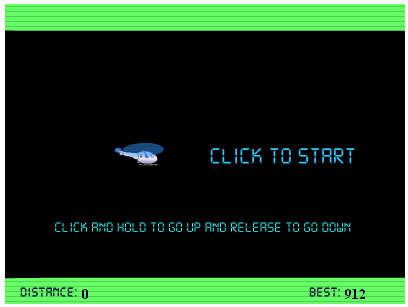
I happened across a very addictive internet game this afternoon — basically, you just fly a helicopter through a tunnel of green. Randomly-placed blocks try to stymie your progress.

helicopter

I’ve linked to it above, or click here. The developer claims that his high score is 2,148, and as you can see, I only got 912 as my best. I was averaging between 600-700 and I really wanted to beat 1,000, but I just couldn’t do it.

Newspaper watch: ‘Magic coins’ will save them

I don’t always love love love Charlie Brooker’s columns in the Guardian, but this one was spot-on: “You know what’ll save newspapers? Magic coins. Yes, magic coins. And I’ve just invented them.”

Of course, he spends half the column ragging on the iPhone, which is even funnier:

I’m unmoved in the face of friends screaming at me to join the iPhone cult. It’s horrible. Here are a few iPhone apps I’d like to see:

1. An app that makes the iPhone scream ‘I’VE GOT AN IPHONE!’ each time the user pulls it out of their pocket. Once activated, it would be impossible to switch off. The only way to stop the constant embarrassment would be to repeatedly crack the device against a wall, or preferably your own face, until it shattered.

2. An app billed as a “comical toilet paper simulator”. You switch it on, pretend to “wipe” your backside, and hey presto: the screen appears smeared with virtual pixilated poo.

Disappointingly, when he gets around to the ‘magic coins’ bit, it’s just a rehash of the micropayments model. Except he thinks it should be fun — like a video game:

On your desktop: a cartoon purse filled with fat gold coins. Pull out a penny. It shimmers on the screen. Drag it toward a “coin slot” situated right there on the web page you want to view, and drop it in. It disappears with a satisfying ker-chunk. And you’re in. If you’re feeling cavalier, you can throw your coin toward the slot; with practice it won’t bounce off the rim. And hey, iPhone users: we’ll even let you play. You can “fling” coins from your phone directly on to the screen.

While I don’t buy his specific version, there’s something to be said for the idea of making payments more than just easy — fun. It’s like a value added. I wonder if you could come up with a news video game that would somehow reward users enough that they would actually pay to play.

Just off the top of my head, what about a crossword variant, computer generated, using actual news stories. Or a “What Type Of News Consumer Are You?” quiz, a la Facebook.

Actually, some sort of social networking is probably a natural fit for news websites, especially smaller ones that serve a specific community. Tied in with geo-tagged photos and blogging functions, and a basic level of functionality could be free, while you pay for extras. Sites like Flickr work allong similar lines, but now we’re getting away from the “fun” attitude.

Any ideas out there?

Could you make it as a pirate?

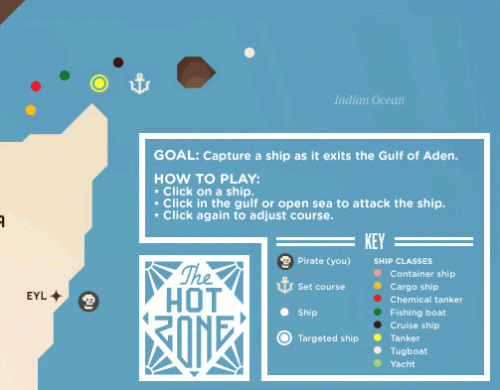
So, do you think you could pull off a life of piracy? I’m not talking about trading mp3s. And I’m not talking about hanging with Johnny Depp. I mean a full-on, AK-47 Gulf of Aden Somali life of misery pirate.

Think you could handle it? Give it a whirl over at the Wired site, where they’re hosting a flash-based game that allows you to play pirate without risking life or limb.

ff_piratehelp_attack

It’s an accompaniment to a lengthy feature about the Somali pirates — analysing their motivations from an economic perspective. The simple point is this:

An ordinary Somali earns about $600 a year, but even the lowliest freebooter can make nearly 17 times that — $10,000 — in a single hijacking. Never mind the risk; it’s less dangerous than living in war-torn Mogadishu.

That’s right — in Somali, crime really does pay.

Happy 40th anniversary, Tranquility Base

Well, as I’m sure you’ve heard, today is the 40th anniversary of the first human landing on the moon. I wasn’t sure what this blog could contribute that everyone else isn’t going to contribute, but I thought I would at least point to one of my favourite lunar landing memories.

What’s that, you say? I’m too young to have watched the moon landing? Why, that’s right. But I do have fond memories of landing on the moon myself — through that old computer game, Lunar Landing. Eventually, it was released as a console by Atari, and there’s an “official” version here. But seeing as how the very original (according to Wikipedia) was written by a high school student on a now-very-obsolete computer, I’m not going to feel too bad pointing you towards a very excellent recreation that you can play right here.

Even better, the programmer, Seb Lee-Delisle, has created a three-dimensional version of Lunar Lander, and specially coded levels in honour of the 40th anniversary.

I’d forgotten just how difficult and unforgiving the game was. It requires patience, I’ll warn you. It’s deceptively simple, and yet requires your rigorous attention.

Have fun!

Where do laws come from? The consent of the governed?

David Myers, a researcher in New Orleans, joined the online role-playing game “City of Heroes/Villains” and decided to play like a jerk. Well, not really — he played strictly by the rules, but intentionally ignored all the social customs that had arisen among the players. Some of the social customs, like “heroes” and “villains” chatting amicably rather than fighting to the death every time they met up, seemed to Myers to be antithetical to the concept of the game:

He created “Twixt,” a scrappy, high-leaping hero decked out in different-colored spandex suits and rocket boots. He took his character to the virtual war zone and set out to simply battle villains.

Twixt proved difficult to beat. From a distance, he could transport villains anywhere he wished. He always took them to a cartoon robot firing line that instantly defeated whomever he zoomed before it.

Of course, people didn’t take kindly to this interloper who ruined the gameplay that they had been used to:

During the first few sessions, other players gently informed Twixt that his method of play was unwelcome. But Twixt kept on vanquishing villains.

Mobs of villains then ambushed Twixt, hoping to defeat him so often that he would quit. Meanwhile, Twixt’s fellow heroes watched without joining the fray.

One by one, Twixt coolly picked his opponents off. As play sessions passed, popular villains and heroes stepped up their attempts to change him.

Eventually, players started complaining about Twixt on off-game forums, and shouting insults and threats at him in-game. Myers, apparently, was flabbergasted:

[The recently-killed] Syphris fired an instant message at Myers moments later.

“If you kill me one more time I will come and kill you for real and I am not kidding.”

The chilling text shook Myers two years ago. It served as a telling detail for his ongoing study of social customs in Internet gaming communities.

I haven’t read the full paper (nor do I intend to, honestly) but the article presents Myers as being surprised that playing by the official rules ends up ostracizing him. Or, as he puts it, “If you aren’t a member of the tribe, you get whacked with a stick,” he said. “I look at social groups with dismay.”

I think he’s forgotten where rules come from. In the Slashdot post where I found this story, there are two very different ways of looking at this. One is that there are rules created by the games designer and that the social customs and mores that develop within the game are somehow lesser, and ignore-able. The other is that the in-game experience is like a society, and it’s rules are just as valid, though more difficult to enforce.

Essentially, it comes down to the argument, are rules “descriptive” or “proscriptive”? Do rules describe in-game behaviour, and you should follow the crowd? Or are the imposed from on-high, and everything not circumscribed should be allowed?

A post commenting on the original article tries to make this point:

Cutting in line isn’t “illegal,” but you can’t claim to be shocked when people treat you like the jerk you are.

But I would take it even further. There’s nothing in the natural laws of the universe that prevent me from killing every person I see today. But of course I won’t do that — it’s “illegal” because we as a society have decided that we don’t approve of that behaviour.

Myers appears to be playing the game as if the only rules that matter are the designers’ rules. Looks like the rest of the players disagree.

Homeless Sims make for gripping tale

I used to love playing The Sims — I would play it for hours and hours. But I never got into a storyline like I got into the created storyline over at “Alice and Kev“. Blogger Robin Burkinshaw has created Sims who have no home, no money, and awful character traits. He’s monitoring their life, and writing touching little vignettes about what happens to his Sims and how they deal with the cards he’s dealt them:

As her father dislikes children, he hates sleeping next to her. In the morning, he’s always the first to wake, and he immediately throws a tantrum and wakes up Alice to tell her to leave the room. Alice understandably responds that they’re not in a room, and she doesn’t have anywhere to go. Then they argue, and Kev seems to blame Alice for every possible thing.

I read the whole thing, so far, straight through in one sitting, although I didn’t intend to. It doesn’t take long. And it’s really quite good.

(via BB)

Board games that misled us all (and caused the financial meltdown)

Slate’s “The Big Money” section has a (slightly tongue-in-cheek) slideshow on board games that we played as kids, and how they are fundamentally flawed. The thesis of the slideshow is how these fundamental flaws can lead to illogical behaviour in the real market.

Take Monopoly, for example (I took the image above from Flickr user DaylandS’ photostream, which is the same place The Big Money got theirs, but I chose a different picture):

Monopoly has taught us that financial institutions are invincible. The game’s banker cannot go bankrupt, according to the rules: “The Bank never ‘goes broke.’ If the Bank runs out of money, the Banker may issue as much as needed by writing on any ordinary paper.”

Whoops?

They also take a look at The Game of Life, PayDay, Risk, and Mall Madness — as well as a game I’d never heard of called Acquire. Two games they didn’t examine, but which I played lots, were Pit and Stock Ticker.

One thing all these games do have in common — and which I think we’ve seen in the economy as well — is the concept of one winner, many losers.

Dansette