How to shoot a gun with your feet, the video

A man named Michael, who has no arms, is nonetheless armed. This video gives me a whole new insight into the possible meanings of the War Amps.

Stick around past the boastful patriotism in the middle to the end of the video, where he also reloads the clip using his toes.

Inspiring stuff.

(Again from thedailywhat)

Big box stores don’t have to be boring

I am no fan of big box style shopping, though I know it’s going to be part of our urban landscape now for decades. Unfortunately, although I know that the retail avant garde has moved on to newer things (plaza-style faux downtowns, for example) the big box monstrosities are still was passes for cutting edge where I’m from.

(Heck, we’re still trying to save our downtown shopping mall, which is about 80 per cent office space these days.)

One of the things that really gets me about these Borg cubes of shopping is their essential sameness. They are cheaply built as quickly as possible, and that leads them to be stripped of any real personality. All they have to differentiate a Wal-Mart from a Home Depot is the colour of the paint, and the subtle differences in the fake arch over the main doors.

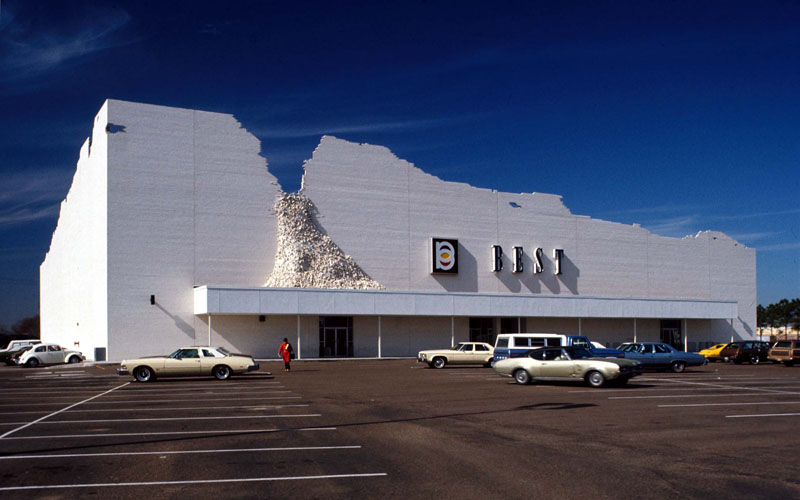
That sucks, because a tiny little bit of whimsy could do so much for these soulless places. Check out the picture above, for example, which cleverly inverts the monolithic permanence of these structures and reminds you that it, too, will eventually be grey field.

It’s part of an experiment in big box design by SITE architecture. They were commissioned by Best Products Company in Virginia to do nine retail buildings. They also came up with a number of unbuilt prototypes.

According to their website:

these merchandising structures have been used as a means of commentary on the shopping center strip. By engaging people’s reflex identification with commonplace buildings, the BEST showrooms also explore the social, psychological and aesthetic aspects of architecture. This approach is a way of asking questions and changing public response to the significance of commercial buildings in the suburban environment.

Depressingly, these were created in the 1970s and early ’80s, so if we were going to see them catch on, I think we would have, by now. Here’s a couple more of my favourites:

Hauling the unbelievable amount of junk out of rivers

Mitchum deodorant held a contest to find the “hardest-working _______ in America.” The winner, as featured on the Good News Network site, is Chad Pregracke.

According to the story, he’s hauled over 6 million pounds of trash from rivers over the past 12 years — including an astonishing 775 refrigerators. I don’t know if he cleaned up the site of an abandoned fridge factory at one time, but that’s an average of more than 60 fridges a year — a fridge every week, and sometimes two! That’s too many fridges in the river.

Here’s his nomination video — click pause at the very last second to read the fine print. It’s worth it.

You can see more nominees at the contest website.

Climate change? Who cares if it’s real

Here’s how to win the war against climate change by simply ignoring the petty battle:

Winning an argument by defining the terms of debate in your favour is a classic technique. It’s done well here.

This is an entry in a video challenge called Living Climate Change. It was submitted by Alex Bogusky, who might just be the 21st century’s answer to Don Draper.

There’s a ton more at Fast Company.

William Faulkner, writer in residence

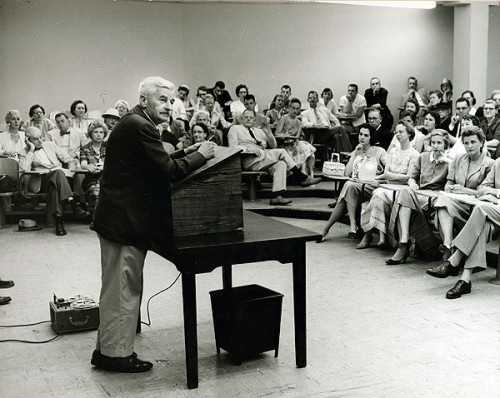
In the late 1950s, William Faulkner accepted an offer to become the first writer in residence at the University of Virgina.

Now, recordings from the talks he gave have been digitized and posted online for all to hear:

The quality of the audio you’ll hear at this archive is uneven, for a number of reasons. By our standards, the equipment used was fairly primitive, and being run by academics, not technicians; background noises on some of the tapes are forms of static from the recorder itself. Only one microphone was used, and because Faulkner was so soft-spoken, it had to be placed immediately in front of him, which means questions and comments from others in the room are often difficult to hear, and frequently inaudible. And the tapes themselves, nearly 40,000 feet of fragile plastic strips, had held onto the magnetic records of voices and coughs, laughter and applause for almost half a century before the Library began to digitize them, further degrading their fidelity to those moments in 1957 and 1958.

Despite that, the recordings are evocative, and they show an author who is fully engaged with his audience. He seems to give thoughtful answers, and he never seems impatient or bored with the young students who are asking him questions.

Thanks to the University of Virginia for thinking to record theses sessions, for holding onto the recordings so long, and for putting them up online.

Montreal searches for ‘Queer of the Year’

If you’re looking to set yourself apart as a gay-friendly city, you couldn’t do much better that this recent initiative in Montreal. Local Pride organizers have teamed up with the official Tourism Montreal organization and Gay.com to search for “Queer of the Year” in the city:

Submit a video to their site, vote on your favourite queer, and the winner will get $4,000 in prizes — after the five finalists battle it out during Pride Week in Montreal.

When an author forgets how to read

NPR has a fascinating tale of Canadian author Howard Engel who, in 2001, woke up one morning to discover that he could no longer read:

The print on the page was unlike anything he had seen before. It looked vaguely “Serbo-Croatian or Korean,” or some language he didn’t know. Wondering if this was some kind of joke, he went to his bookshelf, pulled out a book he knew was in English, and it too was in the same gibberish.

Engel had suffered a stroke. It had damaged the part of his brain we use when we read, so he couldn’t make sense of letters or words. He was suffering from what the French neuroscientist Stanislas Dehaene calls “word blindness.” His eyes worked. He could see shapes on a page, but they made no sense to him. And because Engel writes detective stories for a living (he authored the Benny Cooperman mystery series, tales of a mild-mannered Toronto private eye), this was an extra-terrible blow. “I thought, well I’m done as a writer. I’m finished.”

Watch to see the kind of amazing story of his workaround:

(If the media player doesn’t load for you, click here to watch it on the NPR page.)

The cartoon, as you may have figured, was drawn and narrated by Lev Yilmaz, of “Tales of Mere Existence” fame. We like Lev.

(via Boing Boing)

Safe, stylish and fuel-efficient. Of course the government destroyed it

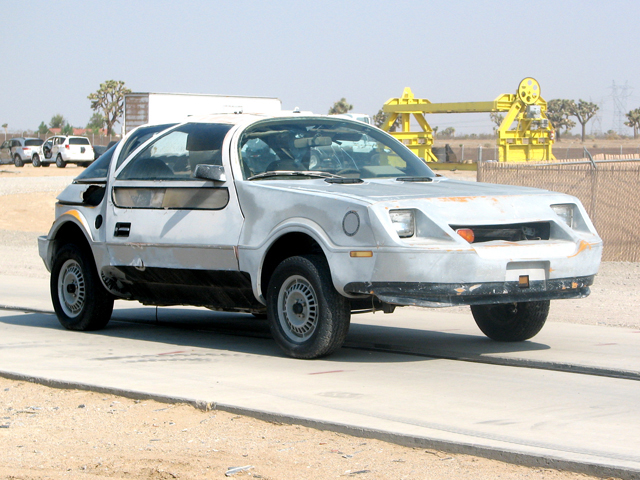
Jalopnik has a great story up detailing the sad history of the RSV. It just might be the best car that the world never saw.

Built for the U.S government, it demolished (sorry) its competitors in safety tests, had ridiculous fuel economy, and actually looked kind of cool. The gullwing doors helped.

Technologically, it was miles ahead of any other car on the road, featuring anti-lock brakes, air bags, and a crumple zone. This in the 1970s, by the way, when even seat belts were sort of an afterthought.

What kills me is this ad. The company that designed and built them for the Department of Transportation, Minicars, obviously wanted to market these wonder vehicles. So they tried to drum up public support:

Unfortunately. It didn’t work. The government — under new administration — decided to scrap the cars, calling them obsolete.

Luckily, two survive.

Read the whole story — it’s equal parts inspiring and depressing.

Seven things you didn’t know were invented by kids

What, you’re already all grown-up, and you don’t have a profitable patent yet? What are you waiting for?

Women’s Day has a nice list of seven things that were invented by kids — and these are serious inventions, from toy trucks to trampolines to television. Seriously.

Okay, sometimes the definition of “kid” is a little stretched — maybe you have the idea for a Popsicle when you’re 11, but if you don’t actually do anything until you’re 24, does that count?

Keeping tabs on your time travellers

The good folks at Information is Beautiful have a nice infographic on time travel in popular fiction. In it, they’ve plotted the back-and-forth time jumps of people like Marty McFly, the crew of the starship Enterprise, and Bill and Ted (on their excellent adventure).

Here’s a snippet:

See the whole timeline here. The infographic is included in their book. There’s a post about the infographic, too, which reveals that it took three designers 34 drafts to get it all right.

So that’s why I liked it even better when they did a subsequent post, looking back at the process of creating the infographic.

I love behind-the-scenes stuff like this — I love to have the curtain pulled back so I can see the process behind the creativity. There’s tons of creativity in there, but seeing how professionals zero in on the good ideas and weed out the bad is instructive.

As they point out, the hardest part is the “temporal bias” — that fictional time travel tends to either start or finish somewhere near the 20th century.

What it’s like to be a hack

I really enjoyed this behind-the-scenes essay by a copywriter — albeit, an unusual one.

Jason Toon works at Woot, a company that sells only one thing (a different thing) every day, and usually at a pretty good price. He writes the ad copy that appears with each of these products, and they are usually funny, isightful, and, well, different.

Today, for example, Woot is selling a pair of mice, once white, one pink. Instead of just giving the specs for the mice, though, Toon has written a little story about his-and-her mice, atop a wedding cake. It goes from endearing to odd and then all the way to pathos.

He does that every day. Except, of course, when the site has what it calls Woot-offs: a time when they sell maybe a dozen or two products, one after the other, in a single day. Those require a little more than the usual amount of work, and Toon didn’t think he could do it.

Turns out, he can:

That morning would have looked like any other to you. Me, at my desk, pondering the minutiae of some hard drive or LCD monitor or robotic vacuum cleaner. You wouldn’t have seen the crushing weight of the 25 product descriptions I had to write before I could claim my next sleep. I felt like I could barely breathe. I tried to commit every detail of my comfortable desk to memory, to savor during the unbearable hours at whatever my next job would be. I started typing, a doomed man, my doomed fingers dancing a macabre funeral march on the keyboard.

Along the way, I’d gained an enormous respect for hacks and hackery (in the old sense of cranking out anonymous creative work by rote, not in the computer-age sense). I’d always flattered myself with the self-designation of an “idea man”, a superior intellect whose brilliant visions were too valuable to waste his time actually carrying them out. But as I pounded out those two dozen joked-up pieces of marketing ephemera, my awe only grew at the comic-book illustrators and pulp novella writers and dance-craze tunesmiths who just got the job done, in the days when their professions earned them no respect and not much more money.

In a sense, although he doesn’t say so explicitly, he’s also describing journalists, or even bloggers. Not every word I write is golden — far from it — but there is a certain sense of accomplishment in just sitting down, banging something out, and Getting It Done. And then looking back over what you have written and noticing, with a professional’s eye, that maybe you did happen to turn a nice phrase here and there.

It’s not Shakespeare, but it’s something.

Read “The Hack Hustle: The Inspiring Story of the Slacker Behind the Woot-off”

The Gulf of Mexico oil spill, explained by Al-Jazeera

Perhaps Western news organizations have produced their own video infographics, but Al-Jazeera’s was the first that I saw.

I’m glad to see an English Al-Jazeera, by the way, because I think it’s important to encourage a diversity of voices in the media. From what I’ve read, it was originally staffed with journalists pinched from the BBC, and I believe that news culture still exists.

Which, I suppose, is more than you can say for Fox.

Behind the scenes of an ‘investigative slide-show’

If you’re familiar with slide-shows on the internet, you’re likely familiar with the fluff — the Top 10 lists that make you flip through each item as a separate page; the endless angles of ‘gadget porn’; the galleries of red carpet celebrity shots.

There are great slide-shows out there, collections of really awesome pictures, but they tend towards the easy-to-curate. That is, someone will put together a slide-show of images from the Olympics, or scenes from Haiti. Some of the photos can be jaw-droppingly good, but they sort of stand alone.

Well, msnbc.com’s Bill Dedman has changed the game. He’s an investigative reporter, but his latest work isn’t a 10,000-word opus, in fact it isn’t a story at all. No, Dedman’s latest work is an investigative slide-show.

With a staggering 47 slides, Dedman tells the story of Huguette Clark, daughter of what you might call a “robber baron” from the Gilded Age. Yes, the 1920s. He rivaled Rockefeller as the richest American, lived on Millionaire’s Row beside the Vanderbilts, and pretty much bought himself a U.S. Senate seat.

His daughter (from his second marriage — a scandal in itself) inherited something over a billion dollars, in today’s money. She has several mansions, owns the largest apartment on New York’s storied Park Avenue, and once bought a castle in Connecticut but never spent a night there.

In an interview on Poynter, Dedman shares how his investigative feature turned into a slideshow — and how it’s turned out great:

I like to talk stories through before I write them. As I was collecting photos of the Clarks, I kept showing them in a little slide show to my family, to my mother (81) and my daughters (7 and 10). It really helped tell the story.

I put the photos online to show our projects team at msnbc.com, and photographer Jim Seida said, why don’t we just publish it as a slide show? I was skeptical at first — would that crimp the writing? — but in the end I was advocating doing it this way when the photo team was skeptical. I thought far more people would read through it this way, and it would be worth an experiment.

We’ve done slide shows for years, of course, but the slide show is not our usual medium for telling an investigative or in-depth story.

I clicked through just so I could get a look at it and pitch the idea at my own newspaper, but I ended up reading the whole thing. As Dedman noted in the interview, he had to lose as a lot of depth and context from the story, because the captions were limited to about 50 words. But in other ways, that terse approach also focused him on what was most important or most interesting.

It’s a great tale about a forgotten famous family. And a great way to tell it. Check out the slideshow here: “The Clarks: an American story of wealth, scandal and mystery” (Click launch to launch the pop-up slideshow.)

Give the behind-the-scenes interview a read, too.

Why the Norwegians did so well at the Olympics, a theory

As David Brooks, a columnist at the New York Times, points out, “the United States, a nation of 300 million, won nine gold medals this year in the Winter Olympics. Norway, a nation of 4.7 million, also won nine.”

He also points out that this is par for the course. Despite Canada’s record-breaking gold-medal run this year — and America’s record-breaking total-medal-count this year — Norway is the all-time champ in both categories.

As his column posits, this has nothing to do with sports training, or Own The Podium type targeted funding.

Instead, Brooks writes, it’s a combination of “hard” Norwegian individual grittiness with “soft” Norwegian love and nurturing. He explains it with a jaw-dropping story of survival in World War Two:

Baalsrud was clothed and fed and rowed to another island. He showed up at other houses and was taken in. He began walking across the mountain ranges on that island in the general direction of the mainland, hikes of 24, 13 and 28 hours without break.

A 72-year-old man rowed him the final 10 miles to the mainland, past German positions, and gave him skis. Up in the mountains, he skied through severe winter storms. One night, he started an avalanche. He fell at least 300 feet, smashed his skis and suffered a severe concussion. His body was buried in snow, but his head was sticking out. He lost sense of time and self-possession. He was blind, the snow having scorched the retinas of his eyes.

He wandered aimlessly for four days, plagued by hallucinations. At one point he thought he had found a trail, but he was only following his own footsteps in a small circle.

Finally, he stumbled upon a cottage.

Read the whole column here. It’s worth it.

The book this story comes from is “We Die Alone” by David Howarth, and you can see a preview of it here, on Google Books. I think I might buy it. I respect our Olympians, but it’s a good reminder that: a) these Games have a quasi-military inspiration (Google “modern pentathlon” for example); and b) no matter how much struggle and competition there is over that gold medal — sometimes there’s something more at stake.

The top rules for writing

If you like writing, then you might be interested to know what’s worked for other writers. Thankfully, The Guardian has compiled a list of 29 different writers’ Rules For Writing.

Mostly, inspired by Elmore Leonard’s list, they come in batches of 10. But some writers condense it down to five — others focus on a single, very important rule.

There’s surprisingly little overlap, which perhaps just proves that you need to come up with your own rules. But there are lots of good ideas, from the stylistic (“Introduce your main characters and themes in the first third of your novel.” — Michael Moorcock) to the idealistic (“Learn poems by heart.” — Helen Dunmore) to the practical (“Do back exercises — pain is distracting.” — Margaret Atwood).

Part one is here. Part two is here.

I believe it would be fun to design a series of inspirational posters based on this compendium of advice.

Older posts «