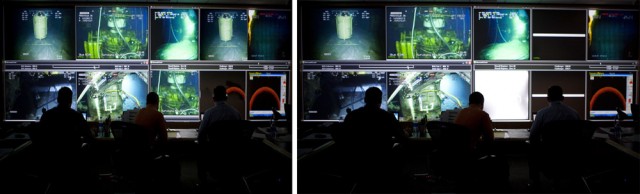
The infamous BP publicity photo above, shows its response to the oil hemorrhage in the Gulf of Mexico earlier this year. It seemed nearly instantaneously after it was release that people noticed it had been digitally altered.
The image on the left is the one they released, replacing the image on the right, which has some blank screens and is presumably less competent for it.
Sometimes, in this age of Photoshop and photorealistic renderings, it seems as if retouching pictures is a purely modern problem. But it’s as old as photography itself.
Here is an excellent site showing a fairly comprehensive history of photo tampering, all the way back to the 1800s.
It’s illuminating.
Personally, although a photograph may “look” real, I think it will be important to develop some critical senses when examining them. Like words, photos can show the truth, or they can show a lie.
It’s not just digital alteration, either, or techniques as simple as cropping. Simply choosing which photo to take, and which not to take, can have a powerful impact on the message that is sent.
It will be interesting, I think, over the next few decades, to see how it develops. I think the near future will see 3-D photography — which will initially be seen as “true-er” because it will be harder to fake. But eventually I think we’ll see photography judged on the same standards we judge paintings and drawings. That is, depending on not just the image represented, but the surrounding context, and how much we trust the image-maker, and on a host of other things.