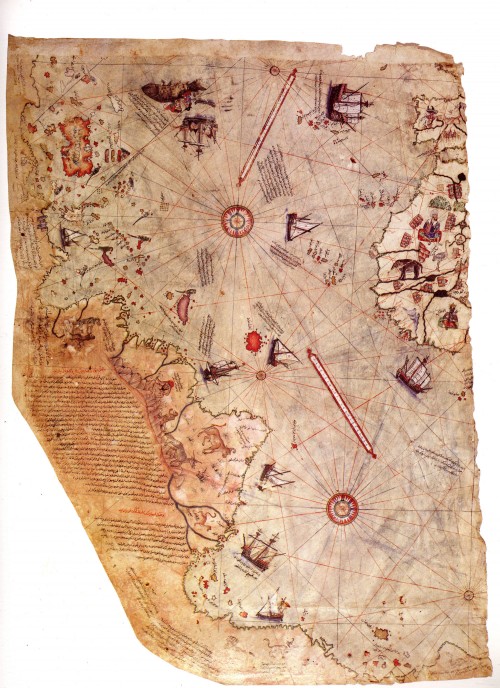
A portion of the Piri Reis world map, showing the coastlines of Brazil and west Africa.
It’s a sad thing that many people, perhaps even the majority, lose their sense of wonder as they age. Children are naturally curious and everything their eyes fall on hold unfathomable mysteries they feel they have to explore.
Have you ever gone for a walk with a kid? Every stick, stone, insect and piece of trash on the sidewalk is worthy, in their mind, of investigation. This fascination with the world around us seems to fade as we age, as we become more familiar with the mundane objects that surround us, as we become more cynical, as we lose the idea of magic and with it our sense of wonder.
Fortunately, as the Bard says (more or less), there are more things in heaven and earth than are dreamt of in our philosophy. These are the things that help keep our sense of wonder alive. The killjoys of the world try to explain them away, but I like the idea there are things that continually defy explanation. Take the Voynich manuscript, for example — I can’t read enough about it. There is something about it that fuels my imagination and excites me in the sense that it is an object that cannot easily be explained.
There are other items, too, that pique my curiosity and make me wish I had the time and resources to try and solve the mysteries behind them. This website has a decent list of some of the anomalous items in the world — although it doesn’t include some strange artifacts that I would have included, it is a good start. It includes some of my favorites such as the Piri Reis map:
He depicts Europe and North Africa, the coast of Brazil, several islands (Azores, Canary Islands, and the mythical island of Antilia), and even Antarctica, which was thought to be discovered more than 300 years later. The most puzzling thing is not that it shows we need to rethink the chronology for a number of exploratory discoveries, but that it describes Antarctica’s topography as not being masked by ice and in great detail. The last time that occured was more than 6000 years ago. Tell me then. How did a Turkish admiral from half a millenium ago map a continent that’s been covered by ice for the last 6000 years?
There are many other strange findings that have been made over the year and around the globe, but I’ll save those for another day.
Hopefully, this list will help you recover some of your sense of wonder.
