You are not so smart

Sorry I haven’t blogged much today, I’ve been too busy reading about how I’m not so smart, after all.

I am in love with this site: You Are Not So Smart. Basically, they take common misconceptions, and then shatter them. It’s awesome. Or, perhaps I just think that it’s awesome, because I just spent a bunch of time reading it, and I want to convince myself that my time was well spent.

Part of a post on how you are not so smart when it comes to fanboyism and brand loyalty:

The Misconception: You prefer the things you own over the things you don’t because you made rational choices when we bought them.

The Truth: You prefer the things you own because you rationalize your past choices to protect your sense of self.

In experiments at Baylor University where people were given Coke and Pepsi in unmarked cups and then hooked up to a brain scanner, the device clearly showed a certain number of them preferred Pepsi while tasting it.

When those people were told they were drinking Pepsi, a fraction of them, the ones who had enjoyed Coke all their lives, did something unexpected. The scanner showed their brains scrambling the pleasure signals, dampening them. They then told the experimenter afterward they had preferred Coke in the taste tests.

They lied, but in their subjective experiences of the situation, they didn’t. They really did feel like they preferred Coke after it was all over, and they altered their memories to match their emotions.

They had been branded somewhere in the past and were loyal to Coke. Even if they actually enjoyed Pepsi more, huge mental constructs prevented them from admitting it, even to themselves.

The thing is, I really do like Coke better!

Oh, Jesuses

If you like this kind of thing (and I do) you’ll love the story of a 1950s psychologist who took three people — each of them convinced that he was the reincarnation of Jesus Christ — and made them live together.

Then, he subtly messed with them. All in the name of “science.”

Oh, it couldn’t possibly be ethical. And he didn’t learn anything — except, perhaps, that Jesusii will come to fisticuffs, the Golden Rule notwithstanding.

You can buy a whole book, “The Three Christs of Ypsilanti“, or you can read about it at Slate:

Leon seems to waver, eventually asking to be addressed as “Dr Righteous Idealed Dung” instead of his previous moniker of “Dr Domino dominorum et Rex rexarum, Simplis Christianus Puer Mentalis Doctor, reincarnation of Jesus Christ of Nazareth.” [The psychologist] interprets this more as an attempt to avoid conflict than a reflection of any genuine identity change.

The Christs explain one another’s claims to divinity in predictably idiosyncratic ways: Clyde, an elderly gentleman, declares that his companions are, in fact, dead, and that it is the “machines” inside them that produce their false claims, while the other two explain the contradiction by noting that their companions are “crazy” or “duped” or that they don’t really mean what they say.

Innoculate yourself against PTSD: Play Tetris

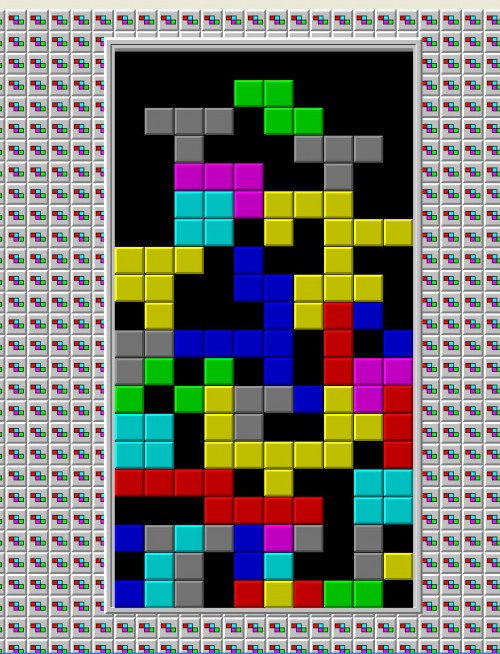
tetris

A recent study hints that soldiers witnessing a horrific, traumatic event may be able to prevent flashbacks due to post-traumatic stress disorder (PTSD) simply by playing a little Tetris.

Playing Tetris appeared to interfere with the brain’s ability to form a significant visuo-spatial memory of the traumatic event. Such memories are an important component to flashbacks. No such memories means a reduced likelihood of future flashbacks.

Granted, the study was conducted on undergraduate students as opposed to soldiers and the “traumatic” incident was a film not a true PTSD-inducing incident. Despite these limitations, this study is interesting in its implications.

First of all, do these findings suggest that in the future soldiers in the field will have a military-grade GameBoy tucked in their belt for emergency innoculations? (“Omigod! They shot Kenny! Break out the GameBoys, men!”) Will this have an effect on the efficacy of the military? (“How could you have missed that sniper on your perimeter check, Private?” “I was giving myself a PTSD shot, sir.”) Will the major video game companies be vying for military contracts?

On the other side of the coin, consider what this has done to those of us who have played way too much Tetris in our time. Is this visuo-spatial interference the reason I don’t remember my high school graduation? How I totalled my car the first time? The name of that girl I dated for three years?

If you want to conduct further studies on your own, you can play a free online version of Tetris here. Say good-bye to both your fears of PTSD and your productivity.

Kind of like deja vu, but not really

Most of us have experienced deja vu and, except for the explanation given in The Matrix, we have no real knowledge as to why this phenomenon occurs. Sure, the guys in white lab coats have some theories, but no one know for sure. Luckily, I’m not going to try and explain deja vu, nor am I going to discuss it. It was simply an easy way to open the door to a discussion of some lesser known, but related mind-based weirdness that people can experience:

  1. Deja vecu (pronounced vay-koo): the feeling that one has experienced an event before - usually in great detail, including sounds, smells, movement, etc. When most people say they are experiencing deja vu (which is the idea that something has been seen before), they are actually referring to deja vecu. Often, this feeling is accompanied by the knowledge (or the sense of the knowledge) of what will occur next
  2. Deja visite: while deja vecu deals with events and their arrangement in time, deja visite relates to geography. Not nearly as common as deja vu or deja vecu, deja visite is the feeling of previously having visited (and the strange knowledge of) new locations - cities or landscapes.
  3. Jamais vu: sort of the opposite of deja vu. Here, situations or things that should be familiar are not — it is the sensation of seeing something for the first time when it is not. This experience can be brought on easily by saying or writing a common word repeatedly until it seems to lose all its meaning.
  4. Presque vu: is a sensation that one is on the verge of an epiphany, though one rarely comes through. It can be thought of as a mental equivalent of something being on the tip of your tongue. You feel as though you are about to have an amazing idea or insight, but you can’t quite grasp it.

The human brain is a strange organic computer that is prone to all sorts of hiccups, bugs and glitches. I like the idea that so many of these very minor, non-clinical blips have been categorized and named.

It’s also quite fascinating to talk to people and discover exactly how commone these phenomenon are…

How do you rate your ability?

While rooting around in that time-suck vortex known as Wikipedia, I came across a fascinating psychological effect. I suppose I have always known about it — certainly, I have experienced first-hand examples of it — but it is 100% awesome to discover that the effect has a name: the Dunning-Krueger Effect.

According to the original journal article, the Dunning-Krueger Effect is the name for an individual’s tendency to “…reach erroneous conclusions and make unfortunate choices but their incompetence robs them of the metacognitive ability to realize it.” In other words, this effect occurs when people of lower levels of competency (in whatever realm) rate their level of said competency higher than those that actually possess it.

Well, duh! Why did it take until 1999 to come up with a name for this effect? Although “Dunning-Krueger Effect” is probably more academically acceptable, “asshattery” is more appropriate.

Further (and to quote directly from the Wikipedia entry):

They hypothesized that with a typical skill which humans may possess in greater or lesser degree,

  1. Incompetent individuals tend to overestimate their own level of skill.
  2. Incompetent individuals fail to recognize genuine skill in others.
  3. Incompetent individuals fail to recognize the extremity of their inadequacy.
  4. If they can be trained to substantially improve their own skill level, these individuals can recognize and acknowledge their own previous lack of skill.

As interesting as this study is, I could have done a much more thorough investigation. Dunning and Krueger are nothing but a couple of no-talent hacks that got lucky with their journal submission. Readingness and grammar would be more good had it been wrote by me.

Psychology shows that golfers try harder to make par than to birdie

I was engrossed by a recent study, reported in the New York Times: Golfers facing identical putts will make them more often when they are putting for par, than when they are putting for birdie. In other words, golfers try harder to sink a par putt than a birdie putt:

Of course, it makes no sense at all: each stroke counts as one on a scorecard, whether for eagle or triple-bogey on any particular hole. The goal is to finish with the fewest strokes, regardless of what each might be artificially termed. All else being equal — distance from the cup, one’s proximity to the lead or cut, the course difficulty and so on — putts should be handled the same way.

Statistically, after correcting for every other variable, the study found that golfers made their birdies about 3 per cent less often than their par putts. Big whoop, right? But as the Times points out, with about nine birdie attempts per round, that adds up to a one-stroke difference in each tournament — a difference that could mean hundreds of thousands of dollars in prize money over the year.

It’s an economic principle known as loss aversion: Essentially, players fear making a bogey so much they try extra-hard on their “last chance” for par. (It’s also a great opportunity to post a Simpsons clip.)