
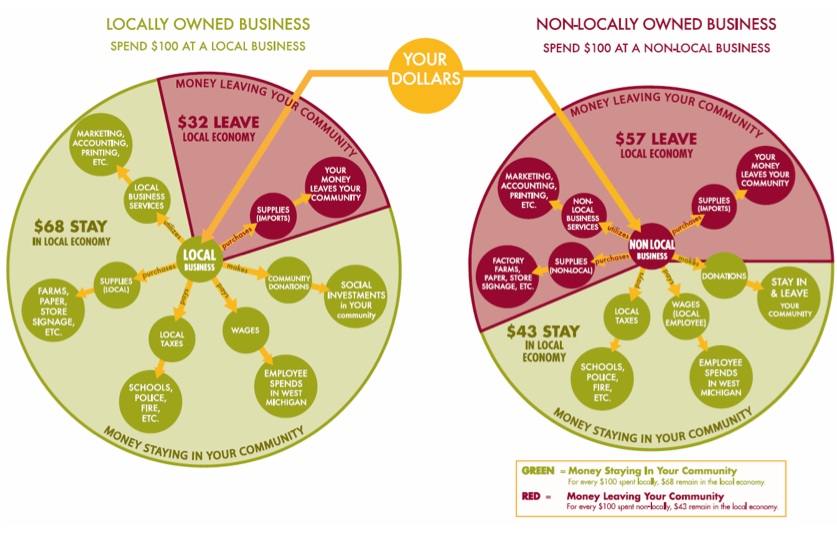
Well, isn’t this an interesting set of numbers, as Americans celebrate Black Friday deals that are so extreme they’re drawing shoppers from this side of the border in droves. According to a study of West Michigan’s Kent County commissioned by a local-shopping advocacy group, if you spend $100 at a locally owned store, between $68 and $73 of those dollars will stay in your community, to recirculate and be used to invest in things that are near, and perhaps dear, to you.
The story is different if you shop at a store that’s not owned locally — perhaps a chain or a big-box store. Some of the money sticks around, through wages and taxes, but far fewer — only about $43 of every $100 you spend.
That’s because non-local stores are much less likely to spend money on things like local advertising (the design and printing will be down at HQ) or local services like accounting. And, I’ve previously read that big box stores like to tout their donations — they do sometimes give big money to lots of local charities. But even if they give 10 times the amount a local store would, what if they’ve put 15 stores out of business?
I don’t always shop local — in fact, I love perusing deals online, and I’ve ordered plenty from websites. Sometimes it’s something that I just can’t get in my own hometown — a specific poster or funny T-shirt, for example. But other times, I’ve felt no compunctions in ordering a computer or a flat-screen TV from an online retailer, where I can save hundreds of dollars at a pop.
Sure, if bothers me, sometimes, that the money won’t be going to my local town — that it won’t help invest in a livable community, just by circulating around and around — but I can’t always justify the extra cost, especially on a big-ticket item.
So, the numbers in this chart allowed me to quantify the savings of shopping non-local against the investment of shopping locally. Yes, these are numbers specific to West Michigan, but I’m going to presume that they are at least somewhat applicable in a more general sense.
Even if I shop at a non-local store, the chart reassures me that $43 of every $100 I spent is going to stay at home. But I could have a nearly 60 per cent greater impact by keeping my money at home — an extra $25 to go around and around in my community.
Let’s crunch the numbers — if I’m a committed shopper at non-local stores, I would need to spend $158.14 in order to have the same impact as spending just $100 at a local store would have.
Alternatively, if I spend just $63.24 at a local store, I would have the same local impact as spending the full $100 at a non-local store.
Or, let’s say we split the different. If I spend $50 at a local store for every $50 I spend at a non-local store, I’ll end up investing $55.50 back into the local economy. That’s significantly higher than if I spent it all non-locally, and yet it still lets me save a fair bit of money if local stores charge more. That’s especially true if you pick and choose where to spend your money with care — spend it at local stores where the price differential is least, for example, or where the local investment is greatest.
When I buy local, I try to buy things that actually make a difference. Coffee beans ain’t exactly local where I live, but I try to buy fair trade coffee from a local shop. I try to patronize farmers’ markets. I try to buy from a local bookstore downtown (though I find I’m reading fewer books and more stuff online). I even try to go to a local mechanic, when I can, and not a chain.
There’s more about the dramatic increase in economic activity when you shift to a local store here, if you’re interested. The chart and link to the study is here.
(via Andrew Sullivan)